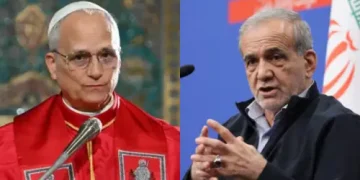



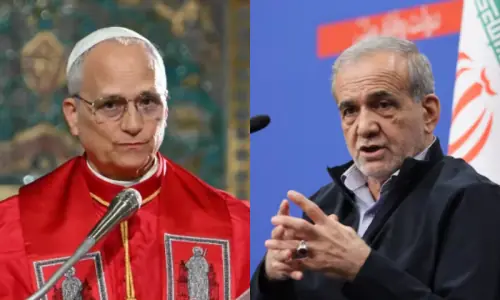
(Web Desk) – Iran’s President Masoud Pezeshkian has publicly welcomed and praised comments attributed to Pope Leo regarding recent United States military strikes on Iranian territory, according to reporting from Al Jazeera citing Iran’s state-run Fars news agency.
In remarks shared through official Iranian media channels, Pezeshkian characterized the pope’s stance as balanced and ethically grounded. He said the religious leader had taken what he described as a “moral, logical and fair” position in relation to the strikes, which Tehran strongly opposes. The Iranian president further argued that the military action carried out by the United States was based on what he called false justifications and represented a breach of international legal norms.
According to the same reports, Pezeshkian accused the United States of acting in coordination with Israel in conducting the strikes. He suggested that such cooperation, in the context of military action against Iran, reflects a broader pattern of hostility toward Tehran. While these claims reflect the Iranian government’s perspective, they have not been independently verified in the report cited.
The Iranian president’s comments also framed the situation as part of a wider diplomatic and geopolitical dispute. He emphasized that the strikes took place during a period when discussions between Tehran and Washington were still ongoing. In his view, the timing of the military action undermines the credibility of the negotiation process and contradicts the spirit of diplomatic engagement.
Pezeshkian’s remarks highlighted Iran’s position that external military pressure during negotiations is counterproductive and damages prospects for peaceful resolution. By referencing the pope’s comments, he appeared to suggest that international moral authorities share concerns about the timing and legitimacy of such strikes.
The Vatican, under Pope Leo, has reportedly commented on the broader context of the escalation, noting that the strikes occurred while diplomatic channels between Iran and the United States were still active. This observation was interpreted by Iranian officials as a subtle critique of the military action and a call for restraint in international conflicts.
Iranian media, including Fars news agency, amplified the president’s response, portraying the pope’s remarks as aligning with Iran’s own narrative that emphasizes legality, diplomacy, and opposition to unilateral military interventions. Al Jazeera’s reporting on the matter reflected how Iranian state outlets have framed the pope’s comments as supportive of Tehran’s position, at least in principle.
The exchange comes amid continued tensions between Iran and the United States over regional security issues, nuclear negotiations, and broader geopolitical rivalry in the Middle East. Statements from religious and international figures are often closely scrutinized in such contexts, as they can influence diplomatic messaging and public perception.
While the Iranian government has welcomed the reported comments from Pope Leo, there has been no indication that the Vatican has taken a formal political stance on the strikes beyond general calls for peace and dialogue. Nevertheless, Tehran has highlighted the remarks as evidence of international concern regarding the legality and timing of the US actions.
The situation underscores the ongoing complexity of Iran–US relations, where military developments, diplomatic negotiations, and international commentary intersect. Pezeshkian’s response illustrates how Iranian leadership seeks to leverage global voices that appear sympathetic to its concerns, particularly in discussions surrounding sovereignty, international law, and the use of force.
As diplomatic efforts continue intermittently between Tehran and Washington, both sides remain engaged in a broader struggle over regional influence, security guarantees, and legal interpretations of military actions. In this context, statements from figures such as the pope are often amplified and interpreted through the lens of ongoing geopolitical tensions.