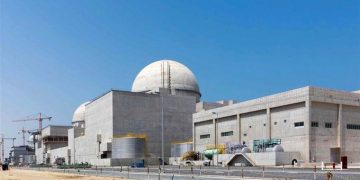



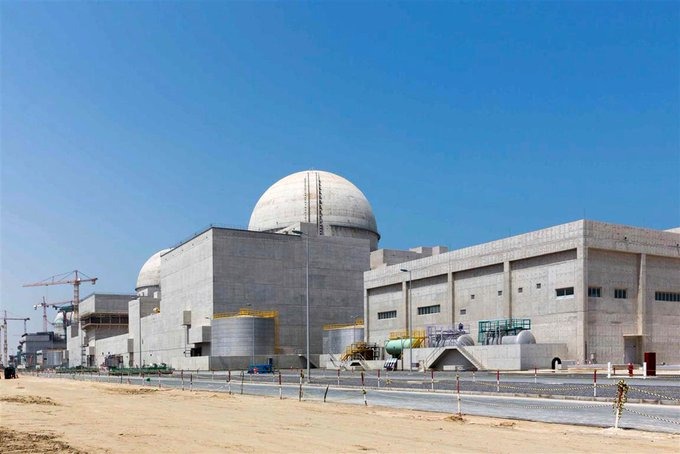
DUBAI (Web Desk) – A drone strike targeted the Barakah Nuclear Power Plant in the United Arab Emirates on Sunday, igniting a fire along the facility’s perimeter and intensifying concerns over a possible escalation in regional conflict.
Officials reported no injuries or radiation leaks, and authorities did not assign blame for the attack. However, the UAE has recently accused Iran of launching drone and missile strikes amid growing tensions around the strategically vital Strait of Hormuz.
The strike comes as a fragile ceasefire remains under strain. The United States has imposed a blockade on Iranian ports, while diplomatic efforts to secure lasting peace have repeatedly stalled. The UAE has also hosted air defense systems and personnel from Israel, which joined U.S. military actions earlier in the conflict.
U.S. President Donald Trump warned that hostilities could resume, while Iranian state media aired programs showing presenters holding weapons, signaling preparedness for further conflict. Fighting has also intensified between Israel and the Iran-backed Hezbollah in Lebanon, adding pressure on the already fragile truce.
Nuclear safety and response
The UAE’s nuclear regulator confirmed that the fire did not affect plant operations. Meanwhile, the International Atomic Energy Agency said the incident impacted an electrical generator, with one reactor temporarily relying on backup diesel power.
IAEA chief Rafael Mariano Grossi expressed “grave concern,” warning that military actions threatening nuclear facilities are unacceptable.
Strategic importance of Barakah
The Barakah plant, developed with South Korean assistance and operational since 2020, is the Arab world’s only nuclear power facility and supplies roughly a quarter of the UAE’s electricity needs.
This marks the first time the four-reactor site has been targeted during the conflict. Located near the Saudi border, it holds significant strategic and economic importance for the UAE.
Broader conflict dynamics
The UAE’s nuclear programme differs significantly from Iran’s, as it operates under a strict agreement with the United States that prohibits uranium enrichment and reprocessing domestically.
In contrast, Iran’s nuclear programme has long been a source of tension, with Western powers suspecting potential military dimensions despite Tehran’s insistence on peaceful intentions.
Nuclear facilities have increasingly become potential targets in modern conflicts, as seen during the Russia-Ukraine war and recent Middle East tensions.
Ceasefire under pressure
Recent incidents across the Persian Gulf region highlight the fragile nature of the ceasefire. Talks between Washington and Tehran remain stalled, raising fears of a broader conflict that could further disrupt global energy markets.
Israeli Prime Minister Benjamin Netanyahu said his country is prepared for all scenarios, while confirming ongoing coordination with the United States.
Meanwhile, Iranian state television has broadcast symbolic displays of resistance, with presenters appearing armed and pledging readiness to defend the country.
The attack underscores the growing risks of targeting critical infrastructure in geopolitical conflicts, particularly nuclear facilities with global safety implications.
Even without physical damage, such incidents heighten fears of escalation and could destabilize energy markets and regional security.
With ceasefire negotiations stalled, analysts warn that further attacks could trigger a wider regional conflict involving multiple state and non-state actors.
Pakistan, as an energy-importing country, could face economic repercussions if tensions in the Gulf disrupt oil supplies or shipping routes through the Strait of Hormuz.