


By N. Ahmed
India’s internet users are asking a new question: why was the viral “Cockroach Janta Party” suddenly blocked online just days after gaining massive popularity?
The controversial parody movement, known as the Cockroach Janta Party (CJP), has become one of the most talked-about political satire campaigns in India after authorities restricted access to its website and social media accounts. The group, which mocked political rhetoric while highlighting unemployment among young Indians, rapidly attracted millions of followers before facing apparent online censorship.
The movement began after India’s chief justice reportedly used the term “cockroaches” while discussing individuals with fake qualifications during a legal hearing. Although the remarks were later clarified and not directed at India’s youth in general, the comments triggered outrage and satire across social media platforms.
Soon after, political strategist and Boston University student Abhijeet Dipke launched the Cockroach Janta Party as a humorous online campaign. The name itself was a satirical twist on India’s ruling Bharatiya Janata Party, commonly known as the BJP.
What started as an internet joke quickly evolved into a viral youth movement.
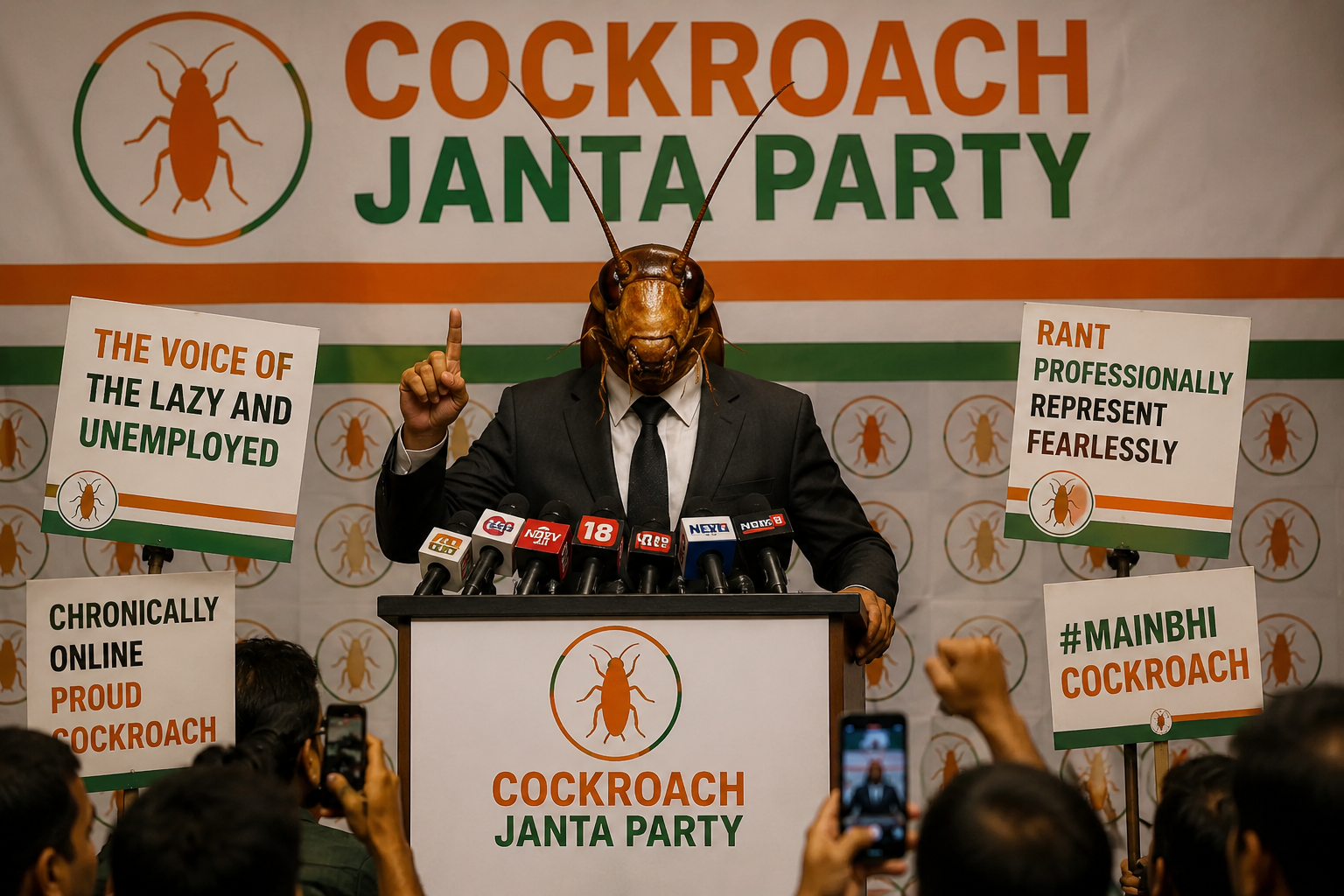
Using AI-generated images, memes, mock campaign speeches, and satirical slogans, the group positioned itself as “the voice of the lazy and unemployed.” Its tongue-in-cheek membership criteria included being “chronically online” and having “professional ranting skills.”
Within days, the campaign exploded across social media. The hashtag #MainBhiCockroach (“I too am a cockroach”) began trending, while the group’s Instagram page reportedly crossed 22 million followers — significantly more than several mainstream political parties in India.
Supporters even appeared at public clean-up drives and demonstrations dressed in cockroach costumes, transforming the internet meme into a visible street-level protest symbol.
However, the movement’s rapid popularity also appeared to attract government scrutiny.
Users attempting to visit the group’s official website recently found it inaccessible, while the party’s X account displayed a notice saying it had been withheld in India “in response to a legal demand.” Dipke accused authorities of targeting the group and sarcastically asked on social media why officials were “so scared of cockroaches.”
Although Indian authorities have not publicly detailed the reasons behind the restrictions, the incident has reignited debate about free speech, online satire, and digital censorship in the world’s largest democracy.
Political analysts believe the parody movement resonated because it tapped into genuine frustration among young Indians struggling with unemployment, economic pressure, and limited political representation. India has one of the youngest populations globally, with nearly half of its 1.4 billion citizens under the age of 30.
Despite this demographic advantage, many young people feel disconnected from mainstream politics and increasingly use social media as a platform for dissent, satire, and activism.
The Cockroach Janta Party may have begun as a joke, but its sudden rise and restriction reveal deeper tensions surrounding youth discontent, internet freedom, and political criticism in modern India.