


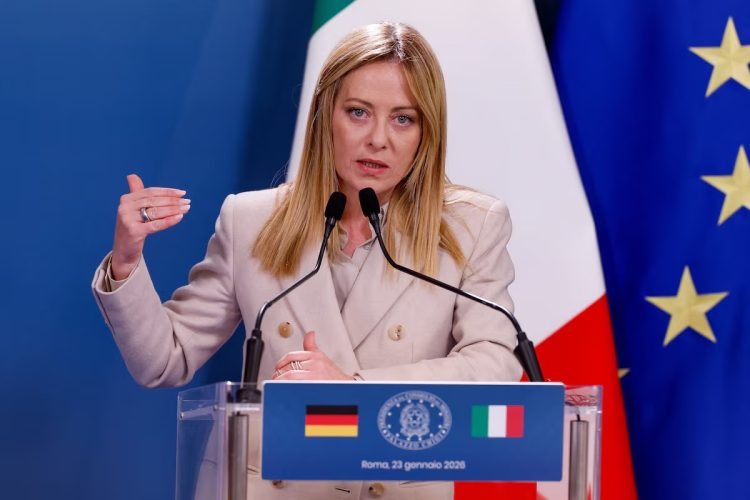
ROME (Agencies) – Italian Prime Minister Giorgia Meloni has strongly condemned the spread of artificial intelligence-generated deepfake images depicting her, warning that such technology poses a serious and growing threat to individuals and public trust.
The controversy emerged after manipulated images of the prime minister began circulating widely on social media platforms. The fabricated visuals portrayed Meloni in revealing attire, sparking outrage, confusion, and debate over the misuse of AI tools. In response, Meloni took to her official accounts to address the issue directly, sharing one of the altered images to highlight the scale and nature of the problem.
In a statement accompanying the post, she struck a tone that blended criticism with irony. “I have to admit that whoever created them, at least in the case attached, has actually made me look a lot better,” she remarked, before turning serious about the implications of such content.
Meloni described deepfakes as a “dangerous tool” capable of deceiving audiences, manipulating public perception, and targeting individuals regardless of their status. She emphasised that while she is in a position to defend herself against such attacks, many others are far more vulnerable.
“Deepfakes can deceive, manipulate and harm anyone,” she said. “I can defend myself. Many others cannot.”
The Italian leader also used the moment to urge greater responsibility among social media users, warning against the rapid spread of misinformation. She encouraged the public to verify content before accepting or sharing it, underscoring how easily false narratives can take hold in the digital age.
“Check before you believe, and believe before you share,” she advised. “Today it is happening to me; tomorrow it could happen to anyone.”
As part of her response, Meloni included a comment from a social media user who had been misled by the fabricated image. The individual criticised the supposed photograph as “shameful and unworthy” of a public office holder, illustrating how convincingly such manipulated content can influence perceptions and provoke unwarranted backlash.
This is not the first time Meloni has been targeted by digitally altered or sexualised imagery. Similar incidents have occurred in the past, reflecting a broader trend in which prominent female figures are disproportionately subjected to such abuse. Last year, doctored images of several high-profile women were circulated on a pornographic website, raising alarm among policymakers and advocacy groups.
In response to growing concerns, the Italian government moved to strengthen legal protections against the misuse of synthetic media. Legislation was introduced criminalising the creation and distribution of deepfakes that cause “unjust harm” to individuals. The law aims to deter malicious actors and provide victims with legal recourse.
Meloni herself has previously taken legal action in connection with such incidents. In 2024, she filed a lawsuit against two individuals accused of producing and distributing fake videos of her on a US-based adult website. The case sought damages amounting to 100,000 euros, signalling a firm stance against those exploiting emerging technologies for harmful purposes.
Experts warn that the rapid advancement of artificial intelligence has made it increasingly easy to generate highly realistic fake images and videos. While the technology has legitimate applications in entertainment, education, and industry, its misuse raises serious ethical and security concerns.
Female politicians, in particular, have become frequent targets of AI-generated harassment, including deepfake pornography and manipulated images designed to undermine their credibility and dignity. Advocacy groups argue that such attacks not only harm individuals but also discourage women from participating in public life.
Meloni’s remarks have reignited global discussion about the need for stronger safeguards, improved digital literacy, and coordinated international efforts to combat the misuse of AI technologies. Analysts say governments, technology companies, and civil society must work together to address the growing risks posed by deepfakes.
As the debate continues, Meloni’s message remains clear: the threat is real, the consequences are serious, and vigilance is essential in an era where seeing is no longer believing.