


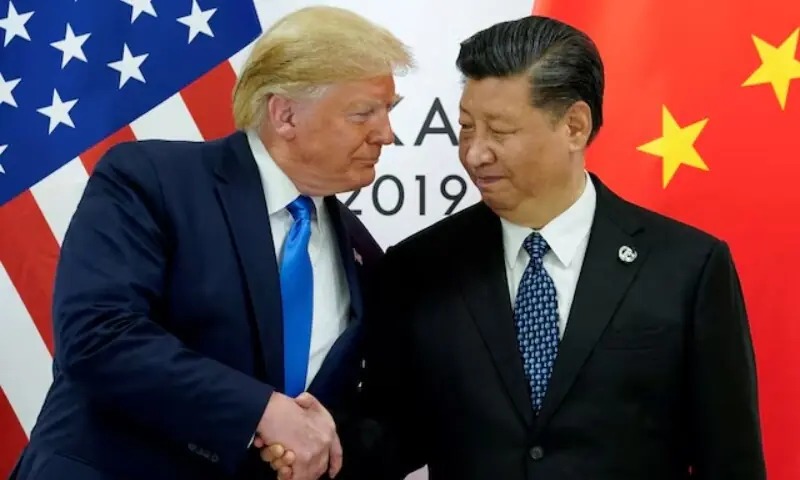
BEIJING (Web Desk) – Donald Trump arrived in Beijing on Wednesday for high-stakes talks with Xi Jinping, as both sides seek to manage tensions over trade, Taiwan and the Middle East.
Ahead of the visit, Trump said he would press China to “open up” its markets to American firms, signalling a strong focus on economic cooperation. Reflecting this priority, top US business leaders including Jensen Huang, Elon Musk and Tim Cook accompanied the trip.
In a social media post after departing Washington, Trump described Xi as a “leader of extraordinary distinction” and said greater market access would allow US companies to contribute to China’s growth.
The visit — the first by a US president to China in nearly a decade — comes amid complex geopolitical challenges, including tensions over Taiwan, ongoing trade disputes and instability in the Middle East, which had earlier delayed the trip.
Trump said he expected a “long talk” with Xi, including discussions on Iran. China remains a key buyer of Iranian oil despite US sanctions, making Beijing an important stakeholder in any diplomatic efforts to ease tensions.
The summit, scheduled over two days, will include formal meetings and ceremonial engagements such as a state banquet at Beijing’s Great Hall of the People.
Key issues on the agenda include US arms sales to Taiwan, China’s restrictions on rare earth exports, artificial intelligence competition and the future of bilateral trade ties. Both sides are also expected to consider extending a temporary truce in their tariff dispute reached during their previous meeting.
Security across Beijing has been tightened ahead of the talks, with increased police presence and identity checks reported at key locations.
Despite growing rivalry, both countries have continued efforts to stabilise relations. Trump expressed confidence in his personal rapport with Xi, saying it could help prevent escalation, particularly over Taiwan.
The visit reflects a strategic attempt by Washington and Beijing to stabilise relations between the world’s two largest economies. While competition remains intense, both sides appear willing to keep dialogue open on trade, security and global crises.
The inclusion of leading US executives underscores that economic cooperation remains central, even as political differences persist.
The outcome of the summit could significantly influence global dynamics. Any progress on trade could stabilise international markets and supply chains, while disagreements may deepen economic uncertainty.
Discussions on technology and rare earth resources are expected to shape the future of global innovation and industrial competition. Meanwhile, signals on Taiwan will be closely monitored by regional allies due to their security implications.
Although there is no direct full-scale war between the United States and Iran, tensions remain elevated due to sanctions, regional conflicts and geopolitical rivalry.
Trump’s discussions with Xi on Iran highlight China’s role as a major purchaser of Iranian oil and a potential diplomatic actor. Beijing has shown interest in promoting dialogue to avoid further escalation in the Middle East.
The summit is expected to set the tone for US–China relations in the coming months. Even limited agreements, such as extending the tariff truce or improving communication channels, could reduce global uncertainty.
However, deep-rooted differences over trade, security and geopolitical influence suggest that competition between the two powers will continue, even if short-term stability is achieved.
For Pakistan, improved US–China relations could ease global economic pressures and support regional stability. As a key partner of China, particularly under connectivity and development initiatives, Pakistan may benefit from reduced tensions and increased economic cooperation.
At the same time, any shifts in US policy towards China or the Middle East could influence Pakistan’s diplomatic and economic positioning.