


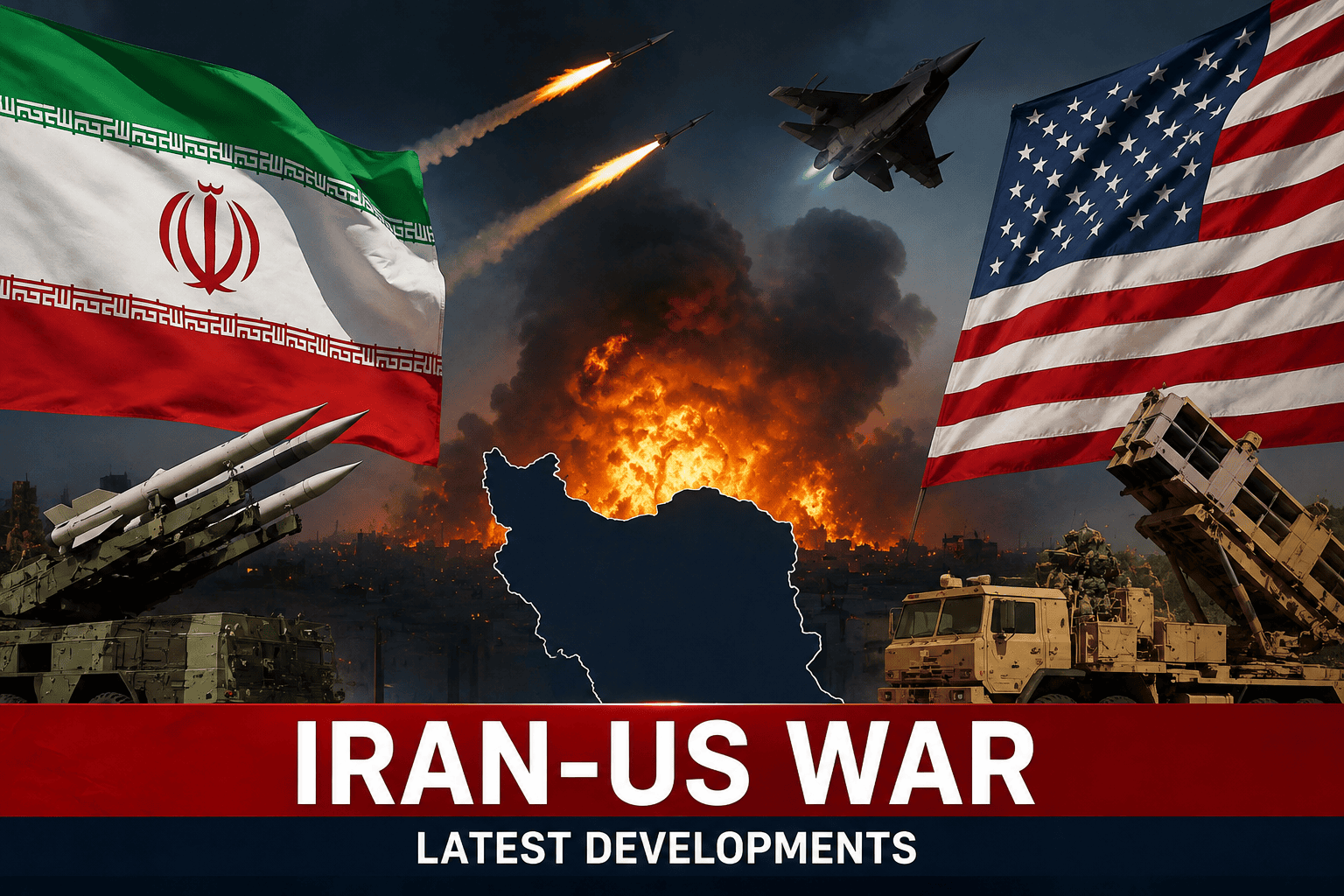
TEHRAN/WASHINGTON (Web Desk) – The US-Iran war entered another dangerous phase over the past 24 hours as American forces launched a major wave of strikes across Iran, Tehran retaliated against US-linked targets across the Middle East, and a deadly attack on a wedding gathering in southern Iran triggered demands for an international war-crimes investigation.
The renewed fighting represents the most serious escalation in weeks after a period of relative calm. US Central Command said its strikes targeted Iranian military infrastructure, while Tehran responded with missiles and drones aimed at US facilities and interests in Jordan, Bahrain and Iraq. Kuwait also reported confronting a hostile drone attack.
The escalation is unfolding around the strategically critical Strait of Hormuz, through which roughly a fifth of global oil supplies passed before the war. The conflict and disruption to shipping have already pushed energy prices higher. Reuters reported that oil rose by more than $4 a barrel on Tuesday, reaching a five-week high.
US launches new wave of strikes across Iran
The United States said its latest operation targeted dozens of sites associated with Iran’s Islamic Revolutionary Guard Corps.
CENTCOM said targets included air-defence installations, radar systems, maritime assets, communications facilities and capabilities associated with laying naval mines.
Iranian media reported explosions in several parts of the country. Reported locations included the vicinity of Ahvaz, Jiroft airport in southeastern Iran, Chabahar, Bandar Abbas, Asaluyeh and Qeshm Island.
Washington said the strikes came in response to attempted Iranian attacks against commercial shipping in the Strait of Hormuz and US military personnel deployed in the region.
The latest attacks followed a weekend exchange of fire and reported attacks on two tankers leaving the Strait of Hormuz, further increasing fears that the conflict could severely disrupt one of the world’s most important energy corridors.
Wedding celebration hit in southern Iran
The most politically and humanitarianly explosive incident came in Kuhestak in Sirik County, Hormozgan province, where a residential building hosting a wedding celebration was hit during the US strikes.
Iranian authorities have given varying casualty figures as information has developed. The Iranian Red Crescent initially reported four deaths, including a child, while later Iranian reporting put the toll at five. More than 60 people were reported wounded in subsequent accounts.
Local authorities identified four of the victims as four-year-old Amir Ali Karimi, 16-year-old Mohammad Malahi and two 43-year-old women. More than 60 people were wounded, some seriously, according to the Hormozgan governor’s office.
Images and videos from the area showed extensive damage to the building and surrounding structures. A telecommunications tower near the coastline was also struck.
A CENTCOM spokesperson said the US military was aware of Iranian reports of civilian casualties and maintained that American forces do not deliberately target civilians. The precise circumstances of the strike and its intended target remain disputed.
Iranian Red Crescent seeks ICC investigation
The Iranian Red Crescent Society (IRCS) has now taken the incident to the International Criminal Court, calling for an independent investigation into whether the attack violated international humanitarian law.
In a letter to the ICC prosecutor, the organisation said the reported civilian nature of the location and the presence of people attending a family wedding raised serious legal concerns.
The IRCS said that if an attack were intentionally launched with knowledge that expected civilian casualties would be clearly excessive in relation to the anticipated military advantage, it could — subject to the requirements of the Rome Statute — give rise to individual criminal responsibility.
The organisation said the circumstances could therefore potentially amount to a war crime and called for an “independent, impartial, thorough, and effective investigation.”
A determination that a war crime occurred would require a competent investigation into matters including the intended target, information available to those ordering the strike, proportionality and precautions taken.
Iran retaliates against US targets
Iran responded rapidly to the American attacks.
The IRGC said it launched a heavy ballistic missile attack against a US base in Jordan, claiming that a large number of American personnel had been killed.
US officials disputed that claim, telling Reuters that initial information showed no casualties from the Iranian attack in Jordan.
Jordan’s armed forces said 13 ballistic missiles entered its airspace. Ten were intercepted, while three landed in remote areas.
Iranian media also reported an attack on a US base in Bahrain involving drones. Bahrain said Iranian drones had been intercepted and destroyed.
Meanwhile, Kuwait’s military said its air defences responded to a hostile drone attack.
Iran’s Revolutionary Guards also claimed missile and drone strikes against US bases in Erbil, northern Iraq, saying infrastructure and equipment had been destroyed and US personnel killed. At the time of Reuters’ report, neither Washington nor Iraqi authorities had confirmed those casualty claims.
The IRGC separately said its attack on Ali Al Salem Air Base in Kuwait was carried out in retaliation for the Kuhestak wedding strike. Iranian claims of American casualties there had not been independently established in the sources reviewed.
Trump threatens much heavier attacks
US President Donald Trump warned Tehran against retaliation and threatened significantly more powerful American military action if Iran continued attacking US forces and regional interests.
Trump indicated that an even larger attack remained possible, while playing down prospects for another ceasefire.
The US president told Fox News that he had little confidence in reaching another agreement with Tehran following the breakdown of an earlier arrangement.
The rhetoric has increased fears that the renewed exchanges could develop into a sustained campaign rather than another limited round of retaliation.
Iran threatens Gulf oil exports
Iran, meanwhile, has linked its military strategy increasingly closely to control of the Strait of Hormuz.
The IRGC warned that renewed US attacks would further tighten restrictions on the strategic waterway.
Iranian parliament speaker Mohammad Baqer Qalibaf issued an even stronger warning, saying that if Iran were prevented from exporting oil through the Persian Gulf, others would not be able to export either.
That threat carries global consequences.
The Strait of Hormuz is the maritime gateway connecting major Gulf oil and gas producers with international markets. Any prolonged disruption could raise shipping and insurance costs, restrict energy supplies and drive international oil prices higher.
Regional war risk grows
The last 24 hours demonstrate how quickly direct US-Iran fighting can spread beyond Iranian territory.
Iranian retaliation has already involved or crossed the airspace of Jordan, Bahrain, Kuwait and Iraq, while American attacks have struck multiple locations inside Iran.
This creates risks not only for US and Iranian forces but also for countries hosting American military facilities.
The exchanges also complicate diplomatic attempts to contain the conflict. A miscalculation, significant US military casualties or another mass-casualty civilian incident could trigger an even larger round of retaliation.
What happens next
Three developments will be critical in the coming days: whether Washington launches the heavier strikes threatened by Trump, whether Iran continues attacking US facilities across the Gulf, and whether shipping through the Strait of Hormuz faces further disruption.
The wedding incident will also attract international scrutiny, particularly following the Iranian Red Crescent’s appeal to the ICC.
For now, there is little evidence that either Washington or Tehran is prepared to back away.
What had been a period of relative calm has abruptly given way to missiles, drones and airstrikes across a wide geographical area — placing civilians, military personnel, regional governments and global energy markets back at the centre of an increasingly unpredictable war.


