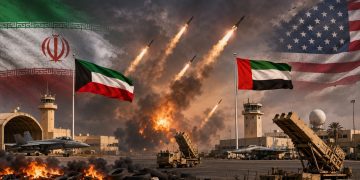



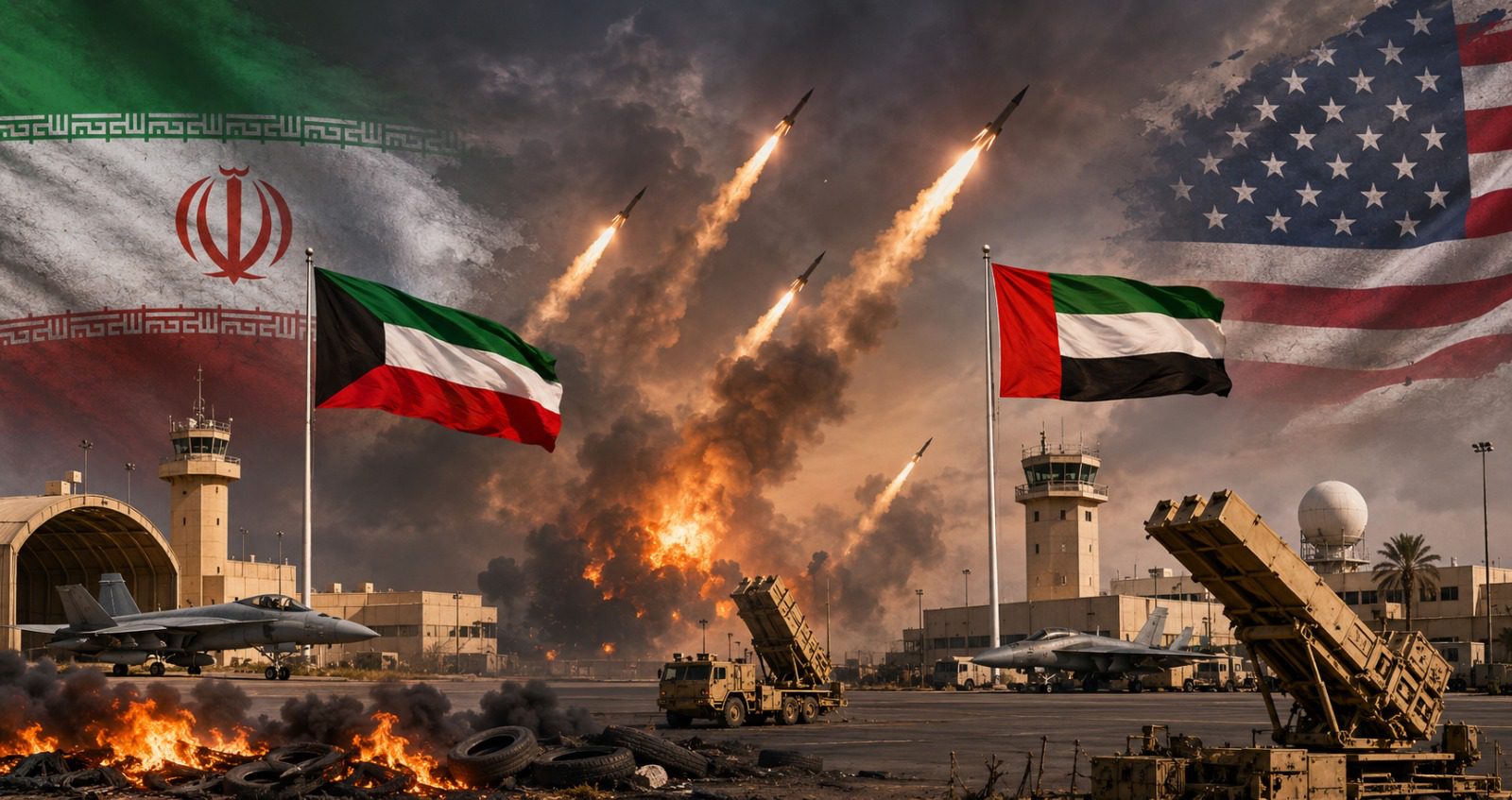
TEHRAN/KUWAIT CITY (Web Desk) – The Iran-US conflict intensified sharply over the past 24 hours as Tehran launched fresh missile and drone attacks against US military facilities in Kuwait and the United Arab Emirates, while Washington warned that it remained ready to strike Iran again.
Iran’s army said on Thursday that it had targeted the Ahmed Al Jaber Air Base in Kuwait and Al Minhad Air Base in the UAE, marking another expansion of Iranian retaliation across the Gulf.
According to the Iranian military, missiles and attack drones targeted satellite communications systems, equipment warehouses and fighter aircraft hangars at Ahmed Al Jaber Air Base.
In the UAE, Iran said its forces targeted US troop positions and radar systems at Al Minhad Air Base.
Tehran claimed damage was inflicted during the attacks, although the extent of those claims could not immediately be independently verified.
Kuwait activates air defences
Kuwait confirmed that its territory had come under Iranian missile and drone attack.
The Kuwaiti military said its air defences confronted what it described as hostile missiles and drones originating from Iran.
No immediate casualty figure was announced in connection with Thursday’s attack.
Kuwait condemned the strikes as a violation of its sovereignty and a direct threat to its security and stability.
The development is particularly significant because Kuwait hosts American military facilities and personnel, placing the Gulf state directly in the path of Iranian retaliation against Washington.
Iran said the latest operation formed part of the 31st phase of Operation Saeqeh, its military campaign in response to recent American attacks inside Iran.
UAE base targeted
Iran’s announcement that it had also attacked Al Minhad Air Base in the UAE further widened the geographical scope of the confrontation.
The Iranian army said missiles and drones were directed against radar systems and locations housing American forces.
The latest attacks followed Iranian strikes against US-linked military facilities elsewhere in the region during the preceding round of retaliation, including targets in Kuwait, Bahrain, Jordan and Iraq.
The latest 24-hour period therefore underlined the growing vulnerability of Gulf countries hosting American military facilities as Tehran seeks to retaliate directly against US forces without limiting its response to Iranian territory.
Trump warns Iran of more strikes
US President Donald Trump, meanwhile, maintained a confrontational position towards Tehran.
Trump said the United States had hit Iran “very hard” and remained prepared to carry out another attack “anytime we want.”
The US president said American forces had targeted equipment Iran had developed around the strategically vital Strait of Hormuz.
His warning suggests Washington has not ruled out another major round of attacks if Iran continues targeting American forces or facilities.
The exchange of threats has raised fears that Iranian retaliation against US bases could prompt another American military response, continuing the cycle of attack and counterattack.
Wedding strike moves to international legal arena
Alongside the latest military exchanges, attention during the past 24 hours has increasingly focused on the deadly strike on a wedding gathering in Kuhestak in Iran’s Hormozgan province.
Iranian authorities say a US missile hit a home where a wedding celebration was taking place.
Iranian media reported that four people, including two children, were killed, while dozens of others were wounded.
The Iranian Red Crescent Society has now called for an investigation by the International Criminal Court (ICC).
The organisation argued that the reported civilian character of the wedding venue and the presence of civilians raised serious concerns under international humanitarian law.
It said the circumstances warranted an independent, impartial and effective investigation and argued that the attack could potentially constitute a war crime.
Such a determination would, however, require an independent legal investigation into the target, proportionality, precautions taken and information available to those responsible for the attack.
Civilian casualties add pressure
Iran has also reported mounting casualties from the renewed American attacks.
Iranian authorities said 18 people had been killed and 142 injured in US strikes since Sunday, including women and children. Those figures cover a period longer than the latest 24 hours but provide context for the escalation now driving Tehran’s retaliation.
US Central Command has said its latest operations targeted Iranian military capabilities, including air-defence sites, radar systems, maritime assets, mine-laying capabilities and communications infrastructure.
Gulf states increasingly caught in conflict
The most important development over the latest 24 hours is the expansion of Iranian attacks into Kuwait and the UAE.
The strikes demonstrate that the renewed confrontation is no longer confined to exchanges inside Iran or around the Strait of Hormuz. Countries hosting US forces are increasingly exposed to Iranian retaliation.
For Kuwait and the UAE, the danger is particularly acute because further exchanges could threaten civilian aviation, energy infrastructure and regional commerce.
The Strait of Hormuz also remains a central flashpoint because of its importance to international oil and gas supplies.
What happens next
Attention is now focused on whether Washington responds militarily to Thursday’s Iranian attacks.
Trump’s warning that the United States is prepared to strike Iran again leaves open the possibility of another escalation.
Iran, meanwhile, has vowed to continue responding to US military operations.
That leaves the conflict at a dangerous point: Iran is striking American military facilities across the Gulf, the United States is threatening renewed attacks, and the controversy surrounding civilian casualties is adding diplomatic and legal pressure to an already volatile confrontation.
The next 24 hours could determine whether the latest exchange begins to subside or develops into an even broader regional conflict.


