


By Asim Shahzad
LAHORE: Civil society representatives, political activists, academics, and former local government representatives on Thursday demanded immediate local government elections in Punjab, terming the continued absence of elected local bodies a violation of Article 140-A of the Constitution.
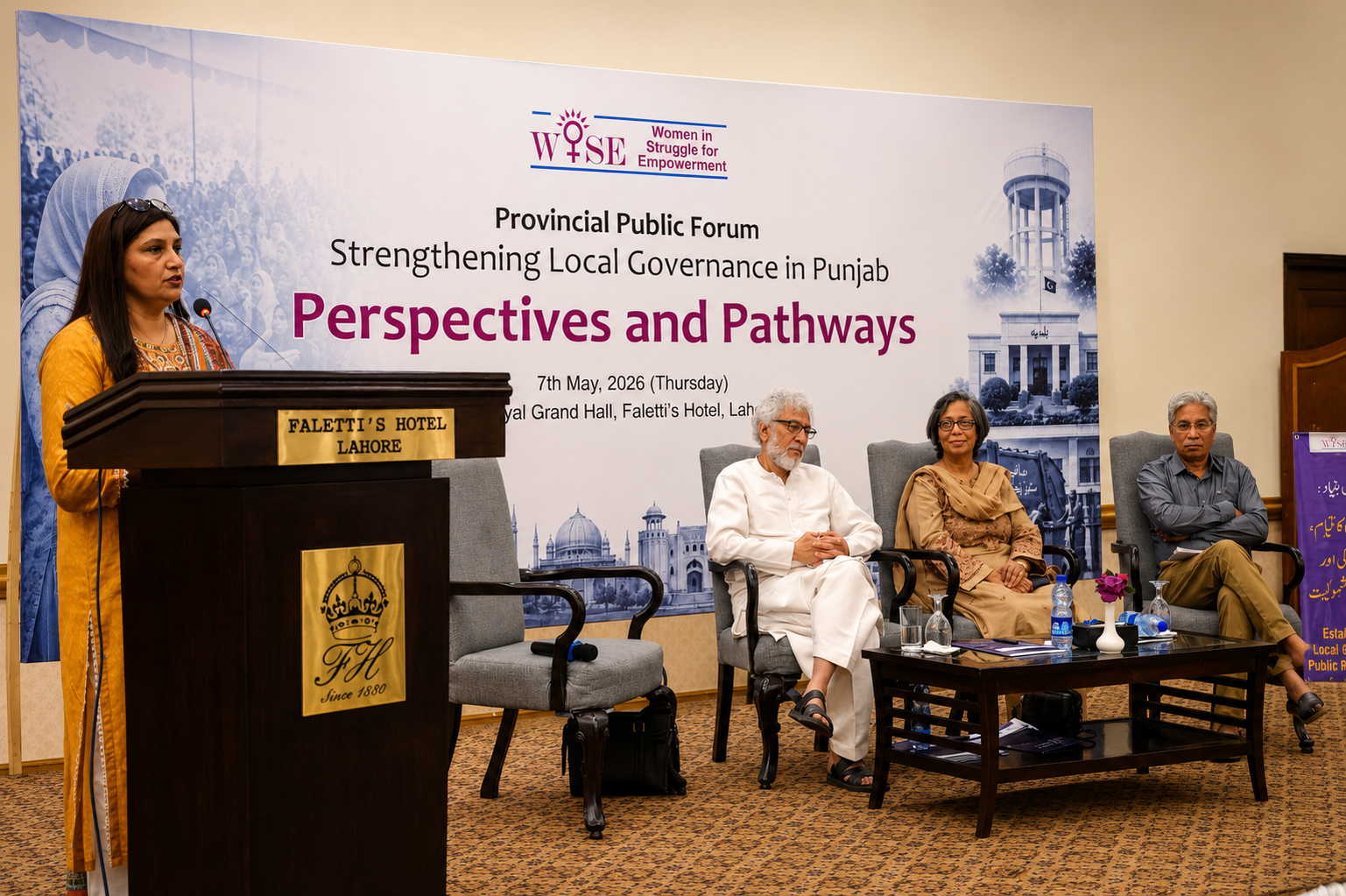
The demand was made during a Provincial Public Forum titled “Strengthening Local Governance in Punjab – Perspectives & Pathways” organized by Women in Struggle for Empowerment (WISE). More than 130 participants from Lahore, Kasur, Sheikhupura, Nankana Sahib, Gujranwala, and Faisalabad attended the event.
Speakers said Punjab has remained without an elected local government system for the last six years, while Sindh, Khyber Pakhtunkhwa, Balochistan, and Azad Kashmir already have functioning local governments.
Executive Director WISE, Bushra Khaliq, said that local governments are the “first tier of democracy” and their absence deprives nearly 56 percent of Pakistan’s population of democratic local governance. She emphasized that women, minorities, and youth are the most affected stakeholders and urged the Punjab government to fulfill its constitutional responsibility by holding LG elections without delay.
Prof. Shakila Sindhu of FC College University criticized the proposed Punjab Local Government Act (PLGA) 2025 for reducing women’s reserved seats instead of increasing them. She noted that women constitute 51 percent of Pakistan’s population, yet their political representation in local governments continues to shrink from the earlier 33 percent quota.
Zahid Islam of Sangat Development Foundation stressed the importance of citizen participation in governance, particularly in the context of rapid urbanization and population growth in Punjab. He argued that provincial authorities alone cannot effectively address local issues without empowered local governments.
Muhammad Tahseen of South Asia Partnership Pakistan warned that prolonged delays in restoring local governments were fueling public frustration and weakening democratic accountability. He called for stronger constitutional guarantees to ensure continuity of local government systems across provinces.
Criticizing the PLGA 2025, Awaz-e-Khalaq Movement representative Ishtiaq Chaudhry said the proposed law contradicts the spirit of constitutional provisions related to devolution and citizen participation. He alleged that political parties have largely ignored local governance in their manifestos.
Dr. Aisha Shahzad of Lahore College for Women University highlighted the repeated delimitation exercises conducted by the Election Commission of Pakistan since 2017 due to successive changes in local government laws. She stressed the need for permanent consensus on local government continuity and devolution of fiscal and administrative powers.
Tanveer Jahan of the Democratic Commission for Human Development demanded at least 33 percent representation for women at all tiers of local government. She also called for reserved representation for peasants, laborers, and workers, saying marginalized groups had been ignored in the new law.
Social researcher Abdul Khaliq criticized the reduction of women’s reserved seats from two to one in the latest draft law and opposed the indirect election mechanism for reserved seats, arguing that direct elections are essential for genuine democratic participation.
Several former women councilors also voiced concerns that women’s political participation was being sidelined by political parties and called for collective struggle beyond party affiliations to reclaim democratic space in local governance institutions.


