


Riyadh airport attack kills 12, leaves 309 injured as Saudi coalition vows response
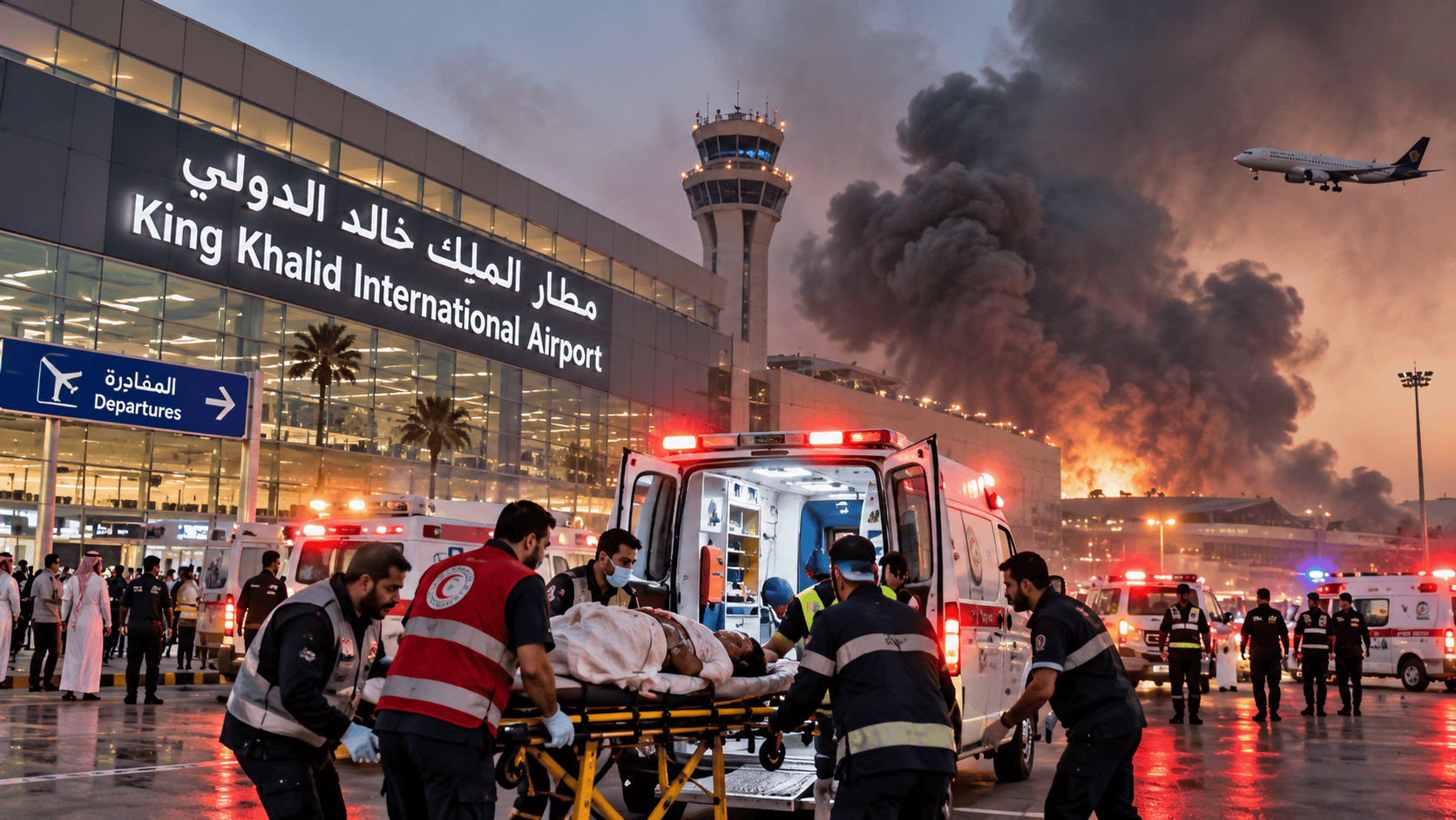
RIYADH (Web Desk) – Saudi Arabia is facing mounting security concerns after a deadly attack on King Khalid International Airport in Riyadh killed at least 12 people and injured 309 others, including several in critical condition, according to the kingdom’s civil aviation authorities.
The attack, which took place on Saturday, October 10, has intensified regional tensions and raised fresh concerns about the safety of civilian aviation facilities as hostilities involving Saudi Arabia and Yemen’s Houthi movement escalate.
The Saudi General Authority of Civil Aviation confirmed the casualty figures on Sunday, reporting that the victims included Saudi citizens and foreign nationals from several countries.
The fatalities comprised four Saudi citizens, two Bangladeshis and one national each from the United States, Egypt, Jordan, Syria, Palestine and Sudan.
The injured were receiving medical treatment at hospitals across Riyadh, with some reported to be in serious or critical condition. Authorities also reported property damage at the airport and began assessing the extent of the destruction.
The Saudi-led military coalition fighting in Yemen has vowed a decisive response to the attack, describing the strike as a serious violation of international humanitarian law. The incident has added to concerns about the widening conflict and the potential consequences for regional security and international air travel.
Airport operations suspended after deadly strike
King Khalid International Airport, one of Saudi Arabia’s principal aviation hubs, suspended operations following the attack as emergency services responded to the casualties and officials assessed damage to airport facilities.
The suspension was intended to allow authorities to examine the affected areas and determine whether airport infrastructure could be operated safely.
The incident prompted heightened security measures and warnings from foreign diplomatic missions advising their citizens to avoid the airport amid the evolving security situation.
Airlines also faced disruption as the security situation affected flights to and from Riyadh. Several international carriers announced cancellations, while passengers faced uncertainty over departures and arrivals.
The airport attack has highlighted the vulnerability of civilian aviation infrastructure during periods of escalating regional conflict, particularly when commercial airports become exposed to missile or drone threats.
Authorities have continued assessing the damage and the operational implications of the incident. Information about the full extent of the destruction and the subsequent restoration of normal airport services remains subject to official updates.
Saudi-led coalition promises decisive response
The Saudi-led coalition fighting the Houthis in Yemen has pledged to respond to the attack.
Coalition spokesperson Major General Turki Al-Maliki said the Joint Forces Command would respond decisively in accordance with international humanitarian law and the applicable rules of warfare.
The coalition described the strike as a serious attack on civilian infrastructure, arguing that the deaths and injuries caused by the incident warranted a firm response.
However, any subsequent military action could have wider implications for the conflict in Yemen and security across the region.
The latest incident comes amid an intensification of hostilities involving Saudi Arabia and the Houthis, with airports and other strategic facilities increasingly exposed to attacks.
The repeated targeting of aviation infrastructure has raised concerns among governments, airlines and international travellers about the risks of further disruption.
The coalition’s pledge signals the possibility of additional military action, although the precise nature, timing and scope of any response were not immediately established in the information released by the authorities.
Houthis blamed as regional conflict intensifies
The Saudi-led coalition has blamed Yemen’s Houthi movement for the attack on King Khalid International Airport.
The Houthis, who control Yemen’s capital, Sanaa, have been involved in a prolonged conflict with the internationally recognised Yemeni government, which has received support from Saudi Arabia and its regional partners.
The latest escalation follows renewed fighting and a series of attacks targeting Saudi facilities.
The airport in Riyadh had already come under attack earlier in the week. According to reports, separate incidents on Thursday killed three Saudi citizens and injured others, while a commercial aircraft was also damaged.
The repeated attacks have raised questions about the ability of Saudi Arabia and its partners to protect critical infrastructure from continuing missile and drone threats.
A diplomatic source attributed Saturday’s attack to a missile, according to reporting by Agence France-Presse. However, details about the weapon used and the circumstances of the strike should be distinguished from information formally confirmed by the relevant authorities.
The Houthis did not immediately issue a clear claim of responsibility for Saturday’s attack, according to reports published after the incident.
The group has previously threatened Saudi aviation facilities amid the deterioration of relations and renewed fighting.
The latest attack therefore comes against the backdrop of an expanding confrontation rather than as an isolated security incident.
Civilian casualties raise international concerns
The loss of life at Riyadh’s international airport has renewed concerns about the protection of civilians and civilian infrastructure during armed conflict.
The victims’ nationalities also underline the international character of the incident, with citizens from Asia, the Middle East, Africa and the United States among those killed.
Airports serve as essential links for passengers, migrant workers, business travellers and humanitarian operations. Attacks on such facilities can therefore have consequences beyond the immediate loss of life and physical damage.
The injury toll of 309 has placed additional pressure on emergency and medical services in the Saudi capital.
Authorities said the wounded were being treated at several hospitals, with some requiring urgent medical attention.
The incident has also heightened concerns among foreign residents and diplomatic missions about the safety of their nationals in Saudi Arabia.
International humanitarian law provides protections for civilians and civilian objects during armed conflict. Parties to a conflict must distinguish between civilian and military targets and comply with the applicable rules governing attacks.
The legality of any particular strike depends on the circumstances and available evidence, but attacks that deliberately target civilians or civilian objects may constitute serious violations of international law.
The coalition has characterised the Riyadh incident as a grave violation, while further details about the attack remain important for a complete assessment.
Pakistan expresses solidarity with Saudi Arabia
The attack has also drawn attention in Pakistan, which maintains longstanding political, economic and security ties with Saudi Arabia.
Prime Minister Shehbaz Sharif condemned the Houthi attack and reiterated Pakistan’s support for Saudi Arabia’s security, according to reporting by Dawn.
Pakistan’s position is significant because the two countries have close bilateral relations, including cooperation on defence and regional security.
Any further escalation could have implications for regional diplomacy, international travel and economic confidence across the Gulf.
Saudi Arabia is an important destination for Pakistani workers, businesspeople and religious pilgrims. Continued disruption to airport operations or wider restrictions on air travel could therefore affect passengers travelling between the two countries.
However, the extent of any impact on Pakistan-bound flights or Pakistani nationals should be established through official aviation and diplomatic updates rather than assumed from the attack alone.
Security outlook remains uncertain
The immediate priority for Saudi authorities remains the treatment of the injured, the assessment of damage and the restoration of safe airport operations.
The coalition’s pledge of a decisive response, however, has increased uncertainty over the next phase of the conflict.
Further military action could trigger retaliatory strikes, placing additional pressure on regional security arrangements and increasing the risk to civilian infrastructure.
The repeated attacks on Riyadh’s airport also raise questions about the effectiveness of existing protective measures and the challenges of defending major civilian facilities against aerial threats.
For airlines and passengers, the situation will depend on security assessments, official instructions and decisions concerning the resumption of normal flight schedules.
For regional governments, the challenge will be to respond to the attack while limiting further harm to civilians and preventing the confrontation from spreading.
As authorities continue to assess Saturday’s deadly incident, the confirmed toll of 12 dead and 309 injured underscores the human cost of the escalating conflict. The Saudi-led coalition’s promised response could prove a decisive development in determining whether tensions intensify further or diplomatic efforts gain renewed urgency.