



ISLAMABAD (Web Desk) – With Eid ul Adha approaching, authorities in Pakistan have stepped up both transportation safety measures and lunar monitoring updates that will determine the religious calendar for the upcoming festival period.
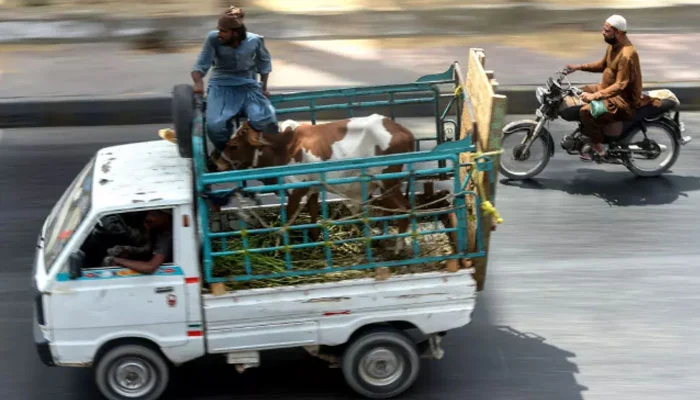
From a traffic management perspective, the National Highways and Motorway Police have announced restrictions on the movement of vehicles transporting sacrificial animals on motorways. The decision has been framed as a preventive safety step aimed at reducing risks during the busy Eid travel season. According to officials, such vehicles—especially when overloaded, poorly maintained, or improperly secured—have previously been linked to serious road accidents and major traffic disruptions on high-speed motorway routes.
Authorities noted that past incidents involving livestock transporters resulted in loss of life and property damage, prompting the enforcement of stricter controls this year. Under the new plan, vehicles carrying animals that do not meet safety standards will not be allowed to enter motorways and will instead be directed toward alternative road networks better suited for slow-moving or heavy-load transport.
To strengthen enforcement, the Motorway Police have also sought coordination with provincial law enforcement agencies, including the Punjab Police and the Khyber Pakhtunkhwa Police. These departments have been requested to set up checkpoints at key entry points to motorways as well as near major cattle markets. The objective is to intercept unsafe or non-compliant vehicles before they reach high-speed corridors, thereby improving overall traffic flow and commuter safety during the Eid rush.
Officials emphasized that the initiative is not intended to disrupt trade in sacrificial animals but to ensure that transportation is carried out responsibly and in line with road safety standards. The broader aim is to facilitate smoother travel conditions for all road users during one of the busiest periods of the year.
Alongside these transport arrangements, attention has also turned to astronomical observations influencing the Islamic calendar. The SUPARCO reported that conditions on May 17 were favorable for the sighting of the new moon. According to its calculations, the new lunar phase was expected to be born at 1:01 a.m., and by sunset the moon’s age would be around 18 hours and 30 minutes—generally considered sufficient for visibility in multiple regions.
Based on these astronomical projections, the start of Zil Hajj is anticipated to fall on Monday, May 18, which places Eid ul Adha likely on May 27. These forecasts provide preliminary guidance for planning, though official confirmation traditionally depends on moon-sighting committees.
Together, the transport restrictions and lunar predictions highlight the dual focus on public safety and religious scheduling as the country prepares for the Eid season.