


DUBAI (Web Desk) – Tensions surrounding Iran escalated on Wednesday as NATO warned that it was prepared to defend all allies against any threat, the United Arab Emirates suspended all trade and financial transactions with Iran following renewed missile tensions, and France announced the expulsion of two Iranian diplomats in a sharp deterioration of bilateral ties.
The developments came amid growing fears that the conflict involving Iran, the United States and Israel could widen beyond the immediate battlefield and further destabilise the Middle East and Europe.
NATO warns against threats to allies
A NATO official said the alliance was prepared to respond to any threat following a report in the Financial Times that Iran had allegedly considered attacking US military targets in Europe if US President Donald Trump escalated the conflict.
“NATO is prepared to address any threat and will always do what is necessary to defend all allies,” the official said.
The NATO official pointed to the alliance’s air defence capabilities, recalling that NATO systems had intercepted ballistic missiles heading towards Türkiye from Iran on four separate occasions earlier this year.
The statement underlined concerns that any expansion of the conflict could trigger a broader security crisis involving NATO members and US military installations in Europe.
UAE suspends trade with Iran
In another major development, the United Arab Emirates announced the suspension of all trade, commercial exchanges and financial transactions with Iran until further notice.
The decision followed the UAE’s accusation that Iran had fired two ballistic missiles towards the country, with both missiles reportedly falling into the Persian Gulf.
The UAE Defence Ministry said its assessment indicated that the missiles were targeting maritime traffic, although it remained unclear whether Emirati vessels or UAE territorial waters were the direct targets.
Iran, however, denied launching missiles towards the UAE.
Iranian Foreign Ministry spokesperson Esmail Baghaei criticised Abu Dhabi’s accusation, saying such claims were contrary to the principle of good neighbourliness and could undermine efforts to prevent further regional escalation.
The UAE’s decision represents a significant setback for economic relations between the two countries, which had maintained important commercial links despite years of political and security tensions.
The latest move also comes after the UAE accused Iran of attacking tankers operated by Abu Dhabi’s state-owned oil and gas company ADNOC in the Strait of Hormuz.
The waterway remains a crucial strategic chokepoint through which a significant share of global oil and gas supplies passes. Continued attacks or restrictions on shipping could therefore have consequences for international energy markets and global trade.
France expels Iranian diplomats
Meanwhile, France announced that it would expel two Iranian diplomats in retaliation for the expulsion of French diplomatic staff by Tehran earlier this week.
French Foreign Minister Jean-Noël Barrot accused Iranian authorities of making false allegations against French personnel and using claims of foreign interference to justify their actions.
France said the move followed an alleged attack by Iranian security forces against two French diplomatic staff in Iran last month.
Tehran had accused the French diplomats of participating in a secret meeting with individuals allegedly involved in a major case concerning foreign infiltration and interference.
The diplomatic dispute adds another layer to Iran’s increasingly strained relations with Western countries as tensions remain high over the wider conflict.
Qalibaf visits Iraq amid regional tensions
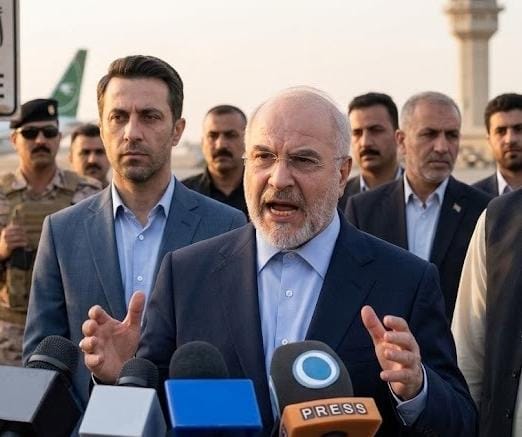
At the same time, Iranian Parliament Speaker Mohammad Bagher Qalibaf arrived in Iraq for a three-day visit and is scheduled to meet Iraqi officials and leaders of an Iran-backed political coalition.
His visit comes as Iran-backed Iraqi militias continue to face scrutiny over attacks targeting US bases and diplomatic facilities.
Qalibaf praised what he called the “resistance” in Iraq, describing Iran-aligned groups as an influential component of regional power.
The simultaneous diplomatic, military and economic developments point to a widening crisis, with concerns growing that further escalation could draw additional countries into the conflict and increase pressure on regional trade, energy supplies and international security.