


By Asim Shahzad
LAHORE: Punjab Assembly Speaker Malik Muhammad Ahmad Khan has called for political consensus, policy continuity and legal protection of agreements to enable Pakistan to fully exploit its vast mineral resources and attract long-term investment.
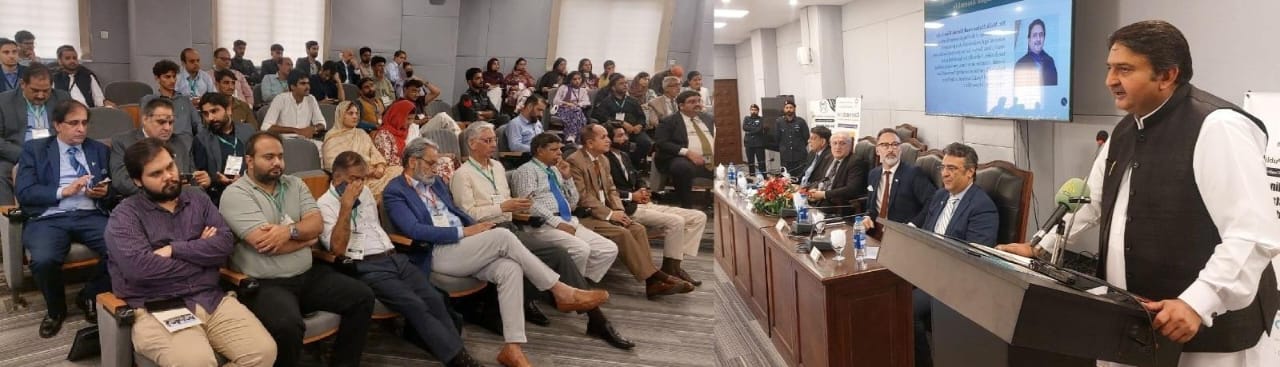
Addressing the concluding session of the annual conference titled “Rare Earth Minerals in Pakistan: Opportunities and Challenges” at the National School of Public Policy (NSPP), Lahore, Speaker Malik Muhammad Ahmad Khan said frequent changes in policies with every change of government undermined investors’ confidence.
He said Pakistan needed a long-term policy for the mineral sector that remained unaffected by changes in government.
“Pakistan has long been described as a country rich in mineral resources. The question is why we have so far failed to turn these resources into national wealth and economic prosperity,” he said.
Speaker Malik Muhammad Ahmad Khan said it was necessary to determine whether the problem stemmed from a lack of political will, shortcomings in the government structure or fundamental weaknesses in the existing policy framework.
He said concerns raised by stakeholders regarding any policy or agreement should not be ignored.
“Whenever stakeholders raise concerns about a policy or an agreement, their questions should be heard seriously and addressed through reasoned dialogue,” he said.
Speaker Malik Muhammad Ahmad Khan said the framers of the Constitution had recognised the need for a clear constitutional framework to govern the distribution of powers and resources between the federation and the provinces.
“The Constitution provides the basic framework. What is required now is the political will to make effective use of this constitutional framework,” he said.
Speaker Malik Muhammad Ahmad Khan said international agreements in the mineral sector were not confined to five or 10 years but could remain in force across several governments and for decades.
“If policies continue to change with every change of government, how can we expect long-term investment to come into the country?” he asked.
He said investors needed confidence that agreements legally entered into would remain protected even after a change of government.
“Policy continuity and the protection and enforcement of agreements are the foundation of investor confidence,” he said.
The speaker stressed the need for greater harmonisation between federal and provincial laws relating to mineral resources. He said legislation governing mineral exploration, extraction, investment, agreements and licensing should be clear and consistent so that investors did not face conflicting legal provisions.
Speaker Malik Muhammad Ahmad Khan also highlighted the environmental challenges associated with mineral extraction, saying environmental protection must be given due consideration during the lawmaking process.
“If forests or other natural resources are affected in the extraction of minerals, the question of how to strike a balance between development and environmental protection will inevitably arise,” he said.
He said such issues had no easy answers and required consultations among experts, institutions and relevant stakeholders.
The speaker said parliamentary standing committees, provincial assemblies, universities and research institutions had an important role to play in policymaking for the mineral sector.
He said universities were producing geologists and experts in various relevant fields, but their research needed to be linked with practical policymaking.
Speaker Malik Muhammad Ahmad Khan appreciated the NSPP for bringing different stakeholders together on a common platform, saying the process should not remain limited to holding conferences and publishing research papers.
He said research findings and recommendations should be shared with elected representatives from all provinces, including Balochistan, and followed by regular consultations with them.
Speaker Malik Muhammad Ahmad Khan said he was not a mineral-sector expert, but as a lawyer and parliamentary office-holder, his primary concern was to ensure that businesses investing in Pakistan were provided with a legal environment that gave them confidence in the security of their investments and the future of their agreements.
He said Pakistan’s mineral resources represented a major opportunity for the country, but turning this potential into national prosperity required strong institutions, political will, effective legislation, provincial participation and a long-term national vision.
The event was attended by National School of Public Policy Lahore Rector Farhan Aziz Khawaja, Sui Northern Gas Pipelines Limited Chairman Muhammad Ismail Qureshi, US Consul General in Lahore Stetson Sanders, NIPP Lahore Dean Dr Naveed Elahi, Chinese Consulate Lahore Commercial Counsellor Mr Bhuteng, as well as experts, policymakers and representatives of relevant sectors.