



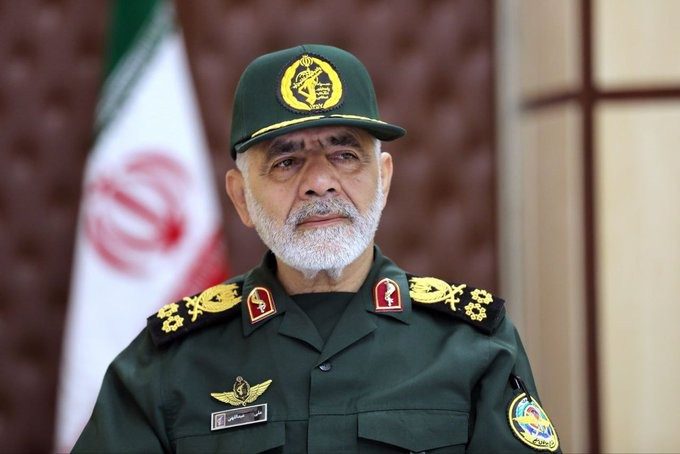
TEHRAN (Web Desk) – Iran’s top military commander has accused the United States of attempting to compensate for what Tehran describes as its military and strategic failures by intensifying economic, psychological and political pressure on the Islamic Republic, as renewed clashes in the Gulf threaten to push the Iran-US conflict into another dangerous phase.
Major General Ali Abdollahi, chief of staff of Iran’s Armed Forces and commander of the Khatam al-Anbiya Central Command, said Washington had failed to achieve its objectives through military means and was now relying increasingly on economic warfare and what Iranian officials describe as “cognitive warfare.”
Major General Abdollahi says US seeks to offset its military defeats through economic pressure
Follow: https://t.co/GHI09iA8ru pic.twitter.com/dpPWTaCLAX
— Press TV 🔻 (@PressTV) September 6, 2026
Abdollahi said the United States believed economic hardship could weaken Iranian society and force Tehran to change its policies, but insisted that such expectations would fail. His comments came amid a wider push by Iranian officials to portray the economic confrontation as the next major front in the conflict.
US-Iran military confrontation intensifies
The comments follow a sharp escalation in the Gulf, where Iranian and American forces have again exchanged attacks.
US Central Command said American forces struck three Iranian oil tankers after Iran’s Islamic Revolutionary Guard Corps launched ballistic missiles towards two US Navy warships. According to the US military, the American vessels avoided the Iranian attacks and no US personnel were injured.
The IRGC subsequently claimed attacks against US-linked vessels and oil tankers operating through what Tehran described as an unauthorised route in the Strait of Hormuz, raising fears that the military confrontation could disrupt one of the world’s most important energy corridors.
US Defence Secretary Pete Hegseth warned that Washington would continue targeting Iranian oil tankers if Tehran attacked American warships.
Iran, meanwhile, has warned that further US attacks will draw a more severe response.
Parliament Speaker Mohammad Baqer Qalibaf said on Sunday that Washington should recognise that the “rules of the game” had changed, warning that future attacks on Iranian interests and security would receive a “faster, heavier and more painful” response.
Economic war becomes central battlefield
While Tehran maintains that Washington has failed to achieve its military objectives, the economic pressure on Iran is significant.
The United States has tightened sanctions and its campaign against Iranian oil exports, restricting Tehran’s access to foreign currency and placing increasing strain on an economy already struggling with inflation and other domestic pressures.
Reuters reported Sunday that three senior Iranian sources acknowledged that the US campaign to restrict Iranian oil exports and prevent sanctions evasion was becoming increasingly difficult to withstand.
Iranian officials themselves are publicly acknowledging the economic challenges.
Qalibaf said the country’s central battle now included production and people’s livelihoods, identifying inflation, unemployment, currency volatility and market management as major problems requiring government action.
Iranian Economy Minister Ali Madanizadeh, however, rejected the idea that Washington could use economic hardship to dictate Tehran’s strategic decisions.
He said responsibility for reforming Iran’s economy belonged to the Iranian government and people rather than the US Treasury, arguing that years of sanctions had already forced Iranian businesses and workers to develop alternative ways to operate.
Iran’s Economy Ministry has also intensified the work of what officials call an “Economic War Headquarters” to address problems created by sanctions and the conflict.
Oil at centre of confrontation
Energy has emerged as one of the most consequential fronts in the confrontation.
Iran is OPEC’s third-largest producer, and before the current war roughly 90 per cent of its crude exports passed through Kharg Island, according to Reuters. Iranian Oil Minister Mohsen Paknejad said Sunday that Kharg Island had been attacked around 550 times in previous months but remained operational.
The renewed targeting of Iranian tankers adds another layer of risk to global oil supplies.
The Strait of Hormuz is particularly important because around one-fifth of global oil supplies passed through the waterway before the conflict. Any prolonged disruption could have consequences far beyond Iran and the United States, potentially affecting international crude prices, shipping costs and inflation.
Iran says deterrence remains intact
Iranian military officials have simultaneously sought to demonstrate that the country’s defensive and offensive capabilities remain intact.
Major General Abdollahi’s comments were echoed by other senior commanders, with Iranian officials arguing that US reliance on economic pressure itself demonstrates that military action has failed to force Tehran into submission.
Major General Habibollah Sayyari also said Sunday that Iran’s deterrence capability had increased significantly, rejecting recent pressure from Washington as evidence of American strength.
Tehran’s position, however, contrasts with Washington’s assessment. US officials argue that military and economic pressure has substantially weakened Iran’s ability to project power and has reduced its leverage over shipping through the Strait of Hormuz.
No clear path towards de-escalation
Six months after the latest major US-Israeli military campaign against Iran began, neither side appears prepared to make fundamental concessions.
A preliminary ceasefire subsequently unravelled, and renewed tit-for-tat attacks have again raised concerns about a broader confrontation.
The emerging battle is therefore being fought simultaneously on several fronts: military operations in and around the Gulf, pressure on Iranian oil exports, sanctions, control of shipping routes and an increasingly intense struggle over domestic economic resilience.
Abdollahi’s latest statement makes clear that Tehran views the US economic campaign not as separate from the war but as another component of it.
For Iran, the challenge is now to demonstrate that it can withstand the financial pressure while maintaining military deterrence. For Washington, the question is whether sanctions and pressure on oil exports can produce concessions that months of fighting have so far failed to secure.
With both sides publicly claiming the advantage and threatening tougher responses to further attacks, the latest developments suggest the Iran-US confrontation remains far from resolution.


