


By Commerce Reporter
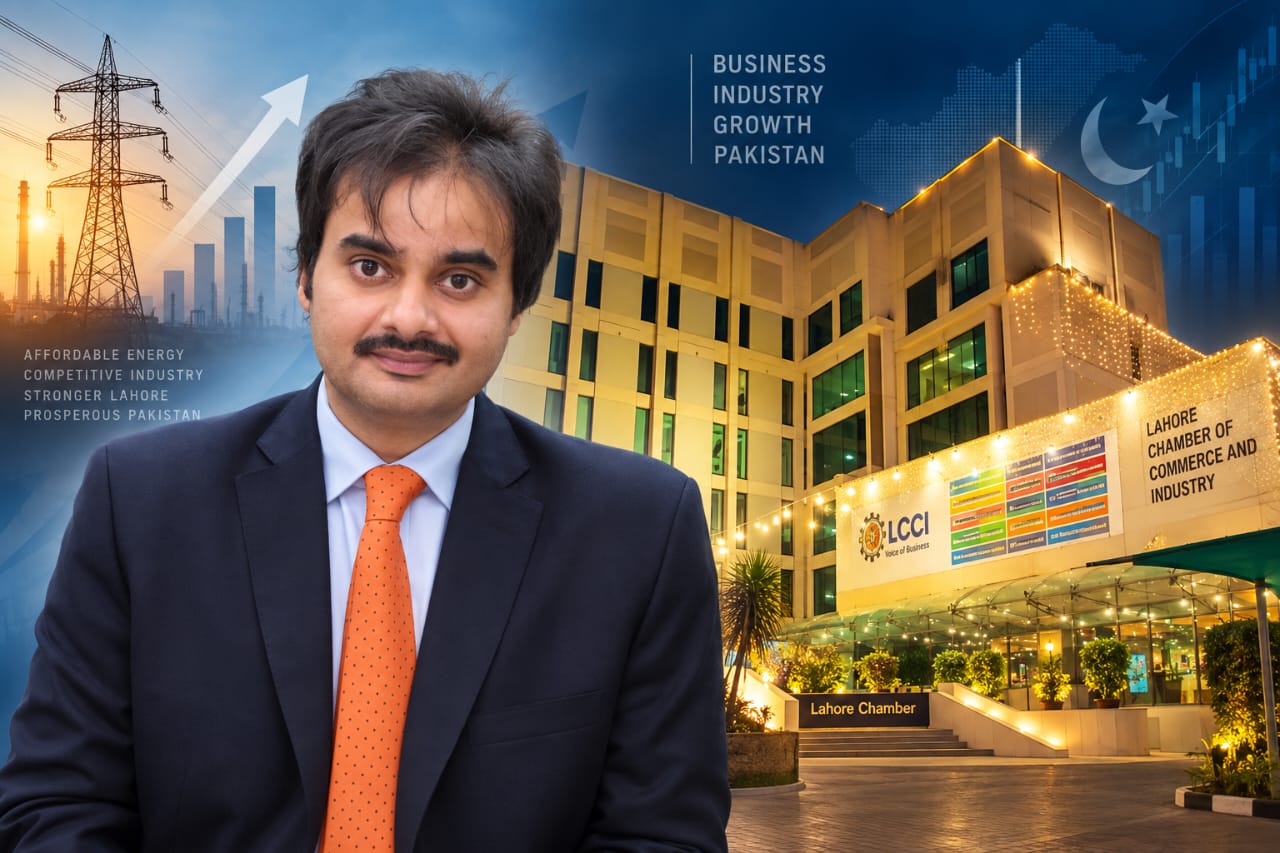
LAHORE: High electricity costs are putting increasing pressure on Lahore’s industrial sector, raising production expenses and making it harder for local manufacturers to compete, according to Ali Hussam Asghar, chairman of the Pioneer Businessman Group and a candidate for president of the Lahore Chamber of Commerce and Industry (LCCI).
Asghar has placed affordable and predictable energy among the key issues in his economic agenda for Lahore’s trade and industry, arguing that reducing the overall cost of doing business must become a central priority for the next LCCI leadership.
He said the electricity issue should not be viewed merely as a matter of monthly utility bills. For industrial consumers, energy is an important production input, and increases in its cost can affect manufacturing decisions, product pricing, investment plans and the ability of businesses to compete in domestic and international markets.
According to Asghar, Lahore possesses a diverse industrial base with businesses operating in engineering, pharmaceuticals, auto parts, chemicals, plastics, food processing, textiles and several other manufacturing and services sectors. Small and medium enterprises also form an important part of the city’s commercial and industrial supply chains.
He maintained that when production costs rise, businesses are left with limited options: absorb the additional expenditure, pass some of it on through prices, reduce margins or reconsider expansion and investment plans.
For this reason, he believes industrial energy costs should receive sustained attention from business representative bodies rather than being treated as an issue only when tariffs are revised.
Competitiveness should drive energy debate
Asghar said the real economic question was whether businesses operating in Lahore could produce goods at costs that allowed them to compete.
Electricity is only one component of that calculation. Businesses also face financing costs, taxation, transportation expenses, labour costs, regulatory compliance and other overheads. Their combined impact ultimately determines whether an enterprise can expand, employ additional workers and compete successfully.
Asghar called for stronger evidence-based representation of industry before policymakers, with LCCI developing sector-specific assessments of how energy and other input costs affect businesses.
He believes such an approach would allow the chamber to move beyond general statements and present policymakers with concrete proposals based on the practical experiences of its members.
The objective, he said, should be constructive engagement with government and relevant institutions to find solutions that balance broader economic realities with the need to maintain a competitive industrial sector.
Predictability essential for investment
Asghar also identified predictability as a critical requirement for business confidence.
Investment decisions, particularly in manufacturing, often involve substantial capital commitments. Businesses considering new machinery, production lines or factory expansion need to assess expected costs and returns over several years.
Frequent changes in major input costs can complicate those calculations and make entrepreneurs more cautious about committing fresh capital, he maintained.
According to Asghar, Pakistan needs an environment in which existing businesses feel confident about expansion while new investors see industry as an attractive long-term proposition.
He said LCCI should consistently communicate the consequences of policy changes to decision-makers and advocate greater consultation with stakeholders before measures significantly affecting businesses are introduced.
SMEs need particular attention
Asghar said the impact of rising business costs could be particularly challenging for small and medium enterprises.
While larger businesses may have greater financial capacity to manage temporary cost increases or invest in alternative energy arrangements, smaller manufacturers and traders generally operate with more limited resources.
Yet these enterprises are important generators of employment and economic activity across Lahore.
Asghar’s economic agenda envisages a stronger role for LCCI in helping SMEs gain access to finance, technology, skills, market information and institutional support.
He believes lowering unnecessary business costs and simplifying regulatory processes would particularly benefit smaller enterprises that lack the administrative and financial resources available to larger corporations.
The health of Lahore’s economy, he maintained, cannot be measured solely through the performance of major industrial groups. Thousands of smaller businesses operating across the city also need an environment that enables them to survive, expand and create employment.
Industrial costs ultimately affect wider economy
Asghar said energy affordability should also be considered from the perspective of consumers and the wider economy.
When manufacturers face higher input costs, businesses may attempt to absorb them, but their capacity to do so is limited. Persistent increases can eventually affect prices, production, investment decisions and employment.
He therefore views competitive industrial energy costs as part of a broader economic development strategy rather than an issue benefiting manufacturers alone.
A stronger productive sector, according to his economic agenda, can contribute to employment, exports, investment and government revenue.
Lahore’s industrial infrastructure needs attention
Asghar said electricity was not the only challenge confronting Lahore’s industrial community.
Businesses also raise concerns involving infrastructure, transportation, access to utilities, regulatory procedures and interaction with different government agencies.
He has proposed that LCCI identify problems on an industrial-area basis and develop a systematic mechanism for pursuing them with the relevant authorities.
Instead of addressing every industrial problem under one broad heading, the chamber should determine which issues affect particular areas and sectors and establish priorities accordingly, he maintained.
A similar approach could be adopted for Lahore’s commercial markets, where traders may face a different set of challenges, including parking shortages, congestion, accessibility, compliance requirements and coordination with public authorities.
Asghar believes ease of doing business should ultimately be measured by the experience of the entrepreneur operating on the ground.
Energy costs linked with export ambitions
The energy issue also forms part of Asghar’s proposed strategy for expanding exports.
Pakistan needs greater and sustainable foreign exchange earnings, while Lahore has significant potential to contribute through manufacturing, engineering, technology, value-added products and other sectors.
However, Asghar maintains that export promotion cannot be separated from domestic competitiveness.
Trade delegations, exhibitions and international business contacts can help companies enter new markets, but exporters also need competitive production conditions at home.
His agenda envisages LCCI helping members identify new markets, establish relationships with overseas chambers and trade organisations, understand international requirements and explore opportunities beyond traditional export destinations.
At the same time, he believes the chamber must continue highlighting domestic factors that make Pakistani products more expensive or less competitive internationally.
LCCI should pursue measurable outcomes
Asghar said the next LCCI leadership should concentrate on outcomes rather than limiting its role to meetings and statements.
His wider agenda includes energy affordability, rationalisation of business costs, support for SMEs, improved market and industrial infrastructure, export development and stronger institutional coordination between businesses and government.
He also favours mechanisms through which legitimate grievances involving regulatory and government departments can be documented and taken up through appropriate institutional channels.
Asghar maintains that effective business representation does not require confrontation with government. Instead, he sees government and the private sector as partners whose interests converge around investment, employment, exports, economic growth and sustainable revenue generation.
With the LCCI elections approaching, he is positioning the cost of doing business as one of the central issues on which the next chamber leadership should be judged.
For Lahore’s industrial community, Asghar believes the objective should be straightforward: create conditions in which businesses can invest with confidence, manufacture competitively, expand into new markets and generate employment.
The strength of Lahore’s economy, he maintains, will ultimately depend on whether its entrepreneurs are given an environment in which doing business becomes easier and more competitive rather than increasingly costly.