


WASHINGTON (Agencies) – A new analysis has warned that the United States could require several years to restore critical weapons stockpiles depleted during the recent conflict with Iran, raising fresh concerns about America’s military readiness in the event of another major global confrontation.
The report, released by the Washington-based Center for Strategic and International Studies (CSIS), says the heavy use of advanced missiles and air defence systems during the Iran war has significantly reduced US inventories of some of its most important weapons. Analysts caution that the recovery process may leave the country exposed to strategic risks, particularly in the Indo-Pacific region where tensions with China continue to grow.
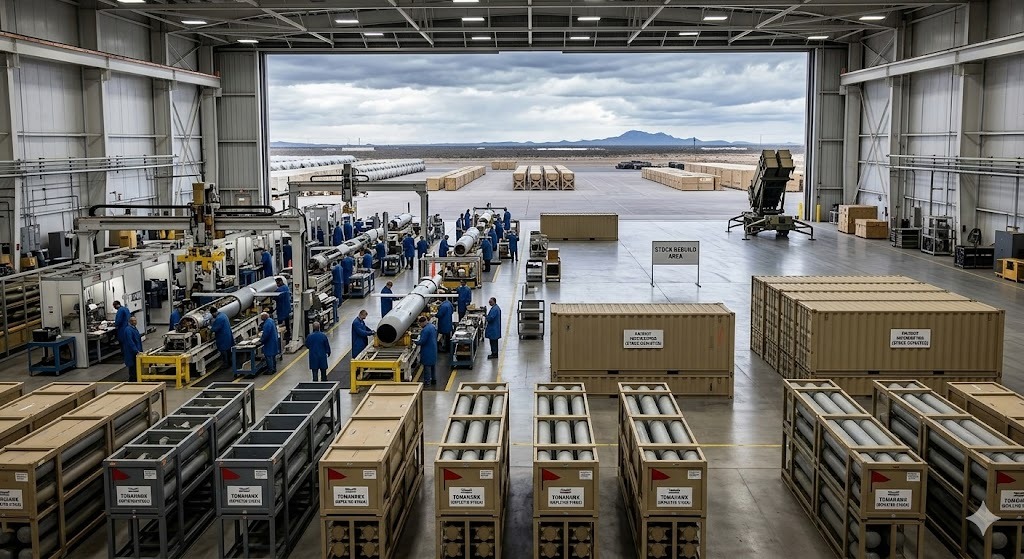
According to the study, the weapons most affected include Tomahawk cruise missiles, Patriot missile interceptors and THAAD air defence interceptors. These systems played a central role in operations linked to Iran and regional defence missions.
Researchers estimate that rebuilding pre-war inventories could take until the end of the decade in some cases, despite a dramatic increase in defence spending proposed by President Donald Trump’s administration.
The report argues that the issue is no longer simply about funding. Instead, the greatest obstacle is the limited production capacity of the American defence industry and the lengthy manufacturing timelines required for advanced weapons systems.
CSIS analysts noted that while the United States still retains enough firepower to respond to immediate threats, the depletion of inventories has created what they described as a “window of vulnerability” if another major conflict were to erupt before supplies are replenished.
The findings come amid rising tensions between Washington and Beijing over Taiwan. Chinese President Xi Jinping recently warned that mishandling relations over the self-governing island could increase the risk of direct confrontation between the two powers.
China has repeatedly stated its intention to ensure its military is capable of taking Taiwan by force if necessary by 2027, although many analysts believe the date represents a strategic objective rather than a fixed deadline.
The CSIS report says the Pentagon’s current challenge stems partly from decades of post-Cold War defence planning. Following the collapse of the Soviet Union, US military planners largely focused on preparing for shorter regional conflicts, resulting in lower demand for high-end precision weapons.
That approach changed significantly after Russia’s invasion of Ukraine demonstrated how modern wars can consume vast quantities of advanced munitions over extended periods. At the same time, concerns about a potential future conflict in the Pacific prompted US defence planners to reconsider inventory requirements.
Retired Marine colonel and CSIS adviser Mark Cancian, one of the report’s co-authors, said the problem cannot be solved quickly because production depends on highly specialised supply chains and complex manufacturing networks.
The study estimates that the US fired more than 1,000 Tomahawk missiles during operations connected to Iran. At current production rates, replenishing those stocks could take until late 2030. Although manufacturer Raytheon plans to dramatically increase production capacity, analysts say expanding manufacturing infrastructure takes considerable time.
Similarly, replacing nearly 290 THAAD interceptors used against incoming missiles and drones may take until the end of 2029. The process of restoring more than 1,000 Patriot interceptors is also expected to continue into mid-2029.
Defence Secretary Pete Hegseth has defended the administration’s military strategy, insisting the US remains fully capable of responding to threats worldwide. Pentagon officials say defence contractors are expanding factories and accelerating weapons production with billions of dollars in new investment.
However, some defence analysts and lawmakers remain concerned that prolonged replenishment timelines could weaken America’s ability to respond simultaneously to multiple global crises.
The debate has also intensified political divisions in Washington. Democrats have criticised the scale of munitions usage during the Iran conflict, while some Republicans argue that years of military assistance to Ukraine further strained US stockpiles.
Despite the concerns, the CSIS report concludes that America’s military experience remains a major advantage. Analysts noted that China lacks recent battlefield experience and argued that this could help maintain strategic deterrence while US inventories are rebuilt.


