


By Rana Farooq Ashraf
The 23rd of March 1940 was a day of a monumental vow taken at Minto Park, Lahore—a vow to carve out a sovereign state that would serve as a sanctuary of peace, dignity, and leadership for the Muslim world. Today, as we commemorate Pakistan Day 2026, that vision has transcended the boundaries of a national celebration to become a global phenomenon. The world is witnessing a Pakistan that is no longer just a participant in international affairs but a decisive architect of them.
Read also: From ‘Greater Israel’ to ‘Akhand Bharat’: A dangerous plan faces Pakistan’s iron-clawed defense
Islamabad has evolved into more than just a capital city; it has become a global “War Room” for peace and a premier diplomatic hub where the most complex geopolitical puzzles, from Washington to Tehran, find their solutions. This tectonic shift in Pakistan’s global standing is the result of a “Pakistan First” doctrine, a strategic masterclass led by Field Marshal Syed Asim Munir. His leadership has pulled the nation from the precipice of economic and diplomatic isolation, placing it firmly in the role of a “Global Mediator” that the world now looks toward with newfound respect.
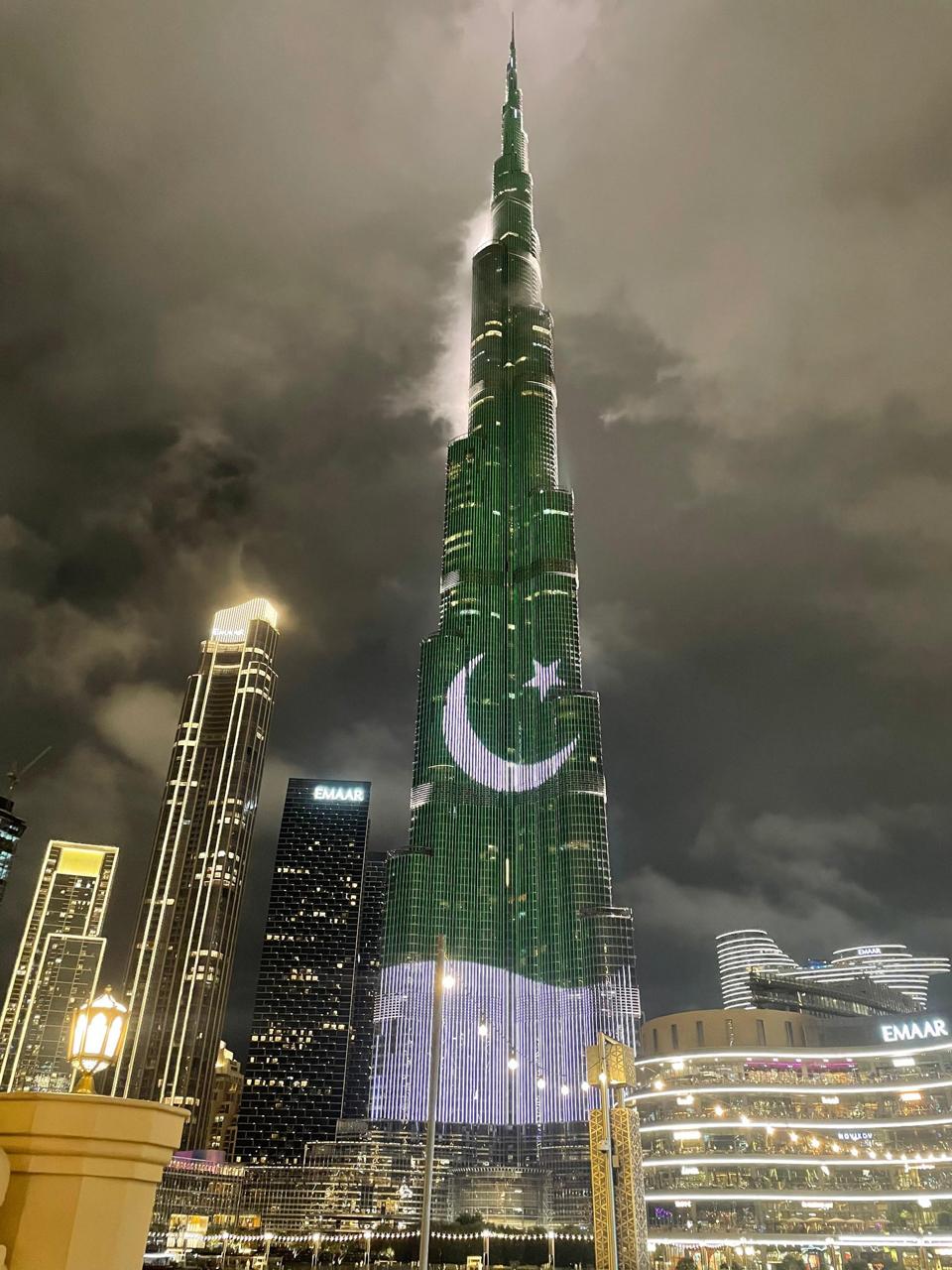
The visual evidence of this prestige is draped across the skylines of the world’s most iconic cities. From the Burj Khalifa in Dubai to the Al-Jaber Twin Towers in Lusail and the Heydar Aliyev Center in Baku, the green and white crescent and star have illuminated the globe. This is not merely a display of lights; it is a profound tribute from the international community to a “New Pakistan” that has successfully navigated the turbulent waters of global conflict without compromising its sovereignty. The gesture from Romania, providing a choral arrangement and official score of the Pakistani National Anthem for the first time in history, underscores a burgeoning soft power that now echoes through the halls of Europe. This cultural diplomacy, meticulously cultivated over the past few years, has finally introduced the world to the true, resilient, and progressive face of Pakistan.
Perhaps the most significant achievement of this era is Pakistan’s central role in averting a catastrophic conflict between the United States and Iran. International media outlets, including Reuters and the Financial Times, have confirmed that as the Middle East stood on the brink of an all-out war, Pakistan played the “masterstroke” that few saw coming. The recent telephonic conversation between Field Marshal Asim Munir and U.S. President Donald Trump served as the catalyst for a historic de-escalation. By coordinating with regional partners like Turkiye and Egypt, Pakistan facilitated separate but crucial negotiations between key figures such as Abbas Araghchi and Steve Witkoff. The immediate result was a five-day ceasefire that halted U.S. strikes, but the broader victory is Islamabad’s role as the host for the upcoming high-level peace talks this week. This is not just a diplomatic win; it is an affirmation of Pakistan as a “Global Peacemaker.” The calls from the people of Iran, Saudi Arabia, and other Arab nations to nominate Field Marshal Asim Munir for the Nobel Peace Prize are a testament to the fact that Pakistan is now seen as the region’s ultimate stabilizer—the hand that puts out fires rather than stokes them.
Under the leadership of Field Marshal Asim Munir, Pakistan has not only conquered the diplomatic front but has also redefined its regional security parameters with unprecedented clarity. The military leadership has ensured that the nation’s borders are not just defended, but respected. The enforcement of a ceasefire with India on Pakistani terms and the strategic management of the western border with Afghanistan have created a shield of stability. The bold decision to repatriate undocumented individuals and the “zero-tolerance” policy toward cross-border terrorism through operations like “Azm-e-Istehkam” have secured the internal fabric of the nation. By making it clear that the state’s writ is non-negotiable, Pakistan has sent a message to both regional spoilers and global observers: this is a nation that makes its own decisions, unswayed by external pressure or extremist threats. This “peace through strength” approach has forced adversaries to choose dialogue over confrontation, securing a period of relative calm that has allowed for national growth.
This security and diplomatic prowess is built upon a foundation of remarkable economic resilience. Only two years ago, various international agencies were predicting a sovereign default for Pakistan. Today, those same institutions are studying the “SIFC Model” (Special Investment Facilitation Council) as a blueprint for rapid economic recovery. Field Marshal Asim Munir’s direct involvement in creating a transparent, investment-friendly environment has unlocked billions of dollars in foreign direct investment from Saudi Arabia, the UAE, and Qatar. This is no longer “aid” or “loans”; it is strategic partnership based on trust. Pakistan is transitioning from a “begging bowl” economy to a regional “investment hub,” revitalizing sectors like agriculture, mining, and information technology. The Field Marshal has proven that a strong defense and a strong economy are two sides of the same coin, and he has worked tirelessly to ensure both are polished to a high sheen.
As we look at the Pakistan of March 2026, we see a nation that has reclaimed its destiny. From the corridors of power in Washington to the strategic circles in Tehran and the economic boardrooms in Beijing, there is a consensus: the path to peace in South Asia and the Middle East runs through Islamabad. Field Marshal Asim Munir has not only restored Pakistan’s lost prestige but has elevated it to a height never before seen in its history. Today’s Pakistan is a responsible nuclear power that knows how to fight for its survival and how to lead for global peace. It is the Pakistan envisioned by Allama Iqbal and realized by Quaid-e-Azam Muhammad Ali Jinnah—a state that stands tall, proud, and indispensable.
The success we celebrate today is the fruit of a cohesive vision, tireless labor, and a leadership that put the nation above all else. Field Marshal Asim Munir’s ability to unite the nation and create harmony between institutions while providing a clear strategic direction will be recorded in the golden pages of history. The dreams of those who waited for Pakistan’s collapse have withered away, replaced by the reality of a nation that is truly invincible. Pakistan has emerged as a decisive force in world affairs, and its flag flies higher than ever before. We take pride in our leadership, we take pride in our armed forces, and we take pride in this great state whose future is now undeniably bright and prosperous. From the streets of Islamabad to the podiums of the United Nations, the message is clear: Pakistan is here to lead, and the world is listening.
Pakistan Zindabad


