


By Maheen Sultan
Behind the optimistic presentation of the federal budget for Fiscal Year 2026-27 lies a deeply concerning economic reality for the citizens of Pakistan. While economic planners fill their speeches with celebrations of digital transformation, structural overhauls, and corporate tax cuts, a deeper look into the document reveals severe fiscal fault lines.
Tracking the immediate impact of economic policy on the ground, we must look past the glossy surface of state-issued statistics. A critical analysis of the budget figures shows that under the weight of fixed expenses, rising inequality, and a real-wage crisis, this budget risks worsening the cost-of-living crisis for the very citizens it claims to protect.
1. The real-wage paradox: Why a pay raise is actually a pay cut
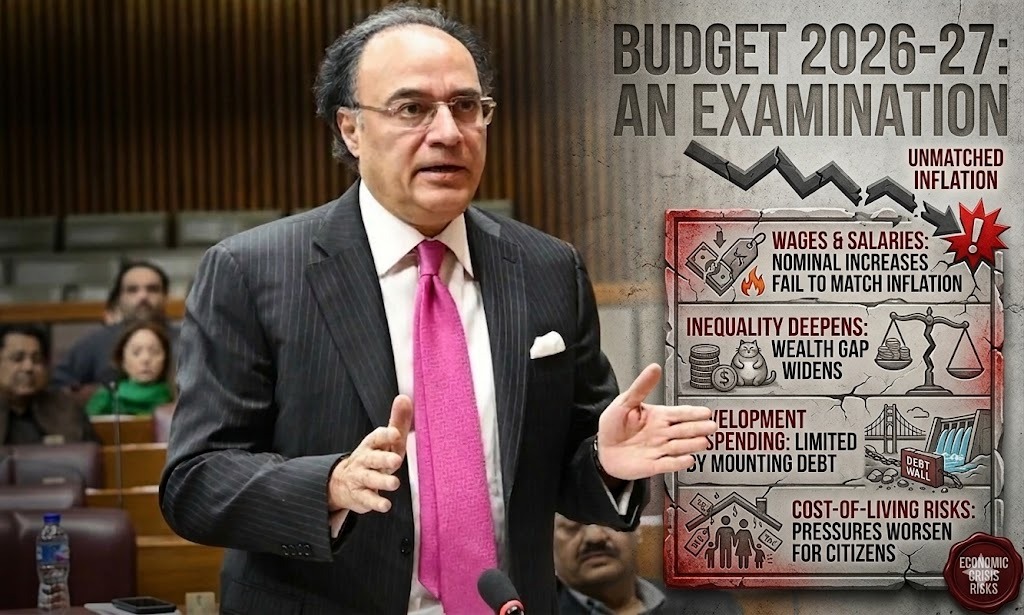
The government has prominently highlighted its direct public relief measures, pointing to a 7 percent salary increase for public sector workers and a 10 percent boost to the monthly minimum wage, which brings the baseline to PKR 40,700. In isolation, these look like protective steps. However, when contrasted with the government’s own macroeconomic forecasts, the math falls apart.
The budget officially projects an average inflation rate of 8.2 percent for the upcoming fiscal year. This creates a classic real-wage paradox:
• Public servants receiving a 7 percent raise are facing market prices climbing at 8.2 percent.
• This leaves them with a net loss in actual purchasing power.
Even the 10 percent minimum wage hike barely keeps pace with basic survival costs. For ordinary laborers and middle-class families already bruised by years of persistent inflation, this budget does not offer a ladder out of financial distress. Instead, it locks in a persistent financial struggle, proving that nominal wage increases mean very little when the state cannot contain the rising cost of everyday goods.
2. Plagued by inequality: The illusion of the ‘non-poor’ majority
To build a narrative of resilience, economic planners frequently reference national data showing that a substantial 71.1 percent majority of the population successfully lives above the national poverty line. But a journalist’s duty is to ask: What does life look like just above that line?
The answers are found in the survey data hidden within the report, which details a sharp rise in the national Gini coefficient from 28.4 to 32.7. In economic reporting, a rising Gini index is an explicit alarm bell signaling widening wealth disparities.
This statistic reveals a harsh truth: while over 71 percent of Pakistanis avoid absolute poverty, the wealth within this “non-poor” block is becoming heavily concentrated at the very top. The lower-middle class is not thriving; they are barely surviving. They are running on an economic treadmill—earning just enough to clear the official baseline of Rs 8,484 per month, but completely blocked from achieving genuine upward mobility or financial security. By ignoring this widening wealth gap, the budget fails to address the systematic economic division fracturing the country.
3. The burden of rigid expenditures: A stifled development blueprint
The most critical structural vulnerability of Budget 2026-27 is its complete lack of fiscal flexibility. A good national budget uses state revenue to fund public development, build hospitals, improve schools, and lower utility tariffs. Pakistan’s budget, however, is held hostage by its own past obligations. Out of an estimated total expenditure of PKR 18,771 billion, a staggering PKR 8,054 billion is entirely consumed by debt interest payments. This means nearly 43 percent of all available public money is gone before a single school is built or a single road is paved.This massive burden explains why the Public Sector Development Programme (PSDP) remains limited to just PKR 1,000 billion.
For economic analysts, Budget 2026-27 presents a stark warning. While its digital tax initiatives and market de-regulation models are highly sophisticated, they cannot mask the underlying stress being placed on everyday citizens. With fixed costs consuming the national treasury, inflation outpacing wage growth, and a widening wealth gap leaving the middle class behind, this financial plan runs the risk of stabilizing state spreadsheets at the direct expense of the average Pakistani household.


