


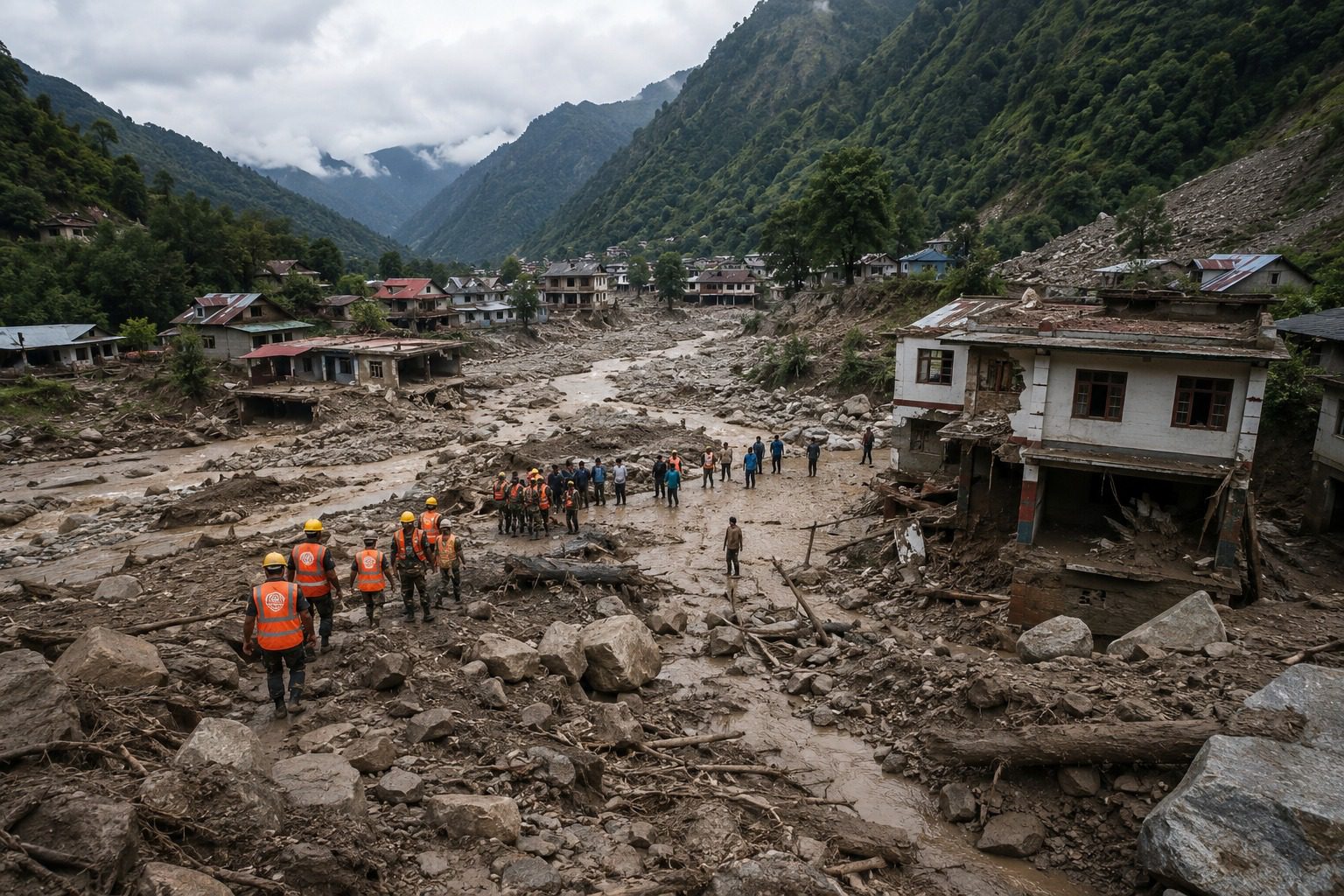
DEVIGHAT, Nepal (Web Desk) : Rescue teams raced against time on Thursday to find more than 1,300 people missing after devastating flash floods and mudslides tore through communities along the Nepal-China border, killing at least 353 people and causing widespread destruction.
The disaster struck after a glacier collapse sent a massive torrent of water, mud and debris through Himalayan valleys, sweeping away buildings, bridges and vehicles and leaving hundreds of families awaiting news of missing relatives.
Authorities said hundreds of people had been displaced, while damaged roads and destroyed bridges were severely hampering rescue operations in some of the worst-hit areas.
Helicopters deployed as roads and bridges destroyed
Nepalese authorities deployed helicopters to reach communities cut off by the disaster. The army said more than 100 people had been rescued from flood-hit areas, while people trapped at facilities connected to the Trishuli hydropower project were also evacuated.
Dozens of injured people were transported to Kathmandu for specialised medical treatment. Officials said dozens of bridges had been destroyed and nearly 40 kilometres of roads damaged in Nepal, making access to remote areas particularly difficult.
Rescue workers were also recovering bodies far downstream from the worst-hit communities, highlighting the extraordinary force of the floodwaters.
Around 1,200 people were reported displaced from at least three villages as relief agencies increasingly turned their attention to providing food, shelter and other emergency assistance.
Hundreds missing in Nepal and Tibet
At least 826 people were reported missing in Nepal, while authorities in Tibet reported hundreds more missing following mudslides and flooding near the border.
Gyirong Port, a key crossing between Nepal and China’s Tibet Autonomous Region, was among the severely affected areas. Thick layers of mud covered parts of the region, while roads leading to the crossing were damaged.
Authorities also warned of the danger of further landslides as rainfall continued.
A barrier lake created by the disaster was reported to be overflowing, raising concerns about further flooding if the natural blockage fails.
Foreign tourists and pilgrims among missing
The scale of the tragedy has taken on an international dimension, with hundreds of foreign nationals among those still unaccounted for.
Nepal’s tourism authorities reported 517 foreigners missing, including nationals from India, the United States, Britain, Ukraine, South Africa, Japan and several other countries.
Many may have been travelling through the region on pilgrimage to Mount Kailash in Tibet, a sacred destination for several religious traditions.
Indian authorities said hundreds of their citizens remained missing, while Chinese officials also reported Chinese nationals unaccounted for in Nepal.
Families gathered at rescue centres and helicopter landing sites, desperately waiting for information about relatives caught in the floods.
Glacier collapse suspected as trigger
Scientists believe a major glacier collapse triggered the disaster. The U.S. Geological Survey initially detected what appeared to be an earthquake near the Nepal-China border but later revised its assessment, identifying the seismic signal as a massive glacier collapse.
Experts at the International Centre for Integrated Mountain Development also said a glacier avalanche was the likely cause of the flash flood. The impact was dramatic. Scientists reported that the Trishuli River rose by as much as nine metres within about 30 minutes at one monitoring point.
The Himalayan region is particularly vulnerable to glacial floods, landslides and other extreme events. Scientists have repeatedly warned that rising temperatures are destabilising glaciers and increasing risks for communities living downstream.
International assistance begins
International humanitarian assistance has begun arriving as Nepal and China confront the enormous scale of the disaster.
The United Nations allocated $2 million in emergency funding to support medical care, clean water and temporary shelter for affected communities.
With more than 1,300 people still missing, rescue operations remain the immediate priority, while authorities are also preparing for a prolonged humanitarian response across devastated Himalayan communities.