


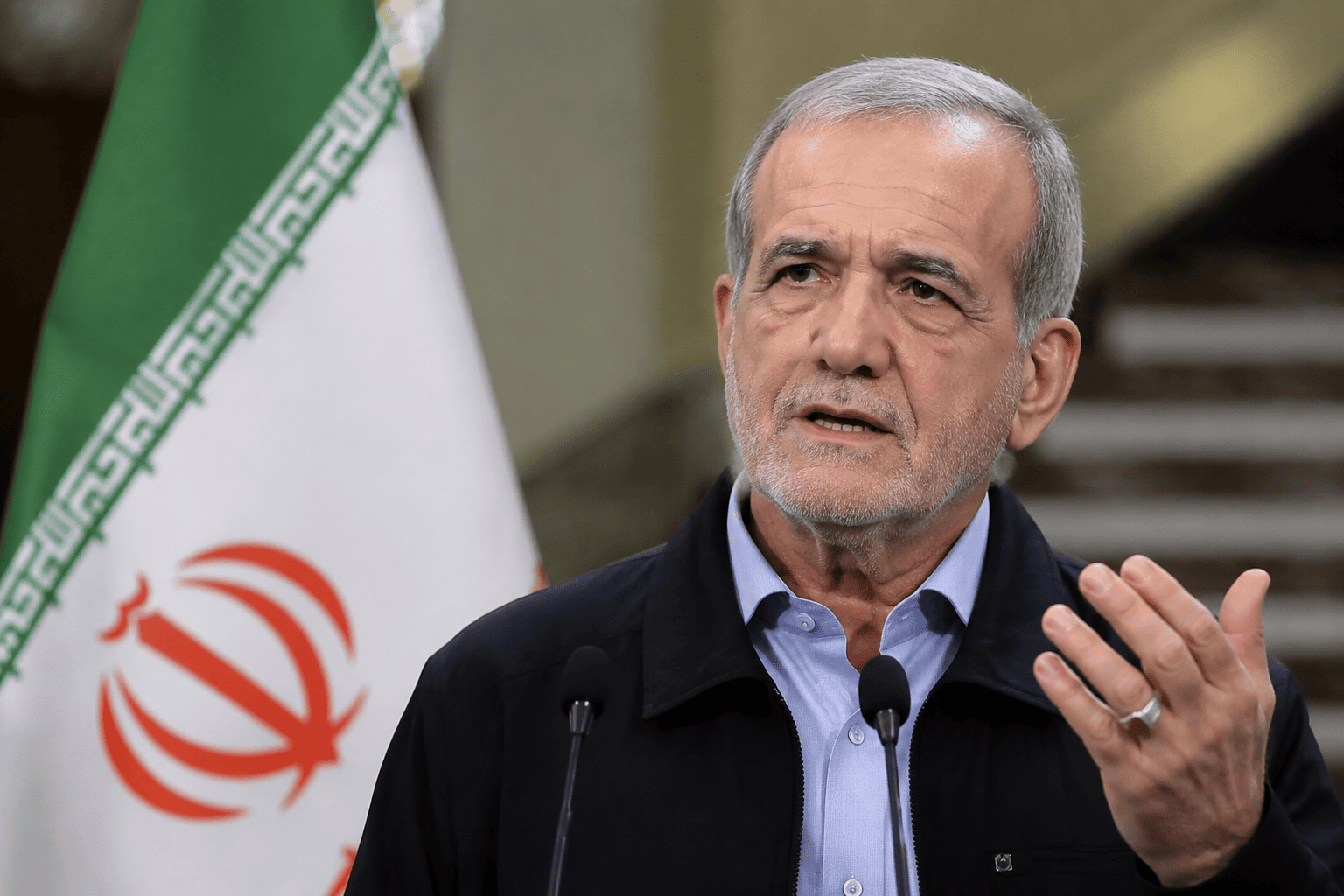
TEHRAN (Web Desk) – Iranian President Masoud Pezeshkian has firmly rejected the possibility of surrendering to external pressure, saying Iran remains determined to confront what he described as the United States’ “economic warfare” while maintaining national unity amid continuing regional tensions.
Pezeshkian said Washington’s economic pressure was aimed at creating divisions and discord among the Iranian people, according to reports carried by Iranian media.
“Should we give in to problems and surrender? Of course not,” the Iranian president said, stressing that the country should respond to economic challenges through unity, cooperation and resilience.
He called for greater mutual support and empathy within Iranian society and urged elites, academics and university scholars to play an active role in addressing social tensions and helping the country overcome economic difficulties.
His comments came as senior Iranian officials adopted a defiant tone over relations with the United States while simultaneously defending recent diplomatic engagement aimed at reducing tensions.
Pezeshkian defends Islamabad MoU with US
Pezeshkian also defended the Islamabad memorandum of understanding reached between Iran and the United States, rejecting suggestions that the agreement amounted to Iranian capitulation.
He said the agreement was reached on the basis of “logic and awareness” and reflected a calculated decision by Iran’s senior national security leadership.
According to Pezeshkian, a majority of Iran’s Supreme National Security Council supported the MoU after considering the principles of wisdom, dignity and national expediency.
His remarks indicate Tehran is attempting to balance resistance to US economic pressure with diplomatic efforts intended to prevent further escalation.
The Islamabad MoU has emerged as an important element of regional diplomacy, particularly as governments seek arrangements to restore stability around the strategically vital Strait of Hormuz.
Iranian parliament speaker predicts US defeat
Iranian Parliament Speaker Mohammad Bagher Ghalibaf also struck a strong tone, saying the United States would ultimately be defeated in what Tehran describes as an economic war.
Ghalibaf made the remarks during a meeting with the president of Iraq’s Supreme Judicial Council.
He claimed Washington would face defeat in the economic confrontation just as, in his assessment, it had failed to achieve its objectives against Iran in military and political conflicts.
The comments underline the Iranian leadership’s efforts to project confidence despite economic pressure and uncertainty surrounding regional security.
Iran asserts control over Strait of Hormuz
Meanwhile, Iranian lawmaker Ebrahim Rezaei said the Strait of Hormuz remained under Iran’s control and claimed that no military force could break Tehran’s will in the strategic waterway.
The Strait of Hormuz is one of the world’s most important maritime energy routes, connecting the Persian Gulf with the Gulf of Oman and the Arabian Sea. Any prolonged disruption to shipping through the waterway can have significant consequences for global oil supplies, freight costs and energy prices.
However, diplomatic efforts appear to be underway to facilitate safer navigation.
Omani Foreign Minister Sayyid Badr Albusaidi said discussions with his Iranian counterpart in Tehran had been “constructive” and expressed hope that a temporary corridor for the Strait of Hormuz would soon be announced.
He said practical arrangements were being considered to restore safe navigation, while discussions over the future management of the Strait and a permanent solution would follow.
According to the Omani foreign minister, consultations with regional partners would support peace, cooperation, stability and freedom of navigation.
Why the developments matter
The combination of Iran’s tough political rhetoric and diplomatic negotiations suggests Tehran is pursuing a two-track approach: resisting US economic and strategic pressure publicly while keeping channels open for agreements capable of reducing regional tensions.
Progress on a temporary Strait of Hormuz corridor could be particularly significant for international markets because disruptions to shipping through the waterway can increase concerns over energy supplies and push transportation and insurance costs higher.
For Pakistan, developments surrounding the Iran-US Islamabad MoU and the Strait of Hormuz carry particular importance. Pakistan depends heavily on imported energy, meaning prolonged instability in the Gulf or sharp increases in international oil prices could add pressure to fuel prices, inflation and the country’s import bill.
The coming days are therefore likely to focus on whether diplomatic discussions produce practical arrangements for safe navigation through the Strait while Iran and the United States attempt to manage their broader political and economic confrontation.