


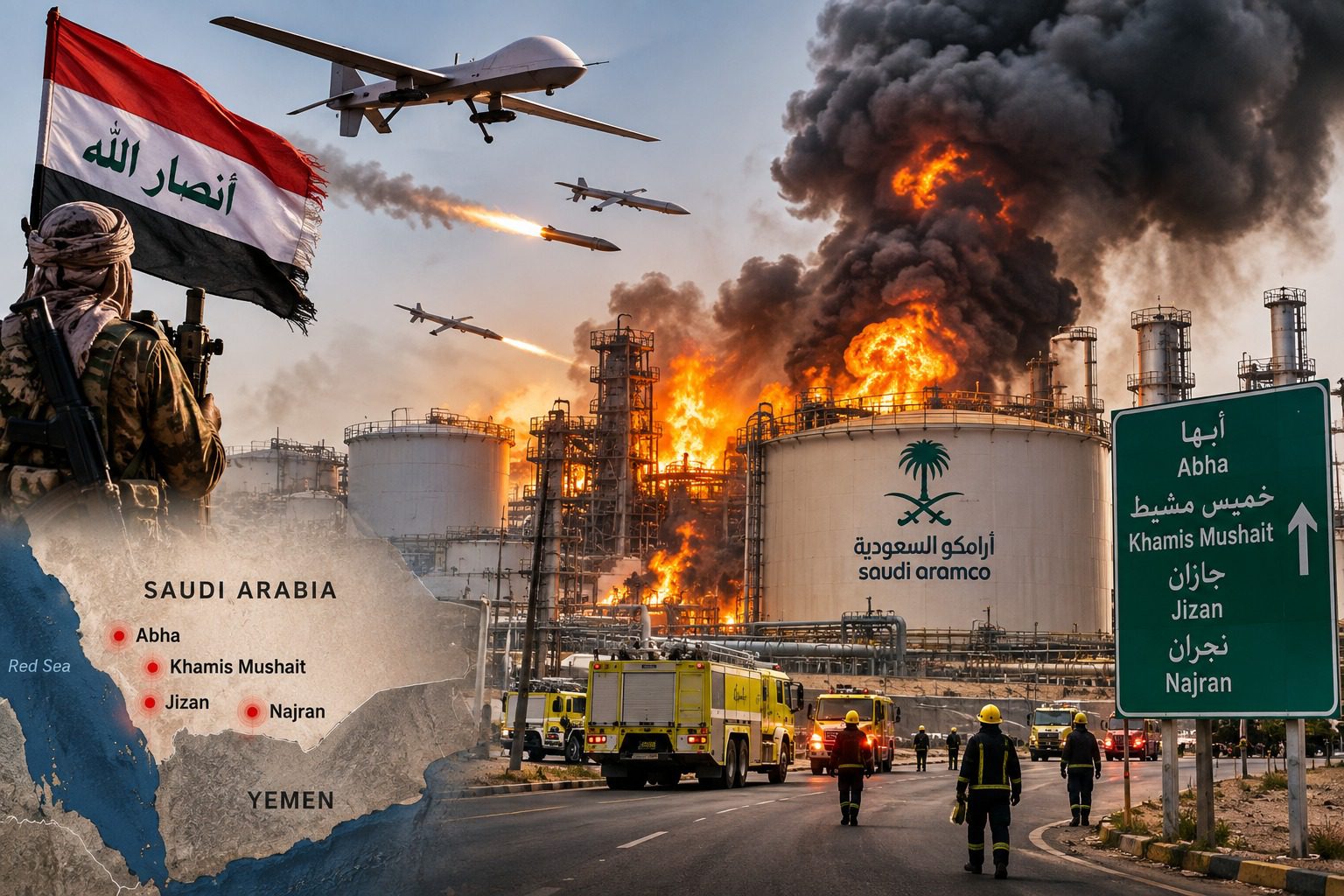
RIYADH (Web Desk) – Yemen’s Houthis launched a major wave of missile and drone attacks on Saudi Arabia on Tuesday, striking energy and civilian sites across the kingdom’s south, wounding at least 73 people and triggering fires that temporarily disrupted operations at some facilities, Saudi authorities said. Reuters
The attacks targeted sites in Abha, Khamis Mushait, Jizan and Najran, according to the Saudi-led coalition fighting in Yemen. Coalition spokesperson Maj. Gen. Turki al-Maliki said women and children were among those injured, describing the strikes as a “dangerous escalation.” Al Jazeera
Saudi Arabia’s Energy Ministry said fires broke out at energy facilities in the southern region following the attacks. Emergency and firefighting teams were deployed to contain the blazes, secure affected sites and assess the extent of the damage. Reuters
Operations at some targeted facilities were temporarily halted, although Saudi authorities said measures were being taken to ensure the safety of workers and allow operations to continue under approved plans. No overall assessment of the impact on Saudi oil production was immediately announced. CNA
Houthis claim large-scale missile and drone operation
Houthi military spokesperson Yahya Saree later claimed responsibility for what the group described as a large-scale military operation involving dozens of ballistic missiles and drones.
Saree said the operation targeted Aramco facilities in Abha, Najran and Jizan, as well as the Khamis Mushait Air Base. The Houthis claimed their strikes caused extensive damage, but the full extent of those claims could not immediately be independently verified. Reuters Connect
The Houthis said the attacks were retaliation for recent Saudi military operations in Yemen. Saree accused Saudi forces of carrying out more than 100 strikes over three days across several Yemeni provinces and vowed that Houthi operations inside Saudi territory would continue. Those casualty and strike claims require independent verification. Reuters Connect
Saudi coalition warns of firm response
Saudi Arabia strongly condemned the attacks on what it described as civilian and economic targets.
Al-Maliki said the Saudi-led coalition would take necessary operational measures to deter the Houthis and confront further threats, raising the possibility of another round of military retaliation between the two sides. The latest escalation follows renewed fighting in Yemen after years in which a relative truce had sharply reduced direct Houthi-Saudi hostilities.
The Houthis control Yemen’s capital, Sanaa, and much of the country’s north and most populous areas. The Saudi-led coalition intervened in Yemen in 2015 in support of the internationally recognised government after the Houthis seized Sanaa.
Recent fighting has intensified on several fronts, with Saudi-backed Yemeni government forces reporting advances in areas including Hodeida, Taiz and Baydah, while the Houthis have stepped up attacks on Saudi interests.
Oil prices jump after attacks
The strikes also had an immediate impact on international energy markets.
Brent crude climbed as high as $99.46 per barrel on Tuesday, its highest level since July 24, before easing to around $98.39. US West Texas Intermediate crude reached as high as $94.73 per barrel, its strongest level since June 8. Reuters
Saudi Arabia is one of the world’s most important oil exporters, meaning attacks on its energy infrastructure can quickly heighten concerns about global supply.
Those concerns are particularly acute because the latest Saudi attacks come amid wider disruption to Middle Eastern energy and shipping routes.
Wider Middle East conflict raises supply fears
The Houthi strikes come as tensions involving Iran, the United States and regional states continue to threaten energy infrastructure and maritime trade.
Iran has recently warned that energy facilities across the Gulf could become vulnerable as its confrontation with Washington intensifies. At the same time, restrictions and military activity around the Strait of Hormuz, through which a significant share of global petroleum supplies normally moves, have already heightened market uncertainty.
The Houthis have also targeted vessels in the Red Sea since declaring a naval blockade against Saudi Arabia in July, further increasing concerns over shipping security and energy transportation. Reuters
Tuesday’s attacks therefore represent more than another episode in the long-running Yemen conflict. Strikes on Saudi energy infrastructure, combined with tensions around Hormuz and the Red Sea, increase the risk that regional hostilities could disrupt global oil supplies and push energy prices higher.
For now, Saudi emergency teams are assessing damage at the affected facilities, while the coalition’s warning of a firm response and the Houthis’ pledge to continue attacks leave the region facing the possibility of further escalation.


