


Dr Alamdar Hussain Malik
There could hardly be a more painful illustration of Pakistan’s misplaced priorities than the decision taken by the Economic Coordination Committee (ECC) of the Cabinet on September 7, 2026, at the Finance Division in Islamabad, under the chairmanship of Finance Minister Muhammad Aurangzeb, to approve a Technical Supplementary Grant of Rs6.6 billion for the purchase of 30 bullet-proof vehicles for the movement of Heads of State during the Shanghai Cooperation Organisation (SCO) Summit, which Pakistan is scheduled to host in September 2027. The Cabinet Division had initially sought Rs12.6 billion for the purchase of more than 50 bullet-proof vehicles, but after deliberation the ECC approved Rs6.6 billion for 30 vehicles and directed the Cabinet Division to undertake an in-depth assessment before seeking any additional funds.
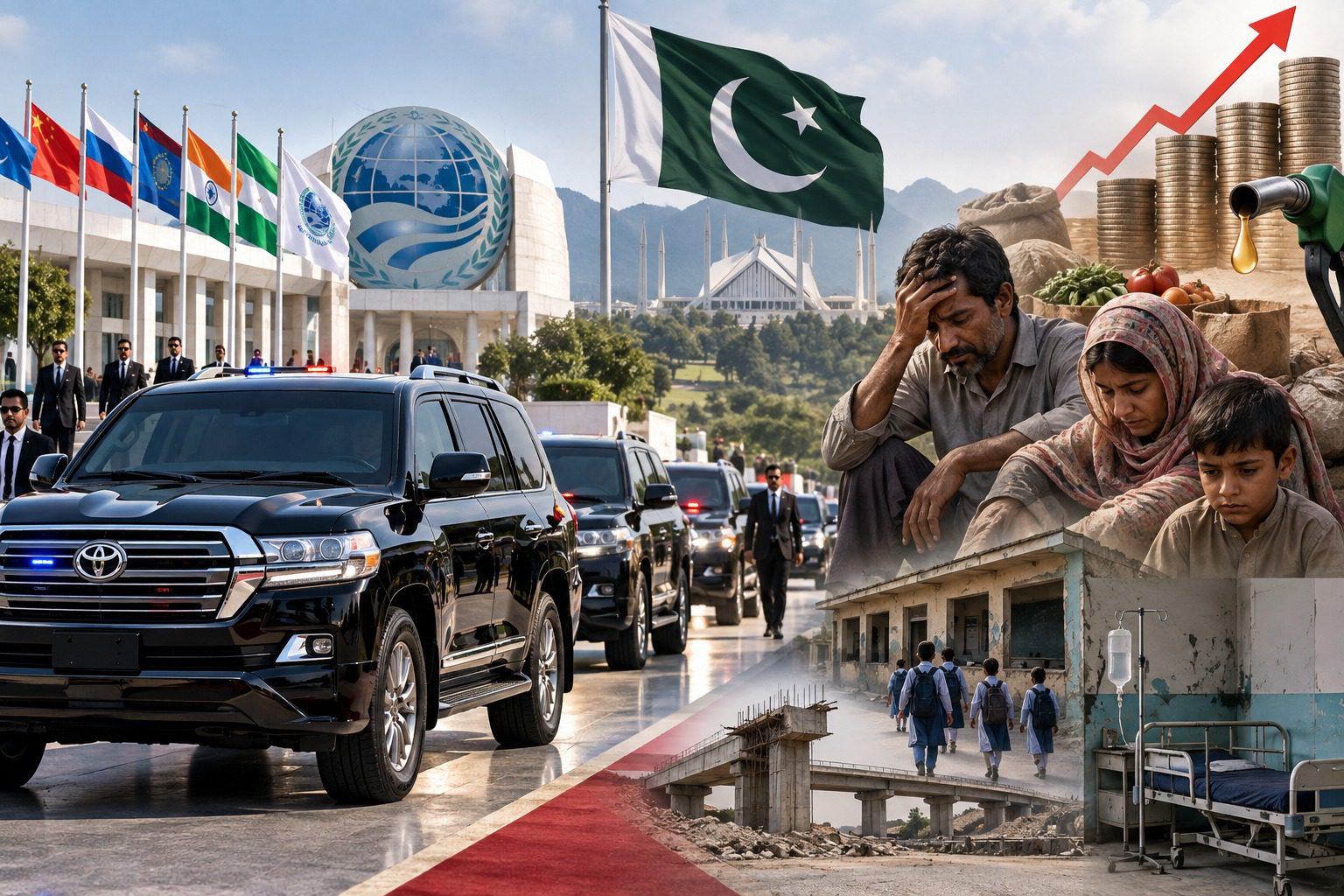
A country struggling under crushing debt, fiscal deficits, unemployment, inflation and deteriorating public services is preparing to spend billions on vehicles that will carry powerful people in safety and comfort. At the same time, millions of ordinary Pakistanis cannot afford quality healthcare, education, nutritious food or even a decent roof over their heads.
This is not simply a story about cars. It is a story about the mindset and priorities of the state. The government can legitimately argue that the security of visiting Heads of State is a national obligation. Pakistan must provide adequate security to foreign dignitaries, and no responsible citizen would object to that. But security is one thing; extravagance is another.
The approved amount works out to approximately Rs220 million per vehicle. That figure alone demands serious public scrutiny. Is purchasing 30 such vehicles really the most economical and responsible way for a financially distressed country to host an international summit?
Could the vehicles not be hired or leased for the duration of the summit? Could some existing government vehicles be upgraded where technically feasible? Could the security and transport requirements have been met through a smaller fleet or another cost-effective arrangement?
These are not questions against national security. They are questions about financial prudence and public accountability. The fact that the Cabinet Division initially sought Rs12.6 billion and the ECC subsequently reduced the approval to Rs6.6 billion makes the matter even more worthy of examination. If a substantially smaller requirement could satisfy the committee after deliberation, then the public deserves to know why such a large demand was presented in the first place.
Pakistan’s financial crisis is not theoretical. The state struggles to finance development, public services and essential institutions. Every budget cycle brings demands for higher taxation, additional borrowing and expenditure cuts. Citizens are repeatedly told that the country cannot afford subsidies, cannot afford development projects and cannot afford increased public spending.
Yet billions can apparently be found for a fleet of highly expensive vehicles.
This is where the issue becomes much larger than the SCO Summit. There is inadequate funding for universities and research institutions. Hospitals struggle to provide quality healthcare. Agricultural research remains under-resourced. Modern laboratories are badly needed. Veterinary services require strengthening. Farmers face escalating production costs. Young graduates confront unemployment and limited opportunities. Water management, food security and export-oriented agriculture require urgent investment. These are not luxuries. They are the foundations of a productive economy.
If Pakistan wants to escape its debt trap, every rupee of public expenditure must be judged against its economic and social return. A bullet-proof vehicle may be necessary for a particular security requirement, but the government must demonstrate why purchase rather than temporary hiring or leasing represents the best use of scarce public resources.
There is another question that cannot be ignored: what happens to these vehicles after the summit? Will they be auctioned? Will they remain in the government fleet? Which officials will use them? What will their annual maintenance, insurance, security and operational costs be? Will another budget allocation eventually be required for their replacement?
A responsible financial decision cannot end with procurement. The entire life-cycle cost must be considered. Pakistan has already spent decades building an expensive culture around official vehicles, protocol, fuel, maintenance and VIP facilities.
Every new government inherits a large fleet, yet new vehicles continue to be justified on one ground or another. Where does this cycle end? The deeper problem is the emergence of what can only be described as selective austerity. The ordinary citizen is told to tighten his or her belt. The salaried class faces higher taxation. Businesses face additional levies. Farmers pay more for electricity, fertiliser, seed, pesticides and other inputs. Consumers face rising electricity and fuel bills. Parents struggle to meet education expenses. Young people search for jobs in an increasingly difficult labour market.
Meanwhile, the state continues to find fiscal space for expensive official facilities.
This sends a deeply damaging message.
A citizen standing in a government hospital without adequate medicines does not see the same state that appears capable of allocating hundreds of millions of rupees per vehicle for VIP transport. A farmer who cannot obtain timely agricultural support does not understand why billions can be mobilised for official vehicles. A graduate unable to find employment naturally asks why national resources are not being directed towards productive investment.
This is not merely an accounting issue. It is an issue of public trust. A genuinely reform-minded government should establish a simple principle: no non-essential luxury expenditure should be approved unless the state can demonstrate that no cheaper and equally effective alternative exists. That principle should apply particularly to official vehicles.
Pakistan’s international guests should certainly be treated with dignity and protected with the highest reasonable security standards. But national dignity does not require unnecessary extravagance.
The real question should be: How can Pakistan host the SCO Summit safely, professionally and with international standards while imposing the minimum possible burden on the national exchequer?
That should be the benchmark. Pakistan’s prestige will not be enhanced by the number of bullet-proof cars parked outside a summit venue. Its real prestige will come when foreign investors see a productive economy; when farmers produce for global markets; when universities generate innovation; when hospitals provide quality treatment; when young people find employment; and when Pakistan can finance its development without repeatedly returning to international lenders for financial support.
We must therefore stop confusing VIP comfort with national development.
The government should make public the complete justification for this expenditure, the procurement mechanism, technical specifications, per-unit cost, security assessment, expected maintenance expenditure and the utilisation plan for these vehicles after the SCO Summit.
Parliament should also examine whether purchasing these vehicles is genuinely more economical than hiring or leasing them for the event.
The ECC has already required the Cabinet Division to undertake an in-depth need analysis before seeking any additional requirement. That requirement should be treated not as a bureaucratic formality but as an opportunity for genuine financial scrutiny.
Pakistan is not a rich country temporarily experiencing a financial problem. It is a country where financial problems have become structural while sections of the state continue to maintain the spending habits of a much wealthier country.
That is the real issue. Thirty bullet-proof cars may protect a few dignitaries from bullets, but they cannot protect Pakistan from bankruptcy. Only responsible governance, disciplined public spending and correct national priorities can do that.
And if billions can be found for bullet-proof cars while essential sectors continue begging for funds, then perhaps it is not Pakistan’s treasury that has run out of money. It is Pakistan’s priorities that have run out of direction.
The writer is Advisor Academics, University of Veterinary and Animal Sciences (UVAS), Swat and Former Financial Adviser, Finance Division, Government of Pakistan


