


By Asim Shahzad
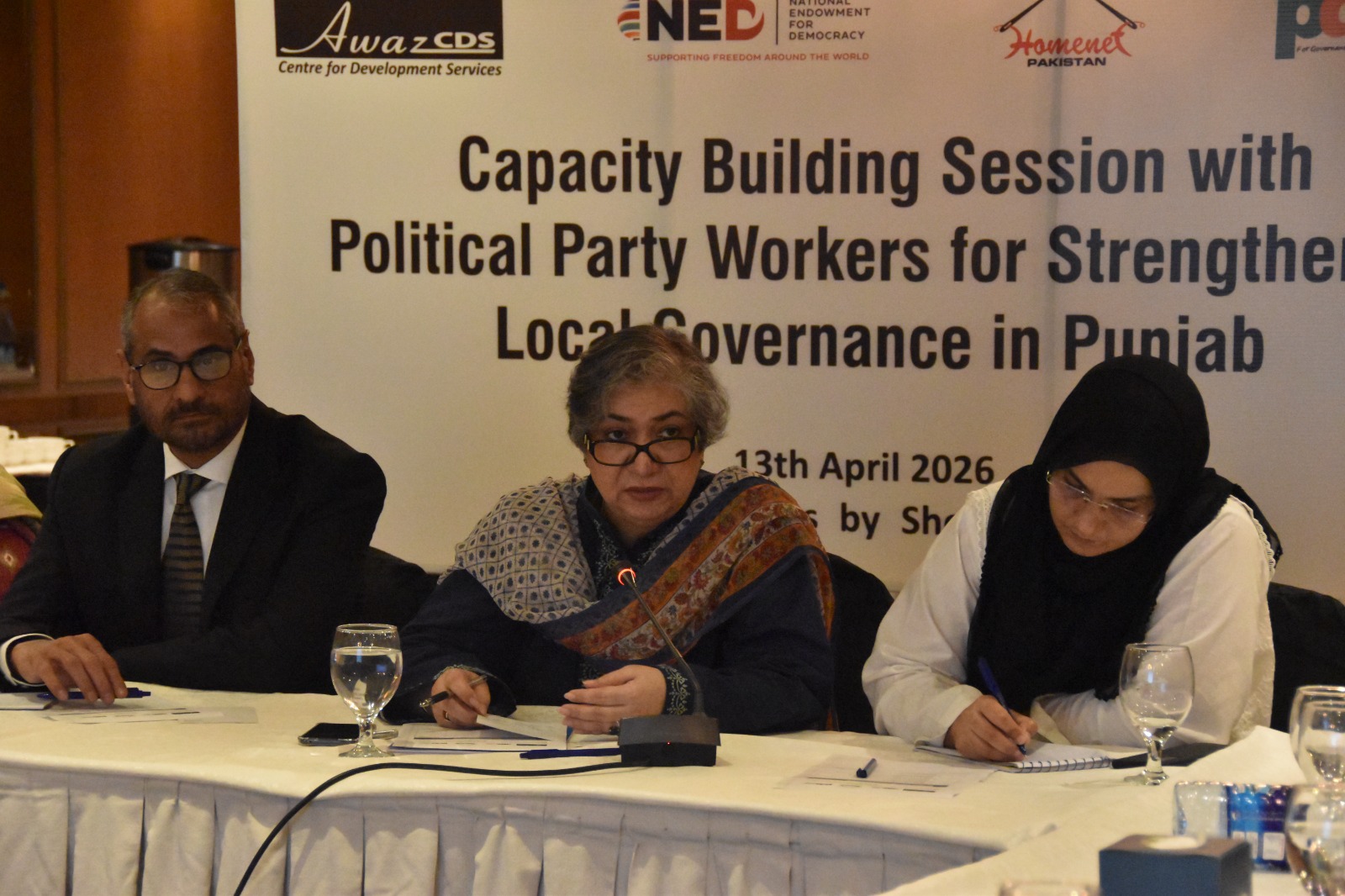
LAHORE: The HomeNet Pakistan (HNP), in collaboration with AwazCDS-Center for Development Services and Pakistan Development Alliance (PDA), organized a capacity building session on “Strengthening Local Government in Punjab” at Lahore.
Read also: HomeNet Pakistan urges accelerated local govt reforms in Punjab
The session has organized in response to a critical gap identified among political party workers, many of whom lacked clarity on local governance systems and had limited awareness of their own party manifestos related to local government. To address this, the session focused on building practical understanding and strengthening participants’ ability to engage meaningfully on the issue.
Participants, including political party representatives and workers, actively engaged in discussions on the structure, evolution, and significance of local governments in Pakistan. The session also covered constitutional provisions, institutional frameworks, and advocacy approaches, enabling participants to better understand their role in promoting accountable and effective local governance.
A key focus of the session was Article 140 A of the Constitution of Pakistan, which mandates the devolution of political, administrative, and financial powers to elected local governments. Speakers highlighted that despite this constitutional requirement, its effective implementation remains a challenge, particularly in Islamabad.
Ms. Ume Laila Azhar, Executive Director, HNP, stated, “Strengthening local governments is fundamental to deepening democracy and ensuring that governance remains responsive, inclusive, and rooted in the needs of citizens at the grassroots level. Local governments serve as the first point of contact between the state and citizens, and their effectiveness directly impacts service delivery, transparency, and public trust.
She further emphasized that political party workers play a pivotal role in shaping governance outcomes and must be equipped with both knowledge and practical tools to advocate for effective local government systems. “There is a pressing need to bridge the gap between constitutional commitments and their implementation. Initiatives like this are designed to build informed political actors who can actively contribute to participatory governance, demand accountability, and support timely local government elections as envisioned in the Constitution.”
Mr. Zia Ur Rehman, Chief Executive AwazCDS, highlighted critical constitutional concerns, stating, “Under Article 7 of the Constitution, the absence of a fully functional third tier of government undermines the spirit of democratic governance. Strengthening local governments is essential to ensure inclusive decision making and improved service delivery.”
The session also featured a detailed briefing by Mr. Anwar Hussain, Expert on Local Governance, on the current Local Government Act, providing participants with a clearer understanding of the legal and operational framework governing local bodies.
Through interactive discussions and group reflections, participants identified gaps in awareness, policy alignment, and implementation. The session concluded with a strong collective demand from political party workers from Riffat Nawaz PMLN, Rao Khalid Khan PPP, Mehboob Irshad & Ch Pervez Cheena PTI, Abdul Hannan MML, Ch Akhtar Abbas, Nasir Iqbal & Maqsood Khan Pakistan Democratic Alliance, and other civil society for timely local government elections, the completion of their full tenure, and a reduction in the gap between successive election cycles. The participants were of view that G election should by conducted as government conduct the Senate Elections. Participants appreciated the initiative of multi-party in a one platform and also propose to approach Election commission or may have a meeting with EC for early elections of LG. All the representatives of political parties appreciated the todays capacity building event
Representatives from HNP, AwazCDS, and PDA reaffirmed their commitment to continuing such initiatives to strengthen civic awareness, enhance political engagement, and promote a more accountable and participatory governance system in Pakistan.


