


By Asim Shahzad
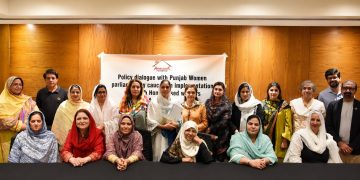
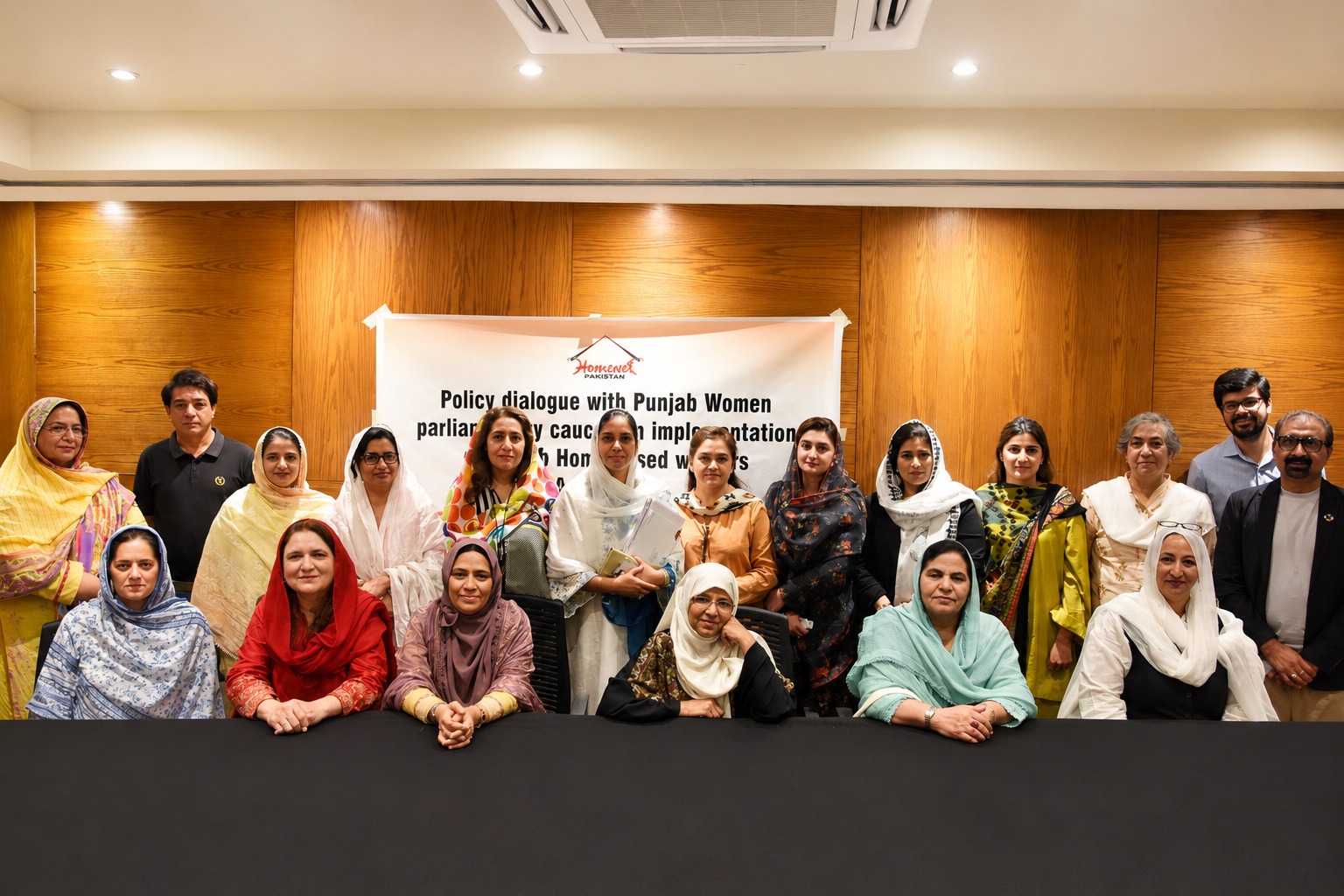
LAHORE: HomeNet Pakistan organized a policy dialogue with women parliamentarians, Members of Provincial Assemblies (MPAs), standing committee members, policymakers, civil society representatives, media representatives, and members of the Women’s Caucus to discuss implementation mechanisms for the Punjab Home-Based Workers (HBWs) Act 2023 at the provincial level.
The meeting highlighted the critical contribution of Home-Based Workers, particularly women workers, to Pakistan’s informal economy through sectors including garments, embroidery, handicrafts, stitching, food processing, and other livelihood activities. Despite their significant economic role, millions of HBWs remain invisible in labour statistics and excluded from social protection, health schemes, labour rights, and financial inclusion mechanisms.
Participants shared evidence from Punjab and national studies indicating that Pakistan has an estimated 4.4 million Home-Based Workers (HBWs), of whom approximately 3.6 million are women. Informal estimates suggest that the actual number may exceed 12 million women workers nationwide. Studies further indicate that HBWs contribute nearly PKR 400 billion to Pakistan’s economy, accounting for approximately 3.8% of the national GDP; however, their economic contribution remains largely unrecognized and undocumented. Participants also noted that while the officially recorded female labour force participation rate stands at 22.7%, the figure could rise to nearly 45% if women’s informal and home-based work were properly documented.
Mr. Zia ur Rehman, Executive Director of AWAZ CDS, highlighted that under Multidimensional Poverty Index-related support initiatives, the Government of Punjab had previously provided stipends of PKR 1,000 for school-going girls through the “Zewar-e-Taleem” programme, implemented under a funding scheme worth PKR 6 million. He noted that following the discontinuation of the programme, school dropout rates increased significantly. He urged women Members of Parliament (MPs) to advocate for the revival of the initiative.
The discussion further emphasized that although all four provinces have enacted legislation for Home-Based Workers, implementation remains weak due to inadequate budget allocations, limited institutional coordination, weak registration systems, and insufficient engagement of local governments and labour departments.
Safia Saeed, Shagufta Faisal, and Uzma Kardar, MPAs, noted that most women workers are employed on low piece-rate wages and continue to live below the poverty line. Only a small percentage of HBWs possess formal contracts. Women workers also face workplace harassment, exploitation by middlemen, and a lack of collective bargaining mechanisms.
Amna Parveen and Farzana Abbas, MPAs, observed that HBWs continue to face exclusion from social security, health insurance, pensions, maternity benefits, and labour welfare schemes. Occupational health and safety protections for HBWs also remain largely absent.
The meeting further highlighted that Punjab’s legal framework recognizes homes as workplaces for HBWs, which is considered a progressive step toward the formal recognition of informal workers. However, implementation mechanisms at district and local government levels remain slow and under-resourced.
HomeNet Pakistan urged provincial governments and MPAs to ensure dedicated budget allocations for HBWs registration systems , Social security and health protection schemes, Labour welfare programmes, Skills development and market access initiatives, Gender-responsive economic empowerment programmes for women workers
Concerns were also raised regarding increasing poverty, climate disasters, economic shocks, school dropouts, and child labour, which continue to push women and children into vulnerable and exploitative informal work arrangements.
During the deliberations, Somia Atta and Syeda Samreen Taj, MPAs, emphasized that although all four provinces have enacted HBWs legislation and policy frameworks, implementation remains weak due to inadequate budget allocations, limited institutional coordination, weak registration systems, and insufficient engagement of local governments and labour institutions.
Ms. Ume Laila Azhar, Executive Director of HomeNet Pakistan, stressed the urgent need for practical implementation mechanisms, district-level registration systems, and the inclusion of HBWs in provincial labour planning and social protection frameworks. Concerns were also raised over underutilized budgets allocated for HBWs welfare in Sindh and the absence of effective monitoring and accountability mechanisms.
Discussions led by Shagufta Faisal and Uzma Kardar further highlighted the challenges faced by women workers in the informal sector, including low piece-rate wages, lack of written contracts, occupational health and safety risks, workplace harassment, exclusion from labour protections, and limited access to healthcare and social security schemes.
Somia Atta, Mumtaz Begum, and Fatima Begum, MPAs, noted that poverty, climate disasters, economic shocks, and increasing school dropout rates are further pushing vulnerable women and children into exploitative informal labour conditions. The need for evidence-based policy planning and improved national and provincial data systems for informal workers was strongly emphasized.
Speaking on the occasion, Ms. Ume Laila Azhar, Executive Director of HomeNet Pakistan, stated that Home-Based Workers are a major pillar of Pakistan’s economy and must be recognized as part of the formal workforce. She emphasized that women HBWs continue to contribute significantly to household incomes and national productivity while remaining excluded from labour rights, social security, and health protection systems.
Ms. Ume Laila Azhar called upon provincial governments, labour departments, and parliamentarians to ensure dedicated budget allocations for HBWs welfare, social security, health insurance, and economic empowerment initiatives. She stressed that policy implementation must move beyond legislation and translate into practical institutional mechanisms that directly benefit workers at the grassroots level.
She further emphasized the importance of utilizing existing national data and strengthening coordination among labour departments, the Women Development Department, NADRA, EOBI, social welfare institutions, Women’s Caucus members, and civil society organizations instead of duplicating efforts and resources. She also shared that 34,000 domestic workers have been registered; however, access to social security benefits remains slow and weak due to procedural gaps.
HomeNet Pakistan reiterated its commitment to continuing advocacy, policy dialogue, and collective action for the recognition, protection, and empowerment of Home-Based Workers across Pakistan and urged all stakeholders to work collectively towards inclusive labour governance, gender equality, and decent work for informal workers.