


By Muhammad Mohsin Iqbal
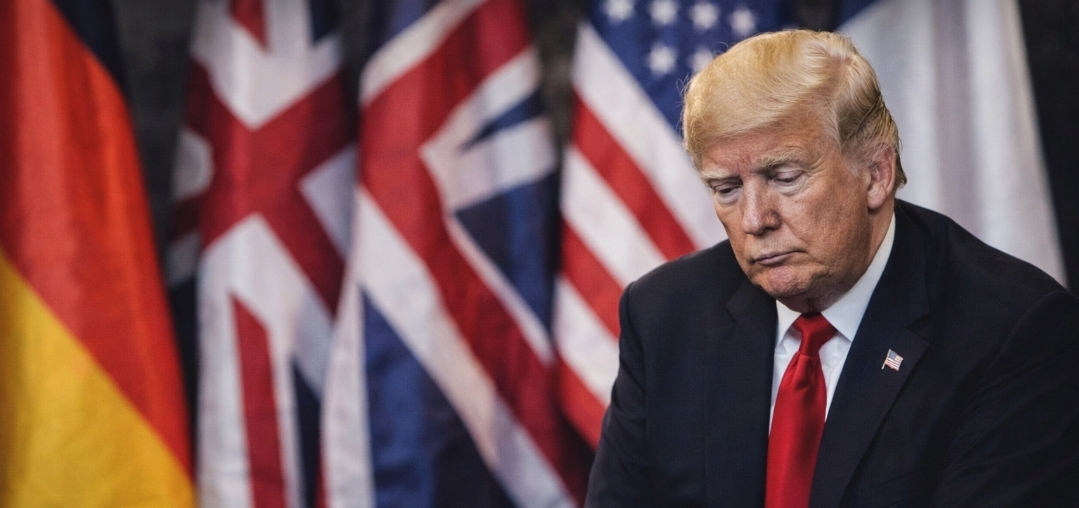
The spectacle of power, when divorced from prudence, often descends into isolation. In the contemporary theatre of international politics, the United States remains a formidable actor, yet its present leadership appears increasingly estranged from the very alliances that once amplified its influence. America may not be alone, but its president stands out in solitude. The distinction is neither rhetorical nor trivial; it reflects a growing divergence between the enduring strength of a nation and the faltering credibility of its leadership.
The erratic cadence of policymaking—decisions announced with flourish only to be revised or contradicted in after-hours pronouncements—has unsettled even the most steadfast allies. Diplomacy thrives on consistency, on the assurance that commitments made today will endure tomorrow. When policy becomes a moving target, trust erodes, and with it the delicate architecture of alliances. This erosion is not confined to transient political discomfort; it strikes at the very reputation of the United States as a reliable partner. Reputations in international affairs are not easily repaired. They are built over decades and can be diminished within moments of impulsive governance.
Historians and scholars of international relations will, in due course, examine this period with particular scrutiny. They will ask why a leader, presiding over one of the most powerful nations in history, found himself rebuffed and even disregarded by traditional allies. The answer lies not merely in policy disagreements, but in the manner in which those policies were conceived and pursued. The paradox is striking: a leader projecting strength abroad while simultaneously diminishing the confidence of those whose cooperation is indispensable.
The pursuit of accolades, notably the aspiration for the Nobel Peace Prize, further illustrates this contradiction. Peace is seldom the product of ambition for recognition; it is the outcome of restraint, patience, and a measured understanding of global complexities. When the quest for such honours appears intertwined with aggressive posturing, it invites scepticism rather than admiration. The dissonance between declared intentions and observable actions becomes too stark to ignore.
Equally disconcerting are the expansive ambitions that have surfaced in recent discourse. The notion of acquiring territories such as Greenland, or orchestrating the apprehension of foreign leaders and bringing them to the United States to assert control over their national resources, reflects a worldview more attuned to coercion than cooperation. Such propositions, even when framed as strategic considerations, resonate poorly in a world increasingly conscious of sovereignty and international law. They evoke an era many believed had been consigned to history, thereby alienating partners who view such ambitions as destabilising.
Compounding this unease are the controversies that have cast long shadows over the credibility of leadership itself. The appearance of Trump’s name in the Epstein files, and the perception—rightly or wrongly—of vulnerability to external pressure or blackmail, particularly in relation to Israel, has further deepened mistrust among allies. In international politics, perception often carries as much weight as reality; even the suggestion of compromised autonomy is sufficient to erode confidence. Allies are less inclined to follow a leader whose decisions may be influenced by factors beyond transparent statecraft.
Simultaneously, a moral and political re-evaluation is unfolding within allied countries. The reported letter by British lawmakers to their Prime Minister, expressing regret over Britain’s historical role in the establishment of Israel, is indicative of a broader shift in perspective. It reflects an awakening conscience that questions long-held policies and their consequences. Within this evolving context, actions perceived as endorsing or facilitating aggression—particularly in relation to Iran—have intensified discomfort among Western partners. The convergence of these sentiments has further distanced them from American policy under its current leadership.
The ongoing tensions involving Iran have thus become a focal point of divergence. While the United States has sought to exert pressure and, at times, adopt a confrontational posture, key allies have exhibited marked reluctance to align themselves with such an approach. This reluctance is not merely tactical; it stems from a fundamental disagreement over both the necessity and the morality of the course being pursued. When alliances falter in moments of crisis, it is often because the underlying trust has already been compromised.
The internal dissent within the United States adds another layer of complexity. The resignation of a senior official, who publicly questioned the justification for military action and asserted that no imminent threat existed, is emblematic of a broader disquiet within the administration itself. Such acts of protest are not routine bureaucratic occurrences; they are signals of profound disagreement at the highest levels of governance. When those entrusted with national security express dissent, it inevitably reverberates beyond domestic borders, further eroding international confidence.
Moreover, the economic ramifications of these policies cannot be overlooked. The prospect of disrupted oil supplies and the consequent pressure on global markets has alarmed not only adversaries but allies as well. Energy security remains a shared concern, and actions that jeopardise it tend to isolate rather than unite. The burden of such policies, both financial and strategic, ultimately falls upon the very nation that seeks to assert its dominance.
Perhaps most telling is the waning willingness of allied nations to commit their military resources. Armies are not instruments to be deployed at the behest of another’s ambitions without clear purpose or shared conviction. The hesitation of allied forces reflects a rational calculus: that participation in a conflict lacking coherent objectives or legitimacy carries risks disproportionate to any potential gains. This reluctance, in turn, affects the morale of the American military, which draws strength not only from its capabilities but also from the solidarity of its partners.
In the final analysis, the present moment serves as a cautionary tale about the limits of unilateralism. Power, when exercised without regard for partnership, becomes self-defeating. The United States retains immense capacity, but its effectiveness is intrinsically linked to the trust and cooperation of its allies. When that trust is undermined, even the greatest power finds itself diminished.
America endures, as it has through many trials, but the path to restoring its standing will be neither swift nor simple. It will require a recommitment to the principles that once underpinned its leadership: consistency, moral clarity, respect for international norms, and an appreciation of the value of alliances. Until then, the paradox will persist—of a nation that is not alone, yet a leader who stands increasingly so