


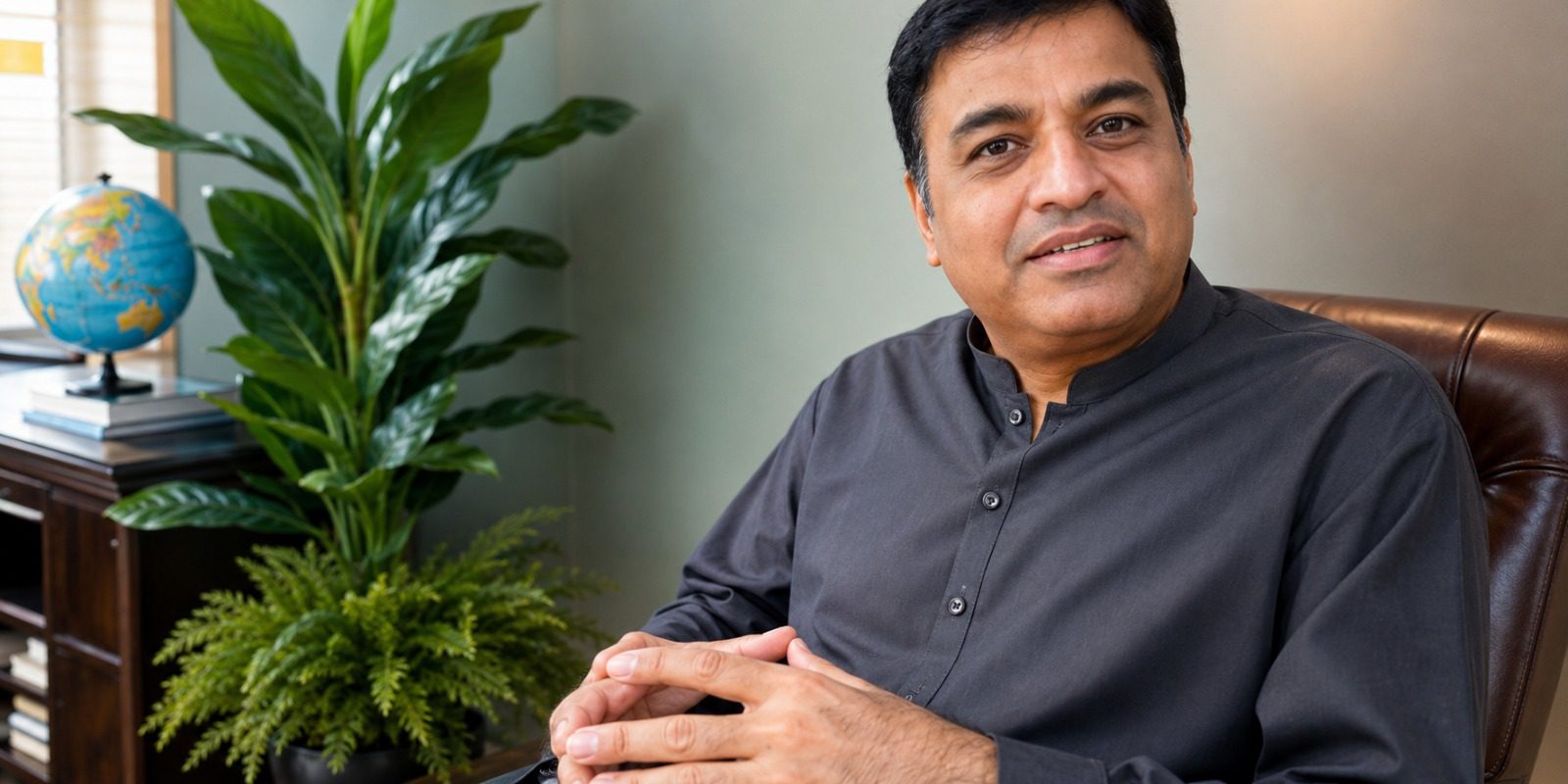
Pakistan’s business community is facing mounting challenges from high energy costs, taxation, interest rates, debt accumulation and policy uncertainty. Business leader Mudassar Masood Chaudhry, a member of the Anjum Nisar Group of the Pakistan Industrial and Traders Association Front (PIAF) and former Executive Committee member of the Lahore Chamber of Commerce and Industry (LCCI), has called for long-term economic planning, private-sector consultation and structural reforms to put the economy on a sustainable growth path.
In an interview, Chaudhry discussed the controversial daily fuel pricing mechanism, taxation, industrial competitiveness, IMF conditions, public debt, remittances, Pakistan-China economic cooperation and the need for a three-year Charter of Economy.
Q: What is your view of the government’s proposal to revise fuel prices on a daily basis?
Mudassar Masood Chaudhry: I believe daily fuel price adjustments could create serious uncertainty for businesses, particularly manufacturers and transport-dependent industries. Industry needs predictability to calculate production costs, prepare quotations, negotiate contracts and plan investment.
If petroleum prices change every day, manufacturers may find it difficult to determine the actual cost of producing goods. A company giving a quotation today may face a completely different transportation and energy cost tomorrow. This uncertainty can disrupt supply chains and make it harder for businesses to fulfil orders.
The government should consult the business community before implementing such a major change. Transparency in petroleum pricing is important, but stability and predictability are equally important for economic activity.
Q: What measures are needed to improve the business environment?
The government should focus on reducing the cost of doing business. Electricity and gas tariffs need to become more competitive, while the tax system should be simplified and made more business-friendly.
Industries also need timely access to export-related facilities and financing. Small and medium-sized enterprises should have easier access to credit at reasonable rates.
Most importantly, policies must remain consistent. Investors cannot make long-term decisions if regulations, taxes and energy prices are constantly changing.
Q: You have proposed a three-year Charter of Economy. Why is it necessary?
Pakistan needs economic policies that continue beyond individual governments and political cycles. I suggest that the government introduce a three-year Charter of Economy with consensus among political parties, business representatives, economists and other stakeholders.
The charter should establish clear priorities for taxation, exports, energy, industrialisation, investment, public spending and debt management.
Investors need confidence that the policies announced today will remain in place tomorrow. Continuity can encourage both domestic and foreign investment and help businesses make long-term plans.
Q: How should development funds be used?
Development expenditure should be linked directly to economic productivity. Public funds should prioritise projects that increase exports, promote technology, improve industrial production and create sustainable employment.
We cannot continue spending scarce resources on projects that do not generate economic value. Development spending should strengthen productive capacity and reduce Pakistan’s dependence on imports and external borrowing.
Loss-making state-owned enterprises should also be restructured through privatisation or public-private partnerships where appropriate.
Q: You have also called for an independent economic think tank. What would be its role?
Pakistan needs an independent national-level economic think tank comprising experts from industry, trade, agriculture, information technology, exports, finance and academia.
Its job should be to continuously monitor economic developments and provide practical recommendations to policymakers.
Economic planning should not be limited to responding to crises. We need forward-looking research on exports, technology, industrialisation, energy, taxation, global trade and investment.
A professional and independent institution could help governments make decisions based on data and long-term national interests rather than short-term pressures.
Q: Pakistan’s public debt has continued to increase. How can this trend be reversed?
The growing debt burden is a serious concern. For years, Pakistan has remained caught in a cycle in which new borrowing is used to meet existing obligations and finance fiscal requirements.
The solution is not simply to borrow more. Pakistan needs a stronger revenue system, disciplined government expenditure and reforms that increase productivity.
We must expand the tax base rather than continuously increasing the burden on existing taxpayers. At the same time, exports must increase so that the country can generate sustainable foreign exchange.
Debt reduction should become a national economic priority.
Q: Can remittances play a role in reducing Pakistan’s external debt?
Remittances are a major source of foreign exchange and provide important support to Pakistan’s external account. However, we should find ways to use a portion of these inflows for long-term economic stability rather than allowing them to be used almost entirely for consumption.
One possible approach is the creation of a transparent and voluntary Overseas Debt Reduction Fund, through which overseas Pakistanis could contribute a defined portion of their remittances toward debt reduction.
Such a mechanism must be completely transparent, subject to parliamentary oversight and designed to protect public confidence.
At the same time, overseas Pakistanis should be offered attractive and credible investment opportunities so their savings can contribute to productive sectors.
Q: What are your concerns about the Finance Act 2026?
The tax system is becoming increasingly complicated for taxpayers and businesses. The Finance Act has increased compliance responsibilities for withholding agents, businesses and financial institutions, while taxpayers continue to face concerns regarding refunds, assessments and their legal rights.
The government should focus on bringing undocumented sectors into the tax net instead of repeatedly imposing additional obligations on businesses that are already paying taxes.
Real tax reform should simplify the system, improve enforcement and broaden the base.
Q: Does Pakistan’s existing tax structure discourage industrialisation?
Yes. The present system can discourage investment, manufacturing and value addition because businesses face multiple layers of taxation and compliance costs.
Export-oriented companies in particular need a competitive tax regime that allows them to compete in international markets.
Pakistan should study successful models adopted by countries such as China, Vietnam, Bangladesh and South Korea. These economies focused on exports, industrialisation, technology transfer and policy continuity.
Our tax system should reward investment and production rather than discourage them.
Q: What should be done to make Pakistani exports more competitive?
We need to reduce production costs, improve energy availability, modernise technology and simplify taxation.
Exporters should have predictable policies and timely access to refunds and other facilities. The focus should also move from low-value products toward value-added manufacturing.
Pakistan cannot achieve sustained export growth simply by selling more of the same products. We need technological upgrading, better skills, research and development and integration into global supply chains.
Q: How do you assess Pakistan’s economic relationship with China?
Pakistan has a long-standing and strategic relationship with China, but we need to improve our own capacity to benefit from it.
The next phase of cooperation should focus on technology transfer, modern manufacturing, joint research, agricultural innovation, technical training, digital infrastructure, renewable energy and export-oriented industries.
CPEC should increasingly support industrial cooperation and value-added production rather than remaining focused primarily on infrastructure.
Pakistan should encourage Chinese investment in industries that can produce goods for both domestic and international markets.
Q: What is your assessment of Pakistan’s dependence on the IMF?
Pakistan cannot achieve sustainable prosperity by focusing only on meeting IMF targets. The IMF can provide financial support during difficult periods, but long-term economic stability must come from domestic reforms and productive growth.
If taxation increases without expanding production, investment and exports, the economy will remain under pressure.
The government should use the breathing space provided by external financing to implement structural reforms rather than repeatedly returning to borrowing programmes.
Q: What should be the government’s immediate economic priorities?
The immediate priorities should be reducing energy costs, broadening the tax base, improving industrial productivity, promoting exports, controlling unnecessary government expenditure and restoring investor confidence.
The government must also engage the private sector before making major economic decisions.
Pakistan has talented entrepreneurs, industrialists, exporters and professionals. Their expertise should be incorporated into policymaking.
Q: What is your message to policymakers?
Pakistan needs to move from crisis management to long-term economic planning.
We should build an economy based on production, exports, technology, investment and innovation rather than consumption and borrowing.
A stable three-year economic framework, an independent economic think tank, meaningful tax reforms, competitive energy prices, disciplined public spending and stronger private-sector participation can help create the foundation for sustainable growth.
Economic reforms require political commitment and national consensus. If the government, private sector, experts and other stakeholders work together, Pakistan can gradually move toward greater economic self-reliance and reduce its dependence on repeated borrowing.


