


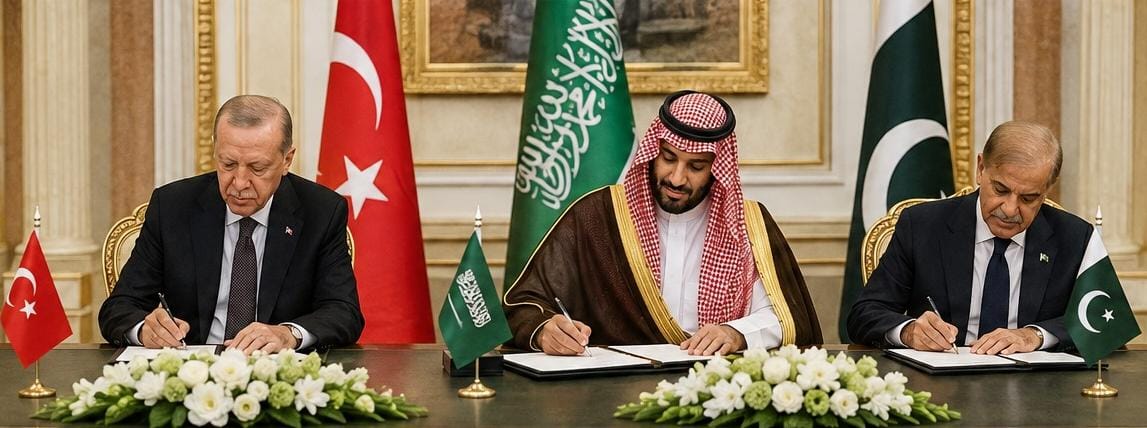
MECCA (Web Desk) – Saudi Arabia, Turkey and Pakistan have signed a landmark defence agreement under which an armed attack against any one of the three countries will be treated as an attack against all three, marking a major expansion of strategic cooperation amid growing security tensions in the region.
The agreement, signed in the Saudi holy city of Mecca on Friday, brings together three influential Muslim-majority countries with significant economic, military and technological capabilities.
Saudi Crown Prince Mohammed bin Salman, Turkish President Recep Tayyip Erdogan and Prime Minister Shehbaz Sharif signed the agreement, according to official statements issued by the three countries.
The pact, described as the Mecca Joint Defence Agreement, seeks to strengthen collective deterrence and expand cooperation across a broad range of defence-related areas.
Collective defence at the centre of agreement
Under the agreement, the three countries have committed themselves to treating an armed attack on one member as an attack on all members.
The arrangement is intended to enhance deterrence against potential aggression while providing a framework for closer coordination in defence and security matters.
The agreement also calls for greater cooperation in areas including military capabilities, defence planning, counterterrorism and defence-industry collaboration.
Turkish President Erdogan said the pact was founded on the principle of collective deterrence and would create opportunities for deeper cooperation in defence production and joint projects.
He stressed that the agreement was defensive in character and did not target any particular country.
According to the Turkish side, the agreement is also consistent with the right of self-defence recognised under Article 51 of the United Nations Charter.
Saudi Arabia rejects idea of military bloc
Saudi Arabia has sought to make clear that the agreement should not be interpreted as the creation of a new military alliance or sectarian bloc.
The Saudi government said the arrangement would not undermine the kingdom’s existing strategic relationships with Gulf states, Arab countries or international partners.
Riyadh also rejected suggestions that the agreement was connected to a nuclear programme or an arms race, saying the focus was instead on developing sustainable and self-reliant defence capabilities.
The clarification is significant given the region’s complex network of existing security partnerships and the heightened tensions surrounding conflicts in the Middle East.
Three countries bring different strategic strengths
The agreement combines the capabilities of three countries with distinctly different but complementary strengths.
Pakistan possesses extensive military experience and is a nuclear-armed state with a large defence establishment. The country has maintained close security ties with Saudi Arabia for decades and has also developed increasingly strong defence relations with Turkey.
Turkey, meanwhile, has developed a substantial domestic defence industry and has expanded its capabilities in areas such as drones, aircraft, missiles, naval systems and other military technologies.
Saudi Arabia brings substantial financial resources, regional influence and a strategic position at the heart of the Gulf and wider Middle East.
The combination could create opportunities for increased defence production, technology cooperation, training and investment among the three countries.
Pakistan-Saudi defence relationship enters new phase
For Pakistan, the agreement represents another significant development in its long-standing security relationship with Saudi Arabia.
Prime Minister Shehbaz Sharif termed the agreement a historic development and described it as a potential “shield of peace” for the three countries and the broader Muslim world.
He also praised Chief of Army Staff Field Marshal Asim Munir, crediting his efforts and commitment for contributing to the agreement.
Pakistan and Saudi Arabia already have a bilateral mutual defence arrangement, making the new three-way framework an expansion of an existing strategic relationship rather than an entirely new security partnership.
Pakistan has historically maintained close defence and military-to-military relations with Saudi Arabia, including training and advisory cooperation.
Turkey-Saudi relations deepen
The agreement also highlights the transformation in relations between Ankara and Riyadh.
Saudi-Turkish ties experienced serious strains in previous years, particularly following the killing of Saudi journalist Jamal Khashoggi in Istanbul. Relations have subsequently improved considerably as both countries have sought closer political and economic engagement.
The new defence agreement provides another avenue for strengthening those ties.
Turkey’s growing defence industry could also offer opportunities for Saudi investment and joint production, while Riyadh’s financial resources could support the expansion of Turkish and Pakistani defence capabilities.
Regional security concerns
The agreement comes at a time of heightened uncertainty across the Middle East, including tensions involving Iran, Israel, Lebanon and Yemen.
Saudi Arabia has faced security challenges in recent years, including attacks targeting critical infrastructure and energy facilities. The kingdom has therefore sought to strengthen its defence capabilities while diversifying its strategic partnerships.
The war and tensions involving Iran have further increased concerns among regional states about the possibility of attacks spreading across borders.
The three governments, however, have stressed that the agreement is intended to strengthen deterrence rather than prepare for offensive military action.
Iran voices criticism
The agreement has drawn criticism from some Iranian officials.
Ebrahim Rezaei, a member of Iran’s parliamentary National Security and Foreign Policy Commission, questioned whether the arrangement would provide greater security for Saudi Arabia.
He argued that agreements with external partners would not necessarily guarantee long-term security and urged Riyadh to reconsider its regional policies.
Other Iranian analysts have sought to downplay the potential military impact of the agreement, arguing that Tehran has already faced significant military pressure from the United States and Israel.
No immediate large-scale troop deployments expected
Despite the agreement’s mutual-defence language, analysts do not expect Turkey or Pakistan to immediately deploy large numbers of troops to Saudi Arabia in response to a regional conflict.
Instead, the pact could initially lead to closer diplomatic coordination, military planning, intelligence cooperation, defence-industry partnerships and technology transfers.
Analysts say limited or symbolic deployments could be possible, but a major military commitment by either Turkey or Pakistan would carry significant political and strategic consequences.
Pakistan, in particular, has previously maintained a cautious approach toward becoming directly involved in military operations in Yemen and other regional conflicts.
Defence industry cooperation likely to expand
One of the most important long-term consequences of the agreement could be greater cooperation among the three countries’ defence industries.
Turkey has emerged as a major exporter of military technology, particularly unmanned systems and other advanced platforms. Pakistan has also expanded its indigenous defence production and maintains experience in aircraft, armoured systems and missile-related technologies.
Saudi Arabia, meanwhile, is seeking to develop domestic defence manufacturing and reduce reliance on foreign suppliers as part of its broader economic and strategic transformation.
Greater Saudi investment in Turkish and Pakistani defence projects could therefore become an important component of the new partnership.
A strategic partnership rather than a new bloc
Officials from the three countries have repeatedly described the agreement as defensive and inclusive rather than directed against a specific state.
Erdogan said the framework remains open to other countries that support peace, stability and prosperity in the region.
The agreement also does not replace existing bilateral or multilateral defence arrangements involving any of the three countries.
Its significance, therefore, lies less in the creation of an entirely new military structure and more in the formalisation of closer strategic coordination among Riyadh, Ankara and Islamabad.
Potential implications for Pakistan
For Pakistan, the agreement could strengthen its diplomatic and strategic position in the Middle East while opening opportunities for greater defence cooperation and investment.
Closer coordination with Saudi Arabia could also deepen economic ties, while stronger defence cooperation with Turkey may accelerate joint production and technology-transfer initiatives.
At the same time, Islamabad will have to carefully balance its relations with Iran and other regional powers to ensure that the new arrangement does not draw Pakistan into broader regional conflicts.
The success of the agreement will ultimately depend on how the three countries translate the political commitment into practical military coordination, joint projects and crisis-response mechanisms.
For now, the Mecca agreement represents a significant step toward a more closely integrated security partnership between Saudi Arabia, Turkey and Pakistan at a time when regional states are increasingly focused on collective deterrence and strategic self-reliance.


