


By Dr Alamdar Hussain Malik
The persistent rise in petrol and diesel prices in Pakistan has become one of the most critical economic challenges for households, farmers, transporters, and industry. While public debate often attributes fuel inflation solely to international crude oil fluctuations, the deeper reality lies within domestic policy choices. In particular, the structural transformation in petroleum taxation—from General Sales Tax (GST) to Petroleum Levy—has played a decisive role in shaping the current fuel price crisis.
Read also: Shahid Khaqan Abbasi says wrong fuel policies, weak governance hurting people and economy
Before 2022, Pakistan’s petroleum pricing framework was primarily based on General Sales Tax (GST) along with a relatively smaller Petroleum Development Levy (PDL). GST was the dominant revenue instrument and was applied as a percentage of the fuel price, while petroleum levy remained a supplementary fixed charge per litre.
Although Petroleum Levy legally existed under the Petroleum Products (Petroleum Levy) Ordinance, 1961, it was not historically the main fiscal tool. For decades, governments relied more on GST to manage revenue from petrol and diesel. The Finance Act 2018 expanded the scope and ceiling of petroleum levy, allowing the government greater flexibility in increasing fixed per-litre charges. However, the real structural shift began in 2021–22 under fiscal pressure and IMF-supported reforms.
A crucial and often under-discussed reason behind the elimination of GST and its replacement with Petroleum Levy is the constitutional and fiscal distribution mechanism under the National Finance Commission (NFC) Award. GST is part of the divisible tax pool, which must be shared between the federation and provinces. This means that a significant portion of GST collected on petroleum products is transferred to provincial governments.
In contrast, Petroleum Levy is a pure federal revenue instrument, which is not part of the divisible pool and remains entirely with the federal government. This fiscal distinction became a key reason for the policy shift: by replacing GST with Petroleum Levy on petrol and diesel, the federal government effectively increased its own net revenue while reducing transfers to provinces.A further important dimension is that petrol and diesel are consumed uniformly across all four provinces—Punjab, Sindh, Khyber Pakhtunkhwa, and Balochistan—yet the revenue collected through Petroleum Levy is not shared under the NFC Award. Unlike GST, which is divisible and redistributed, Petroleum Levy remains entirely with the federal government. This creates a structural fiscal imbalance where provinces collectively bear the burden of fuel inflation but do not receive a proportional share of this major revenue stream, raising serious questions of fiscal fairness within the federation.
By early 2022, Pakistan began reducing GST on petroleum products significantly, and by February 2022, GST on petrol and diesel was reduced to near zero. From mid-2022 onwards, under IMF-linked commitments, the government increasingly relied on Petroleum Levy as the primary revenue instrument on petrol and diesel.
Official fiscal data clearly shows the scale of this transformation. Pakistan collected approximately Rs. 580 billion in Petroleum Levy in FY 2022–23, which increased sharply to around Rs. 1.019 trillion in FY 2023–24. The upward trend continued further, with collections reaching nearly Rs. 808 billion within the first nine months of 2024, while projections for FY 2024–25 indicate record revenue of around Rs. 1.22 trillion. This reflects how the policy shift from GST to Petroleum Levy has structurally changed fuel taxation in Pakistan.
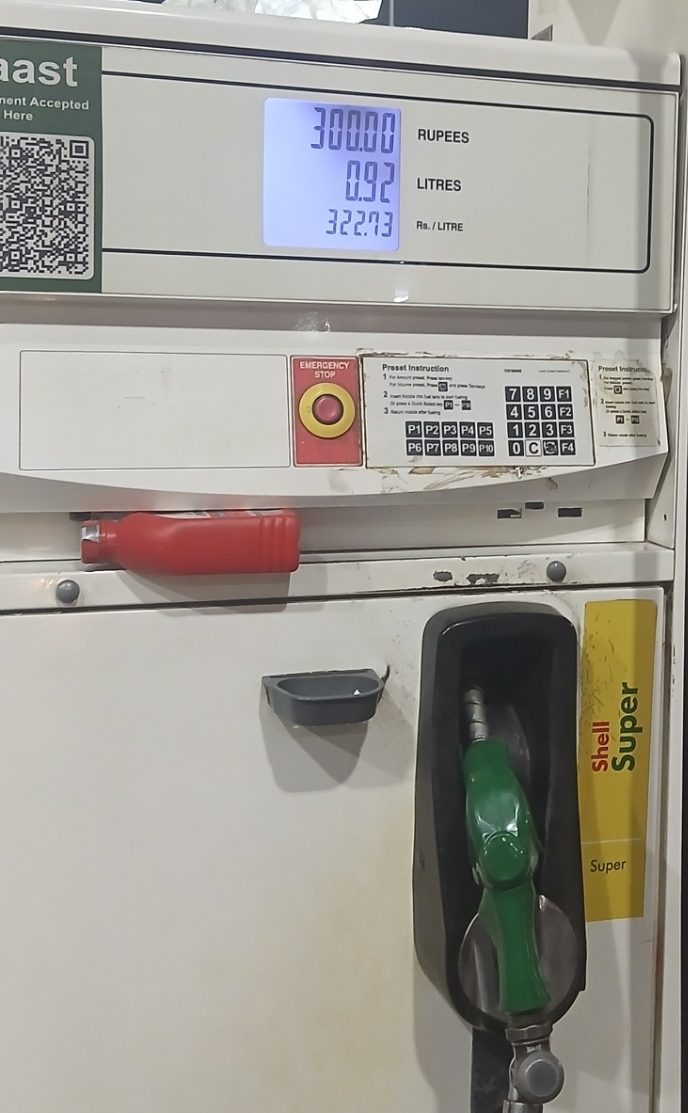
As of recent official revisions (May 2026), petrol in Pakistan is priced at approximately Rs. 399.86 per litre, while High-Speed Diesel (HSD) stands at around Rs. 399.58 per litre. A significant portion of this price is now composed of taxes and levies rather than the actual cost of imported fuel. The Petroleum Levy on petrol alone has crossed Rs. 100 per litre, making it one of the largest components of the retail price.
Diesel carries particularly severe economic implications because it powers agriculture, transport, and supply chains. Any increase in diesel prices directly raises the cost of farming operations, freight movement, irrigation, and food distribution. In a country where road transport dominates logistics, diesel price increases rapidly translate into economy-wide inflation.
When compared with regional countries, Pakistan’s fuel pricing structure shows a distinct pattern. India applies a combination of excise duty and VAT across central and state levels, Bangladesh maintains a more controlled pricing mechanism, and Sri Lanka operates under a formula-based system linked to international oil prices. In comparison, Pakistan’s increasing dependence on Petroleum Levy makes fuel pricing more revenue-driven rather than purely market-linked.
The broader concern is that petroleum taxation in its current form is inherently regressive.
Whether rich or poor, every consumer indirectly pays the same fuel levy burden through transport fare and commodity prices.
This means the inflationary effect disproportionately affects lower- and middle-income groups. The central argument of this analysis—“From GST to Petroleum Levy: The Structural Tax Shift Behind the Real Rise in Petrol and Diesel Prices in Pakistan”—is therefore not merely about tax adjustment, but about a deeper structural transformation in fiscal governance. Fuel inflation in Pakistan is no longer driven only by international oil markets; it is increasingly shaped by domestic revenue strategies that prioritize short-term fiscal gains over long-term economic stability.
The broader concern is that petroleum taxation in its current form is not only economically heavy but also structurally inequitable. Whether rich or poor, urban or rural, every consumer indirectly bears the same burden of petroleum levy through transport fares, agricultural inputs, and commodity prices. This makes the impact of fuel taxation deeply regressive, disproportionately increasing the financial pressure on lower- and middle-income households while amplifying inflation across the entire economy.
A sustainable way forward requires more than repeated fuel price adjustments. Pakistan must urgently move towards structural fiscal reforms, including broadening the direct tax base, reducing dependence on regressive indirect taxation, restoring balance in federal-provincial revenue sharing, and investing in efficient transport and energy systems. Without such reforms, petrol and diesel will continue to function not only as energy commodities but also as powerful instruments of inflation, inequality, and economic stress across the country.