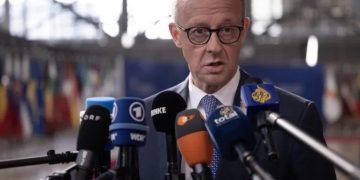



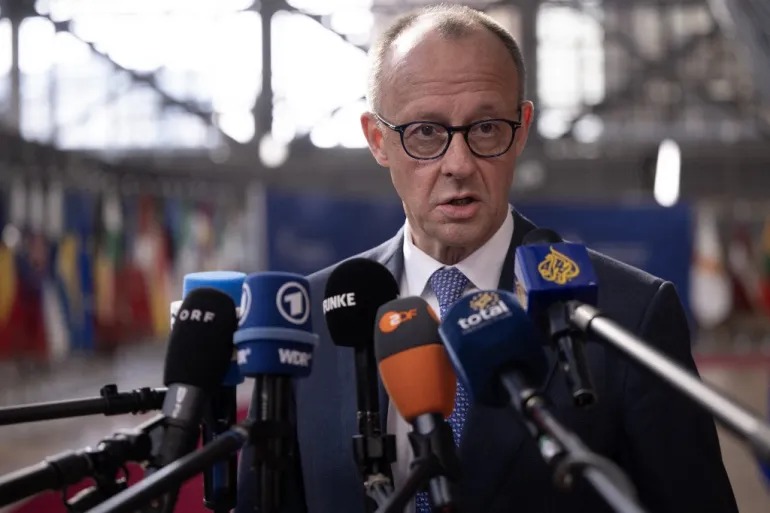
BERLIN (Web Desk) -German Chancellor Friedrich Merz has said Iran has proved “stronger than expected” in its confrontation with the United States, warning that Washington appears to be facing setbacks in a conflict that shows little sign of ending.
In remarks that underscored growing European concern over rising tensions in the Middle East, Merz said developments in the confrontation had reinforced suspicions he held from the very beginning, arguing the United States had entered the crisis without a clearly defined negotiating strategy.
Speaking in Berlin, the German chancellor said the trajectory of the conflict had exposed strategic miscalculations and demonstrated that Tehran had shown greater resilience than many Western observers had anticipated.
“I had concerns from the first day about where this war trajectory could lead,” Merz said, according to his statement, adding that the United States appeared to be struggling to translate military pressure into a coherent diplomatic outcome.
His remarks come amid intensifying debate in Europe and beyond over the direction of the crisis, which has fuelled fears of a wider regional confrontation involving key Middle Eastern powers.
Merz said the conflict in the Middle East did not appear close to resolution and cautioned against assumptions that military and economic pressure alone would quickly alter realities on the ground.
Despite his criticism of Washington’s handling of the crisis, the German leader said his relations with US President Donald Trump remained positive, suggesting his comments were aimed at policy rather than the bilateral relationship.
The chancellor’s remarks were notable as they reflected unease within European capitals over the risk of prolonged instability, disruptions to energy markets and the broader geopolitical consequences of escalation involving Iran.
Analysts say Iran’s ability to withstand pressure has complicated calculations for Western policymakers, particularly as diplomatic avenues appear increasingly uncertain.
Meanwhile, President Trump has reportedly directed US officials to maintain pressure on Iran’s economy and oil exports, signalling Washington intends to sustain economic coercion even as military and diplomatic questions remain unresolved.
According to reports, Trump instructed authorities to continue tightening restrictions linked to Iranian trade and energy shipments, while also seeking measures to obstruct shipping connected to Iranian ports.
The reported strategy suggests the administration views sustained economic pressure and maritime restrictions as preferable to either expanding military action or withdrawing from confrontation under unfavourable conditions.
According to the US position outlined in the reports, initiating broader bombardment or abruptly stepping back from the conflict could carry greater risks than preserving a blockade-centred strategy designed to constrain Tehran.
The developments point to a dual-track approach in Washington, combining pressure tactics with deterrence, even as questions persist over whether such measures can deliver strategic gains without deepening regional instability.
Observers note that the conflict has raised concerns over shipping security, oil supplies and the possibility of further turbulence in already fragile regional dynamics.
European officials have increasingly urged restraint, warning that prolonged confrontation could trigger economic shocks far beyond the Middle East, particularly through disruptions to energy routes and trade corridors.
Merz’s comments may add momentum to calls within Europe for renewed diplomatic engagement, even as Western governments remain divided over how to balance pressure with dialogue.
The German chancellor did not elaborate on possible diplomatic alternatives, but his remarks appeared to suggest scepticism about a strategy focused primarily on coercive measures.
His statement also comes as international attention remains fixed on whether major powers can prevent the crisis from spiralling into a broader regional war.
Political analysts say Merz’s unusually candid assessment reflects mounting frustration in Europe over the absence of a credible roadmap to de-escalation.
For now, with Washington maintaining pressure, Tehran showing resilience and regional tensions unresolved, prospects for an early diplomatic breakthrough appear uncertain.
As the confrontation continues, governments across Europe and the Middle East are closely watching whether pressure tactics, military deterrence or diplomacy will shape the next phase of the crisis.