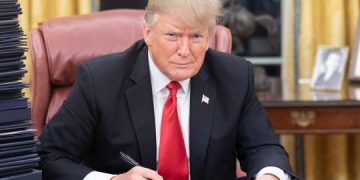



ISLAMABAD (Web Desk) –US President Donald Trump indicated on Sunday that dialogue between Washington and Tehran may continue remotely, a day after he cancelled a planned visit by US officials to Islamabad amid Iran’s reluctance to join in-person negotiations.
In an interview with Fox News, Trump said the United States had paused diplomatic travel for the talks, suggesting Iran could instead call Washington or send representatives there.
“We have all the cards,” Trump said, arguing there was no reason for US officials to make an 18-hour trip to Pakistan while Washington held the stronger hand. Reiterating the US stance, he said Iran must not acquire a nuclear weapon, though he stressed the move did not signal renewed conflict.
Trump also praised Pakistan’s facilitation efforts, saying he had “great respect for Pakistan” and that Islamabad would remain engaged in the process. “We are going to do it by telephone,” he said of the proposed talks.
Iran’s ambassador to Pakistan, Reza Amiri Moghadam, also thanked Pakistan in a post on X, particularly Prime Minister Shehbaz Sharif and Field Marshal Asim Munir, for what he described as tireless efforts to help secure peace and stability in the region. He also appreciated the arrangements made during Iranian Foreign Minister Abbas Araghchi’s visit.
The remarks came after Araghchi departed Islamabad for Moscow following a stop in Muscat, where he held talks with Omani leadership.
Araghchi had been in Islamabad on Saturday, meeting Pakistan’s civil and military leadership to share Iran’s response to US proposals. On Sunday, he held further discussions with Pakistani officials to convey Tehran’s position on a possible framework to fully end the Middle East conflict before leaving for Moscow.
Iranian media maintained the second visit was unrelated to nuclear negotiations, describing it instead as part of Araghchi’s ongoing regional consultations, according to Al Jazeera.
Trump’s remarks appeared to rule out Islamabad as the immediate venue for the next round of talks, while restrictions imposed in Islamabad and Rawalpindi were lifted following the departure of visiting delegations.
Deputy Prime Minister Ishaq Dar late Sunday announced an end to movement restrictions around the Serena Hotel and Red Zone, thanking residents for their patience after days of road closures and traffic disruptions.
Meanwhile, two US Air Force C-17 aircraft carrying security personnel, vehicles and equipment departed Pakistan, two Pakistani officials told Reuters.
Araghchi steps up diplomacy
During his Muscat visit, Araghchi briefed Oman’s Sultan Haitham bin Tariq on Iran’s perspective regarding regional developments and peace efforts. Oman stressed the importance of dialogue and diplomacy in advancing regional peace.
According to Reuters, Iranian officials also discussed security in the Strait of Hormuz, with Araghchi calling for a regional security framework free from outside interference.
Qatar’s Prime Minister Sheikh Mohammed bin Abdulrahman bin Jassim Al Thani also spoke with Araghchi, with both sides discussing efforts to promote peace and regional stability.
The Iranian foreign minister also held discussions with Saudi, Turkish and Egyptian counterparts. Iranian media reported exchanges on ceasefire diplomacy and broader regional developments, while Turkish media said talks with Ankara focused on progress in Iran-US negotiations.
Hormuz tensions persist
Pressure for a diplomatic breakthrough has mounted as the Strait of Hormuz remains closed, disrupting global energy markets.
Iran’s Revolutionary Guards signalled they had no intention of easing the blockade, calling control of the strait a core deterrence strategy.
The IRGC also warned of a severe response to any renewed aggression, while US Central Command said it intercepted a merchant vessel attempting to pass through the blockade. The ship was reportedly part of a so-called shadow fleet transporting Iranian oil products.
The US military said 37 vessels had been redirected since the blockade began.
Separately, British Prime Minister Keir Starmer and US President Donald Trump discussed efforts to restore shipping through the Strait of Hormuz, with Downing Street saying both leaders stressed the urgency of reopening the vital maritime route.