


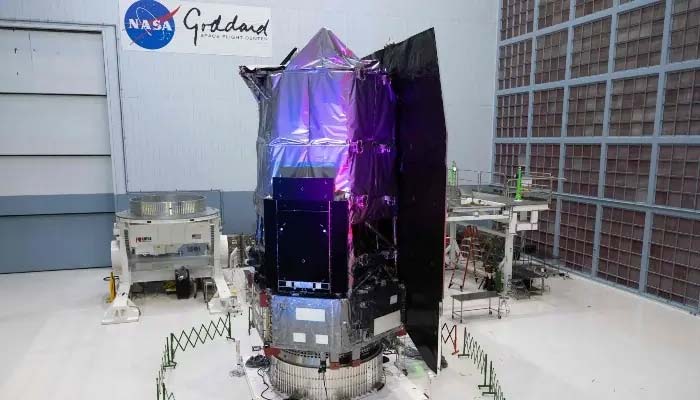
WASHINGTON (Tech Desk) – NASA is preparing to launch one of its most ambitious satellite servicing missions as it attempts to rescue the aging Neil Gehrels Swift Observatory before it falls into Earth’s atmosphere. The historic mission aims to demonstrate that older spacecraft can be repaired and repositioned instead of being abandoned, potentially opening a new chapter in satellite operations.
The mission will use a robotic spacecraft called LINK, developed by American aerospace startup Katalyst, to rendezvous with the Swift telescope in low Earth orbit. If successful, the spacecraft will capture the observatory and gradually move it into a higher and safer orbit, allowing the telescope to continue its scientific work for several more years.
The launch was initially scheduled for Tuesday but was postponed because of unfavorable weather conditions. NASA has announced that the next launch attempt will take place no earlier than Wednesday, subject to suitable weather and technical readiness.
Unlike conventional launches, the Pegasus rocket carrying the LINK spacecraft will be released from an aircraft flying over the Pacific Ocean before igniting its engines and heading toward orbit.
Once deployed, the robotic spacecraft will spend several weeks approaching Swift, which has been orbiting Earth since its launch in 2004. Engineers must carefully synchronize the spacecraft’s movement with the telescope before attempting one of the most challenging orbital docking operations ever attempted.
RelatedPosts
The LINK spacecraft will use three robotic arms to carefully grasp the telescope without damaging its sensitive scientific instruments. After securing the observatory, the spacecraft will slowly raise its orbit by approximately 300 kilometers, reducing atmospheric drag and preventing its expected re-entry into Earth’s atmosphere.
Swift was originally designed to operate for only two years, but the observatory has exceeded expectations by remaining active for more than two decades. During that time, it has become one of NASA’s most valuable astronomy missions, helping scientists detect and study thousands of gamma-ray bursts, black holes, neutron stars and other extreme cosmic events.
Gamma-ray bursts are among the most energetic explosions in the universe and often signal the collapse of massive stars or the merger of neutron stars. Swift’s ability to rapidly detect these brief but powerful events has made it an essential observatory for astronomers around the world.
NASA officials say replacing Swift immediately would not be possible because of the cost and time required to build and launch another dedicated observatory. Extending its operational life therefore offers significant scientific value at a fraction of the cost of developing a replacement mission.
The rescue mission itself is expected to cost around $30 million, considerably less than the original telescope’s development cost of approximately $250 million. Even if the mission does not succeed, NASA believes the knowledge gained will benefit future satellite servicing projects.
The operation presents several technical challenges. Engineers have limited information about the rear structure of the telescope, where the robotic spacecraft must attach itself. Since Swift was never designed for in-orbit servicing, the docking procedure requires innovative engineering solutions and precise autonomous navigation.
NASA officials acknowledge that the mission carries considerable risk but believe the potential rewards justify the attempt. Success would demonstrate that aging satellites can be repositioned, repaired and potentially upgraded instead of being discarded once their original missions end.
The technology could eventually allow commercial satellite operators and government agencies to extend the lives of expensive spacecraft, reduce space debris and lower the cost of future space operations.
Industry experts believe robotic servicing missions could become increasingly important as thousands of satellites continue to enter orbit over the coming years. If NASA’s mission succeeds, it could establish a new model for maintaining valuable spacecraft and significantly reshape the future of satellite management and space sustainability.


