


By Our Correspondent
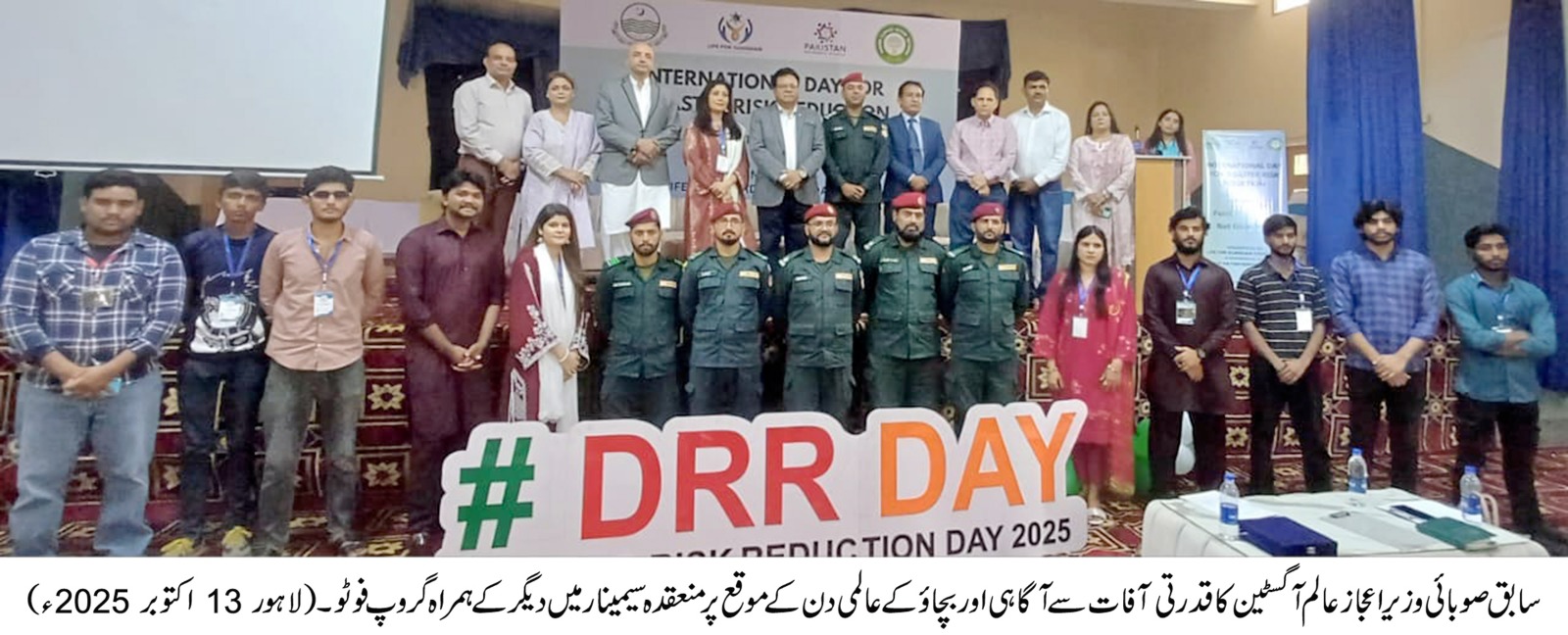
LAHORE: On the occasion of the International Day for Disaster Risk Reduction, a seminar was held at Don Bosco Technical Institute, Lahore, jointly organized by Life for Guardian and the Pakistan Partnership Initiative (PPI). Speaking about the purpose of the event, Mehnaz Javed (Life for Guardian) highlighted that the goal was to emphasize disaster preparedness, community resilience, and sustainable adaptation.
Read also: Former Provincial Minister Ejaz Alam Augustine visits flood-affected areas along River Sutlej
She stressed that under the theme “Funds Resilience, Not Disaster,” resources should be invested in preparedness and prevention rather than only in emergency response.
Ejaz Alam Augustine, Member of the Punjab Assembly and former Provincial Minister, stated that in today’s world, educational institutions and communities must be trained to save lives. “We ourselves are responsible for the destruction around us—there are more tree cutters than planters,” he said. Praising the efforts of the Pakistan Army, PDMA, and Rescue 1122 during recent floods, he added that every citizen must fulfill their individual responsibility. He called on governments to adopt long-term ten-year planning to effectively deal with future crises.
Additional DG EPA Nawaz Manek emphasized the need to understand the nature of the environment, stating that artificial lifestyles have created immense challenges. He called for mandatory installation of treatment plants in industries, extensive tree plantation campaigns, and improved public transport systems to reduce pollution and stress on the environment.
Dureshwar, General Secretary of the Pakistan Climate Action Network (PCAN), said that climate change and disaster risk reduction are interlinked, and building local capacity and ensuring community participation are essential.
Catherine Sapna (CTS) pointed out that women and children are the most affected during crises. Empowering them and providing leadership opportunities form the foundation of real resilience. Kamran Chaudhry, senior journalist, remarked that responsible journalism can save lives, and the media must play its role in spreading awareness and preparedness messages regarding disasters.
Faniyaz Jan, Provincial DRR Coordinator, noted that collaboration between government institutions and civil society is crucial for reducing disaster risks. Public-private partnerships, he said, are the cornerstone of true resilience.
Haider Ali from Rescue 1122 shared that more than 20 million people have been trained under the Life Saver Program. On average, Rescue 1122 responds to over 1,000 emergency cases daily, with ambulances reaching within 7 minutes and motorbike units within 4 minutes. He stressed the need for community capacity building so that more lives can be saved collectively. Participants also paid rich tribute to the rescue teams and life-saving organizations. Sajid Christopher (HFO) and Yousaf Benjamin (Dignity First) emphasized that population growth, river erosion, and deforestation are major causes of environmental damage. They urged the restoration of forests and the use of modern satellite technology for early warning and timely actions, adding that disaster management is not a one-time response but an ongoing process that begins on day one.
The seminar concluded with Ejaz Alam Augustine presenting commemorative shields to the participants. All attendees reaffirmed their commitment to working together for a safe, strong, and sustainable Pakistan, ensuring a better and secure future for generations to come.
The event saw enthusiastic participation from social organizations, educational institutions, community representatives, and a large number of youth.