



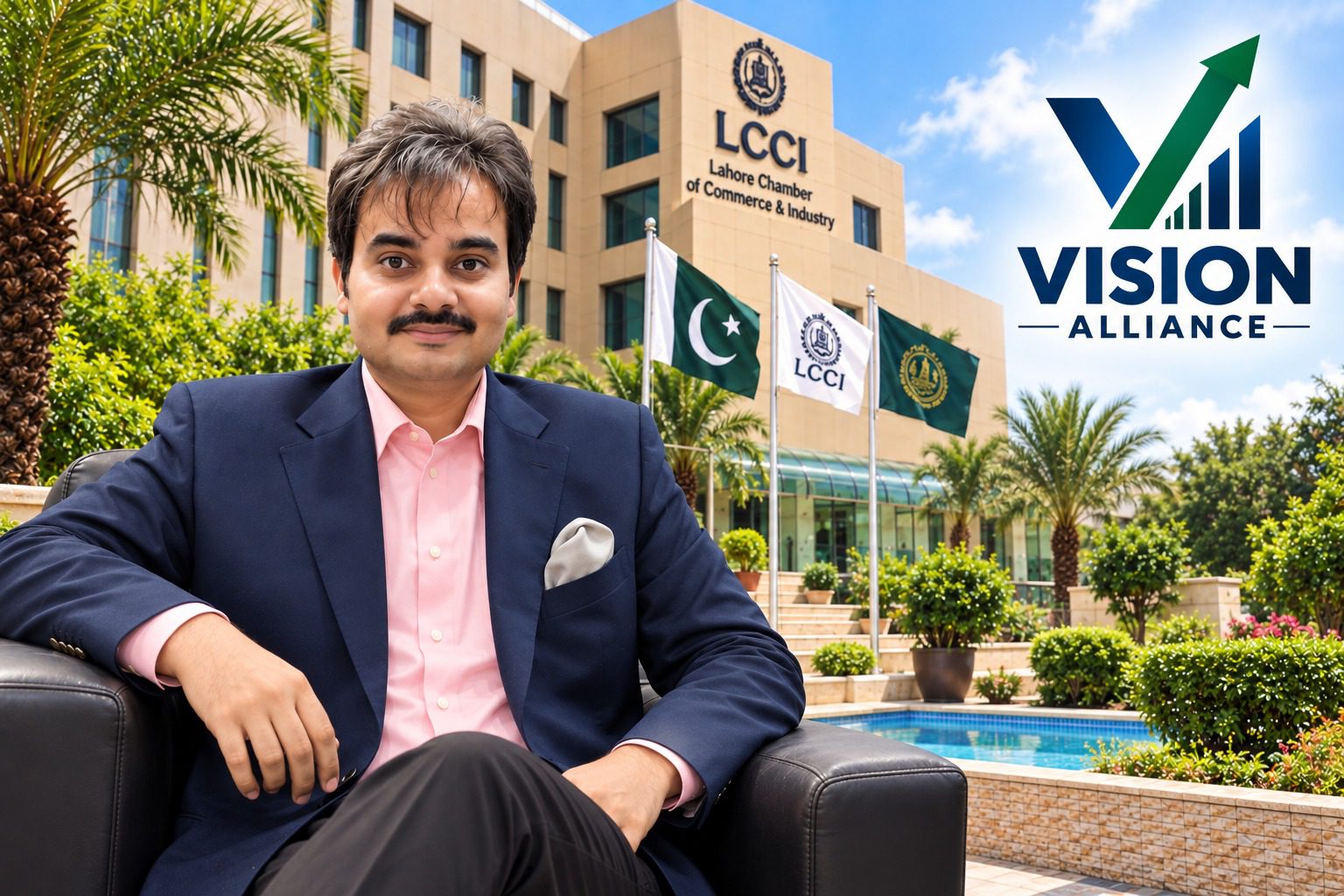
By M Qadeer
LAHORE: Pioneer Businessmen Group Chairman and Vision Alliance leader Ali Hussam Asghar has called for a results-oriented approach to the affairs of the Lahore Chamber of Commerce and Industry (LCCI), saying that the chamber’s effectiveness should ultimately be measured by the practical relief and opportunities it creates for its members.
In a statement ahead of the 2026 LCCI elections, Asghar said the business community needed an institution that could move beyond statements and meetings and translate its representation into concrete outcomes. He said the chamber should maintain regular engagement with traders, industrialists, exporters, manufacturers, SMEs and corporate businesses and ensure that their concerns are properly documented, prioritised and taken up with the relevant authorities.
Read also: LCCI must become stronger voice for traders and industrialists: Ali Hussam Asghar
The LCCI election process is now at its final stage. The chamber’s Election Commission has said arrangements have been completed for transparent, peaceful and lawful elections, with observers appointed and security and traffic arrangements being coordinated for polling.
Asghar said the coming term should be focused on measurable targets rather than broad declarations. In his view, the chamber should be able to demonstrate what issues it has taken up, which departments have been engaged, what reforms have been proposed and what outcomes have been achieved for businesses.
Focus on practical business facilitation
Asghar identified taxation, energy costs, regulatory procedures, trade facilitation, industrial competitiveness and the overall cost of doing business as areas requiring sustained attention.
He said businesses often face delays and complications when dealing with government departments and regulatory bodies. According to him, the chamber should strengthen its institutional mechanisms for identifying such problems and pursue their resolution through structured dialogue.
He also stressed the importance of supporting small and medium-sized enterprises, saying that SMEs need greater access to facilitation, information, markets and policy support.
The chamber, he said, should maintain sector-wise consultations so that the concerns of different sections of the business community are not treated as a single issue. Problems faced by manufacturers, exporters, traders, service providers and emerging entrepreneurs can differ significantly, requiring targeted engagement.
Stronger connection with members
Asghar said an effective chamber must remain connected with its membership throughout the year rather than becoming active only when an issue emerges.
He proposed greater interaction with trade bodies, market associations and industrial clusters, with regular feedback mechanisms to identify emerging problems.
He said chamber committees should have clearly defined responsibilities and should regularly report their progress to the membership.
“Business representation must be linked with accountability,” was the central theme of Asghar’s message. He said members should be able to see what their representatives are doing, what issues have been raised and what progress has been made.
He also emphasised that chamber politics should ultimately remain focused on the economic interests of the business community.
Policy advocacy and government coordination
Asghar said the LCCI should strengthen its role in economic policymaking by providing government institutions with evidence-based recommendations from the private sector.
He said the business community could contribute constructively to policymaking by providing information on the impact of taxation measures, regulatory requirements, energy costs and trade policies on businesses.
Rather than simply opposing policies, he said, the chamber should present alternative proposals and demonstrate how reforms could improve investment, exports, employment and government revenue simultaneously.
Asghar also highlighted the importance of maintaining regular interaction with federal and provincial departments responsible for taxation, commerce, industries, customs, energy and other business-related matters.
He said the chamber should work to establish institutional channels through which business concerns can be communicated and followed up.
Supporting exporters and industrial growth
According to Asghar, export growth should remain a major priority because a stronger export sector can contribute to foreign-exchange earnings, industrial expansion and employment.
He said exporters require predictable policies, competitive input costs, efficient logistics and timely resolution of regulatory matters.
Industrialists, he added, also need a policy environment that encourages investment in productive capacity rather than increasing the cost and complexity of doing business.
He said the chamber could play a constructive role by bringing together exporters, manufacturers, government departments and financial institutions to discuss sector-specific obstacles.
Greater attention to SMEs
Asghar said SMEs should receive greater attention in chamber policy because smaller businesses frequently face difficulties that differ from those of large corporations.
He said the LCCI should help SMEs navigate regulatory procedures, understand policy changes and access relevant business information.
He also called for greater opportunities for younger entrepreneurs to participate in chamber activities and policy discussions.
According to Asghar, the future business leadership of Lahore must include entrepreneurs from established industries as well as new businesses operating in technology, services, manufacturing, retail and other emerging sectors.
A results-based chamber
A recurring theme of Asghar’s statement was the need for measurable performance.
He said the chamber should develop a system through which major policy initiatives can be tracked from identification of a problem to engagement with the relevant institution and eventual resolution.
He argued that such an approach could also improve transparency and allow members to assess the performance of their representatives on the basis of actual work.
The LCCI has a broad representative role within Lahore’s business community, while its elected Executive Committee forms an important part of the chamber’s governance structure. Recent reporting on the 2026 election notes that chamber policies are determined through its elected Executive Committee and that the current contest involves multiple business groups.
Unity and consultation
Asghar also stressed the importance of maintaining unity within the business community while allowing differences of opinion.
He said traders, industrialists, exporters and other business groups may have different priorities, but they can still work together on common issues affecting the broader economy.
He called for a culture of consultation in which major chamber positions are discussed with members and stakeholders before being taken to policymakers.
The Vision Alliance is contesting the 2026-28 LCCI elections as a separate alliance. Recent reporting says the Pioneer Businessmen Group led by Asghar has joined with the Founders Group, Lahore Businessmen Front and Nasir Hameed Khan Group for the contest.
Looking beyond the election
Asghar said the election itself should not be viewed as the end of the process of representation. Instead, he said, whichever representatives are elected will have a responsibility to remain accessible to the membership and address issues throughout their term.
He maintained that the credibility of the chamber depends on its ability to remain relevant to businesses between election cycles.
For that reason, he said, the focus should be on creating institutional mechanisms that continue working regardless of individual personalities or political groupings.
He also emphasised that constructive engagement with government should remain a central part of the chamber’s role.
Business community as a policy partner
Asghar said the private sector should be treated as a partner in economic policymaking.
He argued that traders and industrialists possess practical knowledge about markets, production, taxation, exports, employment and investment and that policymakers can benefit from systematically incorporating this knowledge into decision-making.
He said the LCCI could strengthen this role by producing research-based recommendations and presenting sector-specific data to policymakers.
His message also focused on maintaining a professional and respectful environment during the election process.
The LCCI Election Commission has said it is committed to conducting the elections in accordance with applicable rules and has made arrangements concerning security, parking, traffic management and polling facilities.
Asghar said the business community should approach the electoral process with an understanding that the ultimate objective of a chamber is to serve its members and contribute to economic development.
He concluded that the coming LCCI term should be judged not merely by the number of meetings held or statements issued, but by the issues resolved, reforms advanced, businesses facilitated and opportunities created.
For Asghar, the central principle is that representation must produce tangible outcomes. He said the business community needs an LCCI that listens to its members, follows through on commitments, engages policymakers consistently and reports back on progress.
The Corporate Class polling is scheduled for Sept. 23, 2026, followed by Associate Class polling on Sept. 24, 2026, according to current election reporting.


