



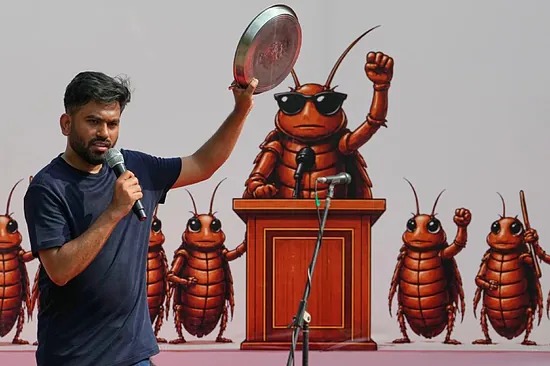
NEW DELHI (Web Desk) — Cockroach Party, what began as a social media joke has rapidly evolved into one of the most unusual youth movements in contemporary India, as thousands of protesters rally in New Delhi demanding accountability over a major medical entrance examination scandal and broader concerns over unemployment and governance.
Hundreds of young demonstrators have spent days camped at Jantar Mantar, the capital’s traditional protest site, sleeping on cardboard sheets and waving flags bearing the image of a smiling cockroach. Police have maintained a heavy presence around the area while organisers have accused authorities of attempting to disrupt the protests by temporarily restricting access to food and water.
The protests were triggered by controversy surrounding the National Eligibility cum Entrance Test for Undergraduate courses (NEET-UG), India’s highly competitive medical entrance examination taken annually by millions of students. Allegations of paper leaks and irregularities in results sparked widespread outrage, forcing authorities to cancel results and order fresh examinations.
The scandal quickly became a symbol of broader frustrations among young Indians, many of whom believe merit and hard work are increasingly undermined by corruption and administrative failures.
At the centre of the movement is the Cockroach Janta Party (CJP), which emerged in May following remarks by a Supreme Court judge who allegedly compared unemployed activists to cockroaches. The comments provoked a backlash online, inspiring Abhijeet Dipke, a Boston University graduate and digital communications specialist, to ask on social media: “What if all the cockroaches came together?”
What started as satire quickly gathered momentum. Memes, videos and online campaigns attracted millions of supporters. The movement’s Instagram account reportedly amassed more than 20 million followers, eclipsing even the social media reach of Prime Minister Narendra Modi’s Bharatiya Janata Party (BJP).
The cockroach, traditionally regarded as a symbol of contempt, was transformed into an emblem of resilience and resistance among disillusioned young people.
India’s demographic realities have contributed to the movement’s appeal. Nearly half of the country’s population of more than 1.4 billion is under the age of 25, while youth unemployment remains a persistent challenge despite economic growth.
Since its first demonstration on June 6, the movement has spread beyond New Delhi to cities including Mumbai, Bengaluru and Nagpur. Protesters are demanding greater transparency in examination systems, reliable employment data and stronger accountability mechanisms.
Political analysts say the movement reflects growing generational alienation after more than a decade of Prime Minister Narendra Modi’s rule. However, experts caution that transforming digital popularity into electoral success remains a formidable challenge.
“The question is not whether the movement will win elections tomorrow, but whether traditional political parties can address the frustrations that gave rise to it,” political analyst Nilanjan Mukhopadhyay said.
Others, including political scientist Sanjay Kumar of the Centre for the Study of Developing Societies, argue that social media influence alone cannot replace grassroots political organisation.
For now, founder Abhijeet Dipke insists the movement’s immediate objective is not electoral power but institutional accountability.
The rise of the Cockroach Janta Party highlights mounting frustrations among India’s younger generation over education, employment and governance.
The movement has amplified pressure on the government and brought national attention to concerns over examination integrity and youth opportunities.
Whether the internet-born movement evolves into a lasting political force will depend on its ability to convert digital support into sustained organisation and influence.


