



By M Qadeer
The Ministry of Commerce’s decision to strengthen monitoring of the 2026-28 elections of chambers of commerce and trade associations, particularly through the appointment of independent observers, is a timely and potentially far-reaching reform that deserves recognition.
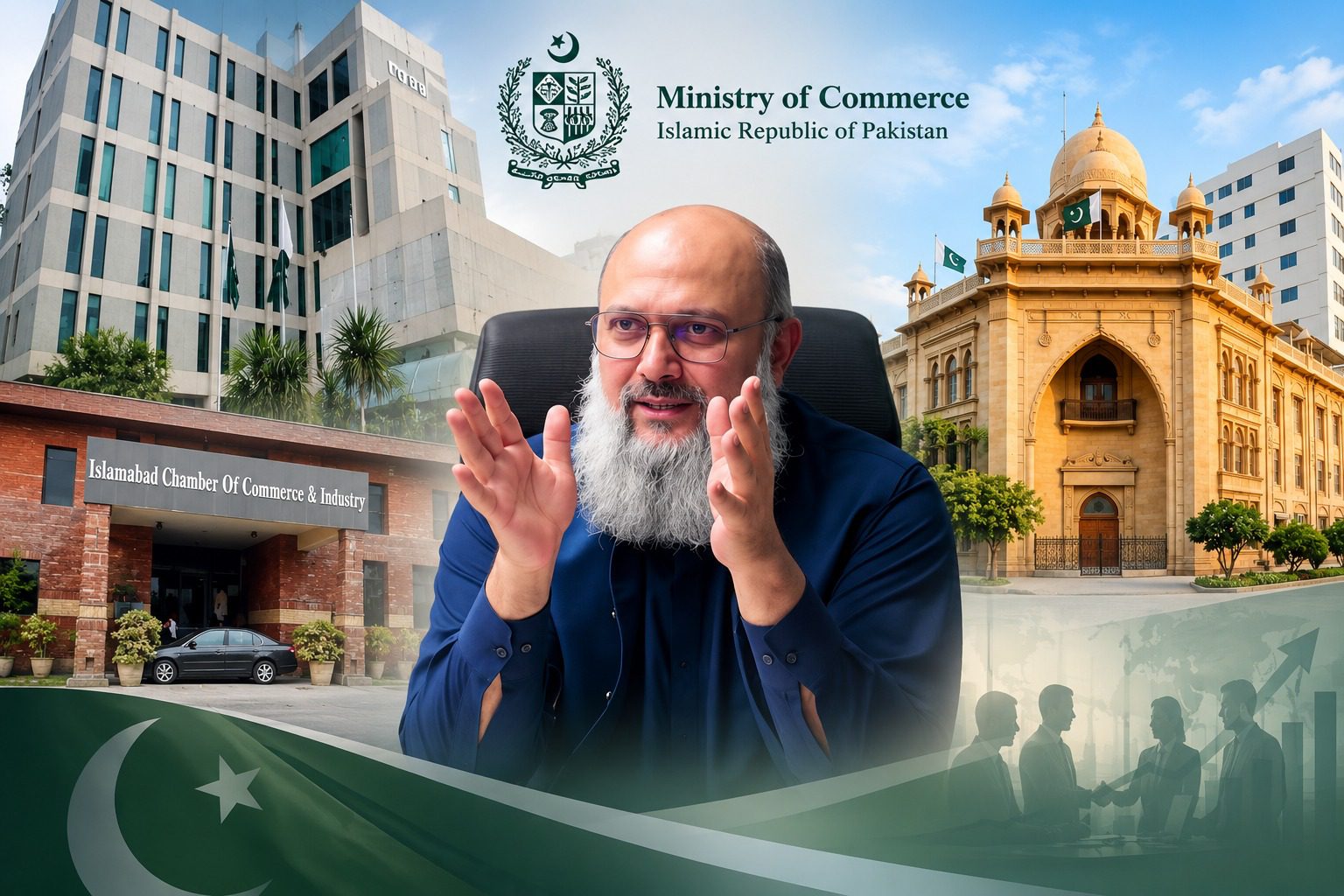
Federal Minister for Commerce Jam Kamal Khan and Director General Trade Organisations (DGTO) Bilal Khan Pasha have outlined a series of measures aimed at making elections of trade bodies more transparent, better documented and increasingly digital. If implemented impartially and consistently, these reforms could substantially reduce disputes among stakeholders and, importantly, the litigation that frequently follows closely contested trade organisation elections.
Among the initiatives, perhaps the most significant is the decision to deploy officers from the Ministry of Commerce, Trade Development Authority of Pakistan (TDAP), State Life Insurance Corporation and other government organisations as independent observers and witnesses during elections.
This is an important institutional development.
Chambers of commerce and trade associations represent businesses before governments and regulators and influence discussions on taxation, trade, industrial policy, investment and economic reforms. Their own electoral processes must therefore command the confidence of the businesses they claim to represent.
Whenever candidates or groups question voter lists, polling arrangements, ballot handling, counting procedures or election results, disagreements can quickly move from election commissions to the DGTO and eventually into prolonged legal proceedings. Such disputes consume time and resources and can damage the credibility of representative business institutions.
The presence of properly trained and genuinely neutral observers can provide an additional layer of institutional credibility.
An observer who witnesses polling, counting and other critical stages can provide an independent account if a dispute subsequently arises. This is particularly important because many election controversies ultimately revolve around conflicting versions of what happened at a polling station or during the counting process.
Independent observation should consequently not be viewed merely as additional government presence. Properly structured, it can become a mechanism for preventing disputes before they turn into litigation.
Jam Kamal Khan’s emphasis on documentation is equally important. A transparent election is not simply one that is conducted fairly; it must also be possible to demonstrate afterwards that it was conducted fairly.
The proposed dedicated election portal on the Ministry of Commerce’s website can play a major role in achieving that objective. Publishing election schedules, applicable laws and rules, notifications, voter lists, results and other relevant information at a central location can provide candidates and voters with equal access to essential election information.
Similarly, requiring trade organisations to submit schedules, voter lists and election results electronically should create a clearer regulatory record.
The proposed digital dashboard for real-time monitoring represents another welcome step towards modernising election oversight. With hundreds of trade organisations operating across Pakistan, traditional paper-based supervision alone makes effective monitoring difficult. Digital reporting can enable the DGTO to identify procedural problems earlier instead of responding only after formal complaints have been filed.
According to the DGTO briefing, around 380 registered trade organisations fall within its regulatory framework and approximately 320 are scheduled to hold elections this year. The scale itself demonstrates why institutional reform and digitalisation have become necessary.
The proposal to issue comprehensive Standard Operating Procedures is also significant. Election disputes often arise not only from deliberate violations but also from different interpretations of procedures. Uniform SOPs can help election commissions, candidates, voters and observers understand precisely what is expected at each stage.
Clear procedures governing voter lists, nominations, ballots, polling, counting, documentation and declaration of results can significantly narrow the space for controversy.
The Commerce Ministry’s coordination with provincial authorities for administrative and security arrangements at major polling venues is another sensible precaution. Highly competitive chamber elections can attract large numbers of voters and supporters. Orderly polling conditions are essential both for voter confidence and for protecting the integrity of the electoral process.
These reforms are particularly relevant for major chambers where elections can be intensely contested and the stakes for rival business groups are high.
However, the ultimate success of the initiative will depend on implementation.
Independent observers must actually be independent. They should neither interfere in the electoral process nor appear aligned with any candidate, alliance or incumbent management. Their role should be clearly defined, their observations properly documented and their conduct governed by uniform guidelines.
A stronger accountability safeguard should therefore accompany the observer system. Each observer should be required to submit a signed post-election report recording significant incidents, objections raised by candidates, polling or counting irregularities noticed, and the response of the election commission. These reports should become part of the official election record and remain available to the DGTO when deciding complaints and appeals. Observers should also disclose any potential conflict of interest before deployment so that their neutrality cannot reasonably be questioned.
Equally important is preservation of the election trail. Final voter lists, ballot-account statements, polling records, counting sheets, results and observer reports should be securely retained for a prescribed period. Where digital systems are used, records should carry timestamps and an auditable history so that material information cannot be altered retrospectively without leaving a trace. This would protect successful candidates against unfounded allegations while giving genuinely aggrieved parties reliable evidence on which to base a complaint.
Accountability must also apply to everyone involved in the process. Where a deliberate and material violation of election rules is established through due process, there should be proportionate consequences under the applicable law and rules. Conversely, frivolous complaints should not be allowed to become a tool for indefinitely obstructing legitimately elected bodies. A credible accountability framework must protect both the right to challenge genuine irregularities and the finality of a lawfully conducted election.
The same principle applies to digitalisation. Technology will strengthen transparency only when information is uploaded accurately, promptly and equally accessible to all stakeholders.
The minister’s direction that officials maintain complete neutrality and strictly follow the Trade Organisations Act and Rules is therefore crucial.
There is also a larger institutional benefit.
When candidates know that voter lists, polling proceedings, counting and results are being properly documented and independently observed, incentives for procedural manipulation diminish. At the same time, unsuccessful candidates are more likely to accept legitimate results when they have confidence in the process.
That is how litigation can be reduced sustainably — not by restricting the right to challenge irregularities, but by making the electoral process sufficiently credible that fewer genuine grounds for disputes emerge.
Jam Kamal Khan and DGTO Bilal Khan Pasha deserve appreciation for moving towards this preventive approach.
Pakistan’s trade bodies need strong internal democracy because their credibility before policymakers ultimately depends upon their credibility among their own members. Elections that repeatedly end in allegations, appeals and court cases weaken institutions that should instead be concentrating their energies on economic policy, exports, taxation, investment and the problems facing businesses.
The 2026-28 elections therefore offer an important test.
If independent observation, digital monitoring, uniform SOPs, transparent voter lists, comprehensive documentation and a verifiable accountability mechanism are implemented effectively, the reforms could establish a stronger model for future trade organisation elections.
The objective should not merely be to complete hundreds of elections by the statutory deadlines. It should be to build an electoral system in which winners and losers alike have confidence that the rules were applied fairly.
The Commerce Ministry has taken an encouraging step in that direction. Now, consistent and impartial implementation — backed by an accountability mechanism that leaves a clear and verifiable record of every important stage — can transform these reforms from administrative measures into lasting institutional improvements for Pakistan’s business representative bodies.


