


Dr. Alamdar Hussain Malik
Pakistan today stands at a troubling crossroads where economic decisions are no longer merely policy choices—they are becoming instruments of public humiliation. What was once considered a technical adjustment tied to global oil markets has now turned into a recurring spectacle of manipulation. Recent data itself exposes this pattern. Within just a few weeks, petrol prices jumped from Rs. 321 per litre in March 2026 to over Rs. 458 per litre, while diesel surged beyond Rs. 520 per litre, marking increases of over 40–55% in a very short span. At the same time, earlier phases show smaller, incremental hikes followed by brief pauses or marginal adjustments, creating an illusion of control. This pattern is not economic management; it is a staged fluctuation that reinforces the perception of policy jugglery rather than stability.
Read also: Fuel price shock amid smart lockdown: Livelihoods in Pakistan hanging by a thread
The repeated increase and occasional cosmetic decrease in petroleum prices is presented as “relief,” but in reality, it is nothing more than a calculated illusion. A closer look at the pricing timeline reveals the inconsistency: petrol stood around Rs. 253 in January 2026, rose gradually to Rs. 266 in early March, then sharply climbed to Rs. 321, and within days escalated further to Rs. 378 and even above Rs. 450 per litre. These abrupt jumps, interspersed with brief holds or negligible adjustments, clearly demonstrate a pattern of large upward shocks followed by minor or symbolic corrections.
However, beyond these numerical fluctuations lies a far more damaging consequence—the steady erosion of public confidence. When citizens repeatedly witness sharp increases followed by token relief, they begin to perceive the entire mechanism as engineered rather than transparent.
This perception breeds distrust, not only in fuel pricing but in the broader economic governance of the country. Households lose the ability to plan their monthly expenditures, small businesses struggle to forecast costs, and investors grow increasingly reluctant to commit resources in an unpredictable environment. Over time, this uncertainty transforms into economic anxiety and social frustration, as people feel that policies are neither stable nor fair. In essence, fuel price jugglery does not merely burden the public financially—it undermines the very confidence that sustains economic activity and weakens the trust between the state and its citizens.
A deeper examination of the pricing structure further strengthens this argument. Even when base prices fluctuate, the burden on consumers remains constant due to embedded fiscal components. Fuel prices are not merely reflecting global crude trends—they are shaped by domestic policy choices, including levies and indirect taxation. Consequently, even when international prices stabilize or slightly decline, the domestic consumer rarely experiences meaningful relief.
Fuel is not just a commodity in Pakistan—it is the backbone of the entire economic structure.
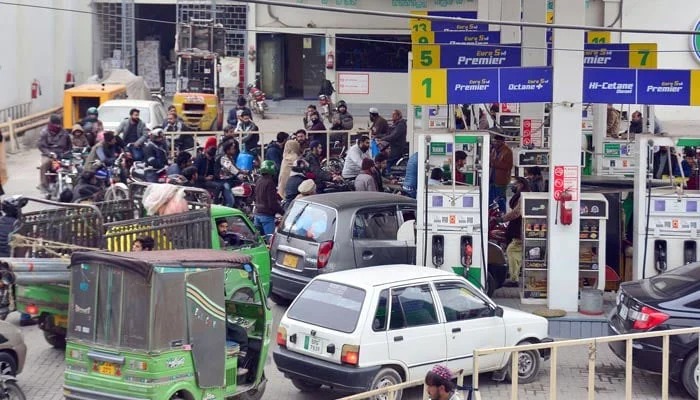
When petrol crossed Rs. 450 and diesel exceeded Rs. 520 per litre, the immediate consequence was a surge in transport and commodity prices, intensifying inflationary pressures across the board. Public transport, agriculture, and supply chains—all heavily dependent on diesel—transmit these increases directly to the common citizen, multiplying the economic burden. Yet, when prices are marginally reduced, there is almost no corresponding decrease in transport fares or essential commodity prices, effectively nullifying any claimed relief.
This policy inconsistency reflects a deeper governance crisis. Instead of adopting a stable and transparent pricing mechanism, authorities appear to rely on reactive decisions driven by external shocks and short-term fiscal needs. Frequent and abrupt revisions within short intervals highlight the absence of a predictable and credible policy framework. Such inconsistency not only disrupts economic planning but also signals institutional weakness.
More damaging, however, is the psychological impact. Constant fluctuations in fuel prices create uncertainty and anxiety among citizens and businesses alike. When prices swing drastically within days, it reflects not resilience but vulnerability. Investors hesitate, industries slow down, and daily wage earners—who operate on the thinnest margins—bear the heaviest burden.
Equally concerning is the absence of accountability. Why are massive increases implemented immediately, while relief—if any—is delayed, diluted, or symbolic? Why does every global fluctuation translate into a domestic crisis without any buffering mechanism? These unanswered questions deepen the perception of unfairness and policy arbitrariness.
The jugglery of fuel prices also raises serious questions about priorities. At a time when people are struggling to make ends meet, the expectation from leadership is stability, foresight, and fairness. Instead, what is delivered is volatility packaged as governance, where perception management appears to take precedence over real relief.
The way forward is neither complex nor unattainable—it requires clarity of intent and consistency of policy. The government must immediately introduce a transparent fuel pricing formula that is publicly available and strictly followed, leaving no room for discretionary manipulation. A petroleum price stabilization fund should be established to cushion sudden international shocks, ensuring that abrupt increases are smoothed rather than passed entirely to consumers. At the same time, there must be parliamentary oversight on fuel taxes and levies, so that revenue generation does not come at the cost of public exploitation. Most importantly, the government must commit to predictability—fixing review intervals, limiting abrupt changes, and ensuring that any relief in global prices is directly and proportionately transferred to the public. This is not merely an economic reform; it is a test of governance credibility.
Without restoring transparency, fairness, and consistency, no policy—however well-intended—will regain the trust that has already been eroded.
If this trend continues, the damage will not be limited to economic indicators. It will deepen public disillusionment, widen the trust deficit between the state and its citizens, and weaken the already fragile social contract. A nation cannot move forward when its people feel misled rather than supported.
Pakistan does not lack resources—it suffers from inconsistency in governance. Fuel pricing should be a tool for stability, not a mechanism for public humiliation. Anything less will only reinforce the painful perception that the nation is being managed, not governed—and that its people are being tested, not served.
Dr. Alamdar Hussain Malik
Advisor, Veterinary Sciences
University of Veterinary and Animal Sciences, Swat
Former Financial Adviser
Finance Division, Government of Pakistan


