



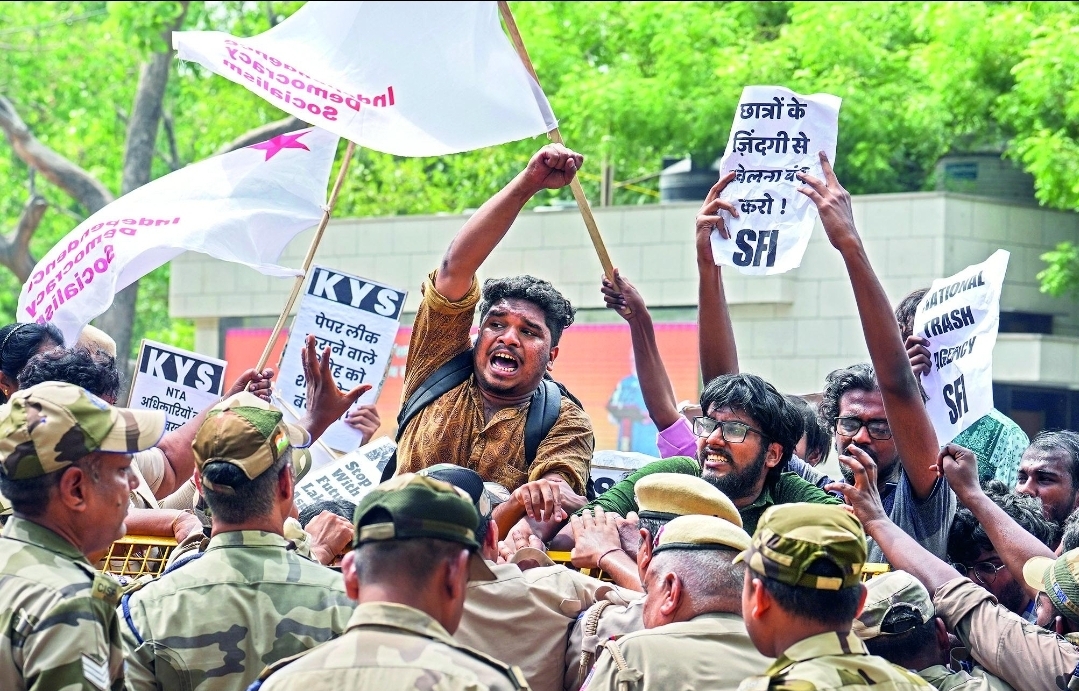
NEW DELHI (Agencies) — A youth-led movement calling itself the Cockroach Janta Party has gained nationwide attention after staging protests in India’s capital, intensifying pressure on authorities over allegations of repeated failures in the country’s education and examination systems.
The group, which began as a satirical social media initiative, has rapidly transformed into a real-world protest platform drawing support from students across several regions. Demonstrators gathered at Jantar Mantar in New Delhi, where they demanded accountability for what they described as systemic flaws in competitive examinations and evaluation processes.
Protesters called for the resignation of Union Education Minister Dharmendra Pradhan, alleging that recurring incidents of paper leaks, administrative lapses, and irregularities in examination marking have eroded trust in India’s academic assessment structure. They argued that these failures have placed enormous pressure on students preparing for high-stakes entrance tests.
The movement is led by student activist Abhijeet Dipke, who is based in the United States but returned to India to participate in the demonstration. Dipke and other organisers said the aim is not only to highlight specific grievances but also to push for broader reform in how national examinations are designed, secured, and evaluated.
During the protest, participants raised slogans demanding transparency, accountability, and systemic reform. They also issued a seven-day ultimatum, warning that if authorities fail to respond, the group will expand demonstrations to other cities across India.
Security forces were deployed around the protest site as a precautionary measure. Authorities closely monitored the gathering, which remained largely peaceful throughout the day. Officials reported no major incidents of violence, although some participants were briefly detained during crowd-control operations.
Despite its unusual name, the Cockroach Janta Party has built a significant online following, particularly among young people who express frustration with competitive education systems and limited employment opportunities. The group’s symbolic identity, according to supporters, reflects resilience in the face of institutional pressure and perceived neglect.
The movement has gained traction on social media platforms, where videos and messages from the protest circulated widely, amplifying its visibility beyond the physical gathering in New Delhi. Analysts say this reflects a growing trend in India, where digital activism increasingly translates into offline mobilisation.
Education-related controversies have been a recurring issue in recent years, particularly in high-stakes entrance examinations for medical and engineering programs. Allegations of question paper leaks and inconsistencies in evaluation have frequently sparked public debate and legal challenges.
Government officials have yet to issue a detailed response to the latest protest demands. However, authorities have previously stated that measures are being taken to improve examination security and strengthen transparency in assessment systems.
The Cockroach Janta Party has warned that its campaign will continue if no concrete action is taken within the given timeframe. Organisers say they plan to escalate their movement through coordinated protests in multiple cities if their demands are ignored.
As the movement expands, it is increasingly being seen as a reflection of deeper youth dissatisfaction in India over education stress, job scarcity, and institutional accountability. Observers note that the group’s rapid rise underscores the growing influence of online-driven activism in shaping public discourse and pressuring policymakers.


