


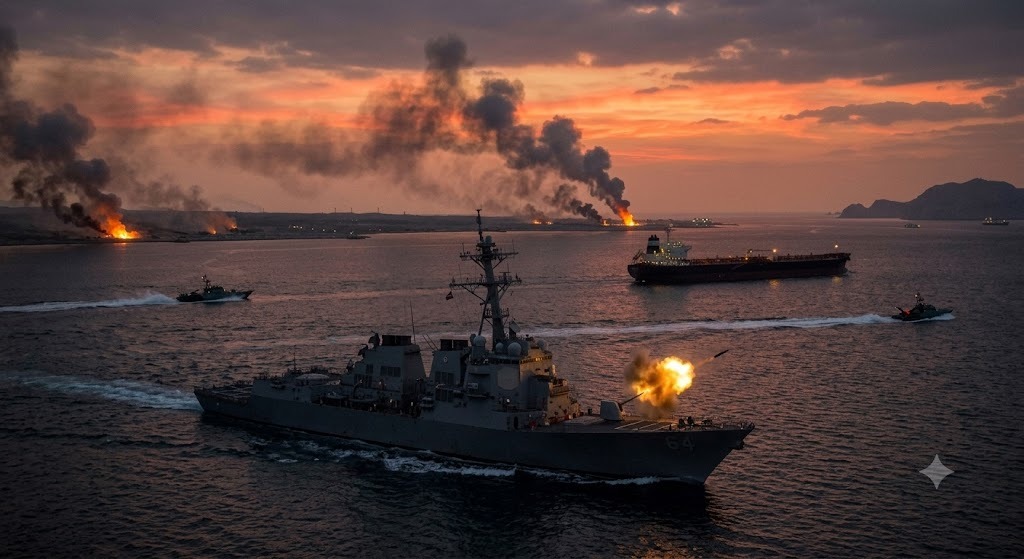
WASHINGTON/TEHRAN — The United States carried out military strikes against targets in Iran for a ninth consecutive day on Monday, while tensions in the Strait of Hormuz intensified after Iran warned that the strategic waterway would remain unsafe during what it described as continued American military action.
According to the US Central Command (CENTCOM), the latest operation targeted military command facilities, coastal surveillance systems, air defence positions, communications infrastructure, missile launch locations and maritime assets. US officials said the strikes were intended to reduce Iran’s ability to launch attacks against commercial shipping and civilian vessels operating in the Gulf.
The latest developments come as hostilities between Washington and Tehran continue following the collapse of an earlier ceasefire arrangement, adding to concerns over regional stability and international energy supplies.
Iranian media reported explosions in several cities, including Tabriz, Chabahar, Konarak, Bandar Mahshahr and Bandar Imam Khomeini. Iranian authorities did not immediately provide official details on the extent of the damage.
US Secretary of State Marco Rubio said Washington would continue military operations if commercial shipping remained under threat.
He stated that the Strait of Hormuz is an international waterway and stressed that the United States remained open to diplomatic efforts while also responding to attacks affecting maritime security.
Meanwhile, Iran’s Islamic Revolutionary Guard Corps (IRGC) announced what it described as operations targeting US military facilities in the region. Iranian state media reported strikes involving military assets linked to US positions in Syria, Jordan and Kuwait, although independent verification of these claims was not immediately available.
Kuwaiti authorities said a desalination facility had been struck for a second consecutive day, resulting in a fire. Officials described the incident as an attack on civilian infrastructure.
Shipping activity through the Strait of Hormuz also remained under close observation. The United Kingdom Maritime Trade Operations (UKMTO) reported receiving information about a vessel catching fire near the coast of Oman but said the cause had not yet been confirmed.
The IRGC also claimed that two oil tankers had suffered explosions while attempting to transit the Strait of Hormuz. Iranian officials alleged that the vessels had been directed through an unsafe route. No independent confirmation regarding the ships, their identities or possible casualties was immediately available.
Iran warned that navigation through the Strait of Hormuz could remain hazardous as long as military operations continue in the region.
Shipping data indicated that fewer vessels passed through the Strait on Sunday compared with the previous day, reflecting growing caution among maritime operators. Analysts continue to monitor the situation closely because nearly one-fifth of the world’s seaborne oil trade moves through the narrow waterway.
Global energy markets reacted to the renewed uncertainty, with international crude oil prices climbing above $90 per barrel during Monday’s trading.
Separately, the US military confirmed that one American service member was killed during an operation involving the disposal of unexploded ordnance from a downed Iranian drone in northern Iraq. US officials also said investigations were continuing into personnel reported missing following earlier attacks.
The conflict has continued to increase security concerns across the Middle East, with governments and international observers urging restraint while monitoring the impact on regional stability, commercial shipping and global energy markets.
As military operations continue, attention remains focused on whether diplomatic efforts can prevent further escalation in one of the world’s most strategically important regions.


