


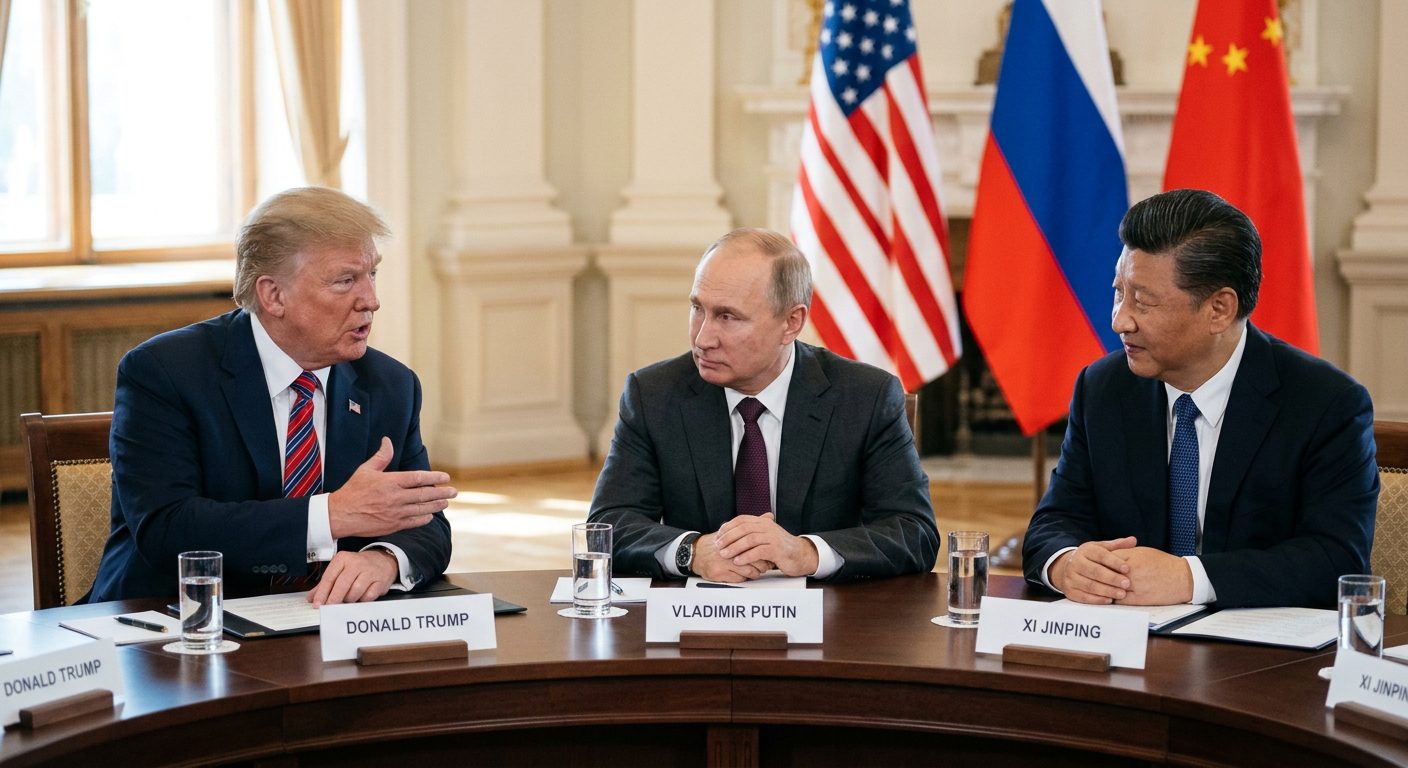
The meeting, scheduled for Thursday on the sidelines of the Asia-Pacific Economic Cooperation (APEC) summit in the southern Chinese city of Shenzhen, would mark the first trilateral gathering involving the leaders of the three major powers.
The proposed discussions come at a particularly sensitive moment in international relations, as Washington, Moscow and Beijing navigate growing strategic competition, regional conflicts and disagreements over the future of global security arrangements.
Trump is expected to place nuclear arms reduction high on the agenda, arguing that the growing danger posed by nuclear weapons requires renewed international attention and cooperation.
White House spokeswoman Olivia Wales said the US president believed nuclear proliferation represented a serious threat and intended to discuss reducing nuclear arsenals with his Russian and Chinese counterparts.
The issue carries particular significance because the United States and Russia possess the world’s largest nuclear stockpiles, while China has been expanding and modernising its nuclear capabilities.
Although the three governments have different positions on arms control, their participation in direct discussions could provide an opportunity to explore possible measures to reduce strategic risks.
However, reaching an agreement is likely to prove difficult because of disagreements over nuclear transparency, weapons modernisation, missile defence systems and the future balance of military power.
Iran is also expected to feature prominently during the discussions, reflecting Washington’s growing concerns over the conflict and its wider consequences for regional stability.
A senior US official said Trump intended to raise the Iranian situation with both Putin and Xi, although details of the proposed discussions have not been disclosed.
Russia and China have maintained important diplomatic and economic relationships with Tehran, making their positions potentially significant in any broader effort to address the conflict.
The absence of Ukraine from the expected trilateral agenda, however, highlights the different diplomatic approaches being pursued by Washington.
US officials said the administration did not consider the Shenzhen meeting an appropriate forum for discussing the war because separate negotiations involving Washington, Kyiv and Moscow were already under way.
The decision could disappoint Ukrainian President Volodymyr Zelensky, who has repeatedly warned against arrangements between major powers that could determine his country’s future without its participation.
Zelensky has expressed concern that the meeting could resemble the 1945 Yalta conference, where major Allied leaders discussed the post-war political settlement and the division of influence across Europe.
His concern reflects fears that powerful countries could attempt to establish informal spheres of influence at the expense of smaller nations’ sovereignty and territorial integrity.
The comparison also raises questions about whether the emerging international order will be shaped through multilateral institutions or direct negotiations between dominant military and economic powers.
Meanwhile, Trump is expected to hold a separate bilateral meeting and working lunch with Xi during his visit.
The encounter will provide another opportunity for Washington and Beijing to address their complicated relationship, which has been shaped by trade disputes, technological competition, military tensions and disagreements over international security.
It will be their fourth meeting since Trump’s return to the presidency last year.
Despite speculation surrounding technology and business interests, US officials indicated that sensitive semiconductor export controls would not be part of the discussions.
Trump will also be accompanied by billionaire entrepreneur Elon Musk, whose business interests include electric vehicles, space technology and artificial intelligence.
However, officials said Musk would not participate in the trilateral meeting involving the three presidents.
Trump is scheduled to depart Washington on Monday, travel to the Philippines on Tuesday for the ASEAN summit and subsequently continue to China.
The Shenzhen gathering could become an important test of whether the world’s three most influential powers can cooperate on shared security concerns despite their competing strategic priorities.
Its outcome may also offer an indication of how international diplomacy will evolve as global conflicts and great-power rivalry increasingly challenge existing political arrangements.