


PARIS (Web Desk) – Thousands of people took to the streets across France on Saturday for a fourth consecutive weekend of demonstrations against the government, as anger over the rising cost of living continued to fuel public discontent ahead of next year’s presidential election.
Although the latest protests attracted fewer participants than previous demonstrations, confrontations between police and protesters in Paris and Lyon underscored the continuing volatility of the movement.
The interior ministry estimated that 146,000 people participated in demonstrations nationwide, including 46,000 in the capital. Trade unions, however, placed the turnout considerably higher, reporting 250,000 protesters across France and 75,000 in Paris.
The figures represented a decline from the previous three weekends of demonstrations. They also followed a major union-led protest on Thursday, which drew 575,000 people according to authorities and 1.6 million according to union organisers.
The protests have developed into a sustained challenge for the government, combining concerns over purchasing power, education spending and public services with broader dissatisfaction over political and economic policies.
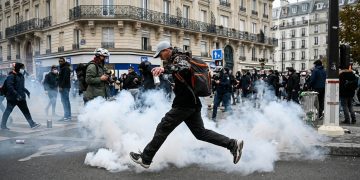
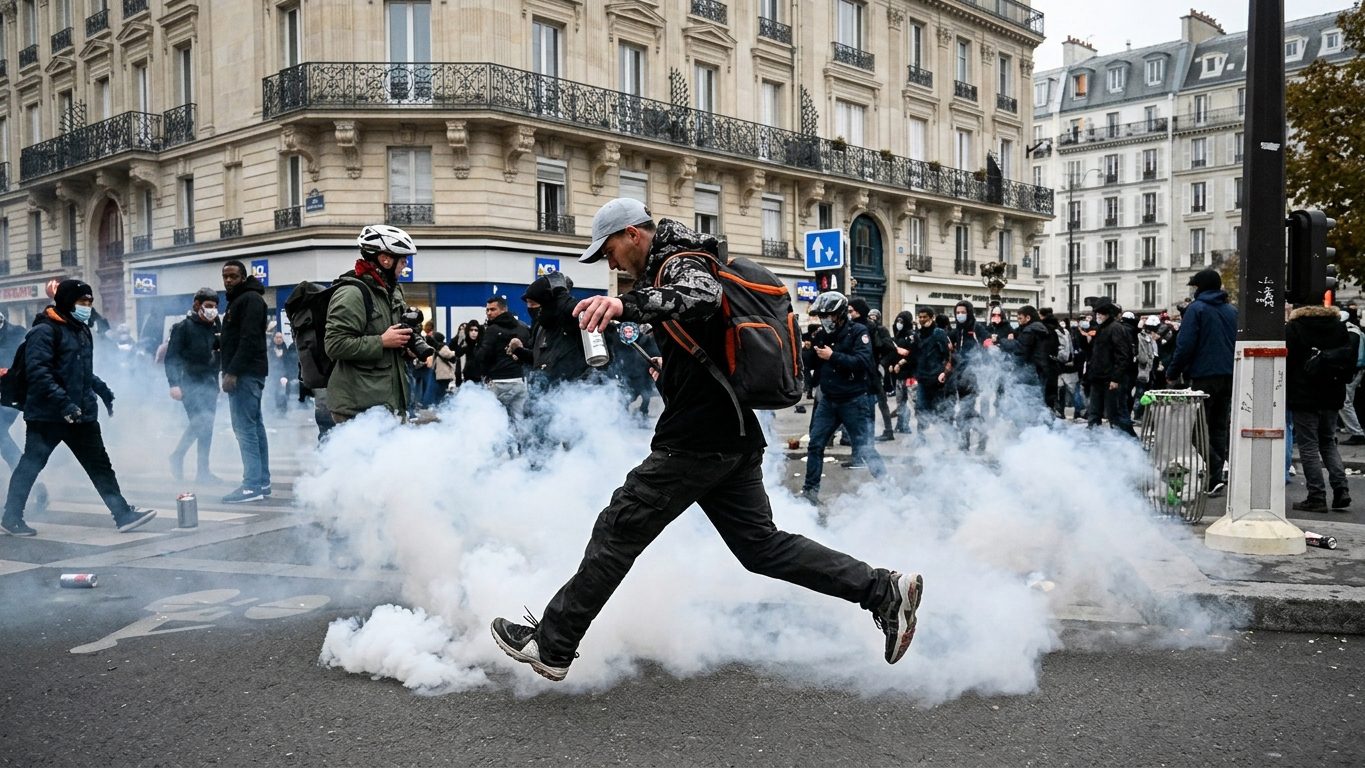
In Paris, a union-organised march followed the traditional route from Place de la Republique to Place de la Nation. Clashes broke out near the end of the march, where police used tear gas after some individuals threw projectiles and homemade fireworks at security forces.
Police said around 200 people engaged in violence against officers as they attempted to arrest a man accused of setting fire to a rubbish bin in the square.
Authorities had deployed approximately 70,000 security personnel nationwide, seeking to prevent a repeat of the serious unrest that followed demonstrations on October 17.
Police restrict rival gathering
The authorities also moved to prevent a separate demonstration organised by the Yellow Vests movement, which called on supporters to gather at Place de la Concorde in central Paris, near the presidential Elysee Palace and parliament.
The gathering had been banned by authorities. Police maintained a strong presence around the area and prevented protesters from approaching the designated location.
Around 100 people who arrived at the square were surrounded by police, while movement coordinator Benjamin Ball and spokeswoman Azelma Sigaux were among those arrested, according to an AFP reporter at the scene.
In Lyon, southeastern France, police fired tear gas to disperse several hundred people who had gathered without authorisation and blocked a road in the city centre.
The Yellow Vests movement previously shook President Emmanuel Macron’s government during the early years of his presidency, becoming a prominent expression of public anger over economic inequality and living costs.
Students remain central to demonstrations
The current wave of protests began in late September, initially involving high school students dissatisfied with conditions at their educational institutions. University students subsequently joined the demonstrations, helping expand the movement.
Student representatives said young people remained determined to maintain pressure on the government, arguing that official responses had failed to address their concerns.
“Today is a date that helps keep the pressure on,” said Sabine Kharbach, spokeswoman for the Student Union, adding that many students remained dissatisfied with the government’s response.
The demonstrations have also raised questions about police conduct. Dozens of internal investigations have been launched into allegations that officers used excessive force against protesters.
The continuing disruption has affected businesses, particularly shops located along major demonstration routes. Some retailers have closed during protest days, while others have covered windows with wooden shutters to reduce the risk of damage or looting.
Jean Emile Moulinier, a shop manager in Paris, said security barriers had discouraged customers from visiting his store during demonstrations.
He warned that the situation could become disastrous for local businesses if the disruption continued.
Government faces economic and electoral pressure
The government is under pressure to respond to demands for higher wages and improved purchasing power while managing France’s substantial public debt, which has raised concerns in financial markets.
Prime Minister Sebastien Lecornu is scheduled to meet trade unions and employer federation representatives on Monday to discuss wages and household purchasing power.
However, the planned talks may not be enough to ease tensions. Student and teacher organisations have called for another strike on Tuesday, demanding increased spending on education.
The protests are unfolding as political parties prepare for the 2027 presidential election, with opinion polls suggesting that the far right has a strong opportunity to win the presidency.
Marine Le Pen has emerged as a leading contender, while hard-left leader Jean-Luc Melenchon is also seeking to position himself as a major challenger.
Addressing a rally attended by around 20,000 people outside Paris on Saturday, Melenchon declared that his movement would win and called for sweeping political change.
The combination of economic dissatisfaction, student mobilisation and political competition is adding pressure on the government as it attempts to contain the demonstrations and restore public confidence.
Saturday’s lower turnout offered some indication that mobilisation may be easing, but continuing calls for strikes and further demonstrations suggest that the unrest is far from resolved.