


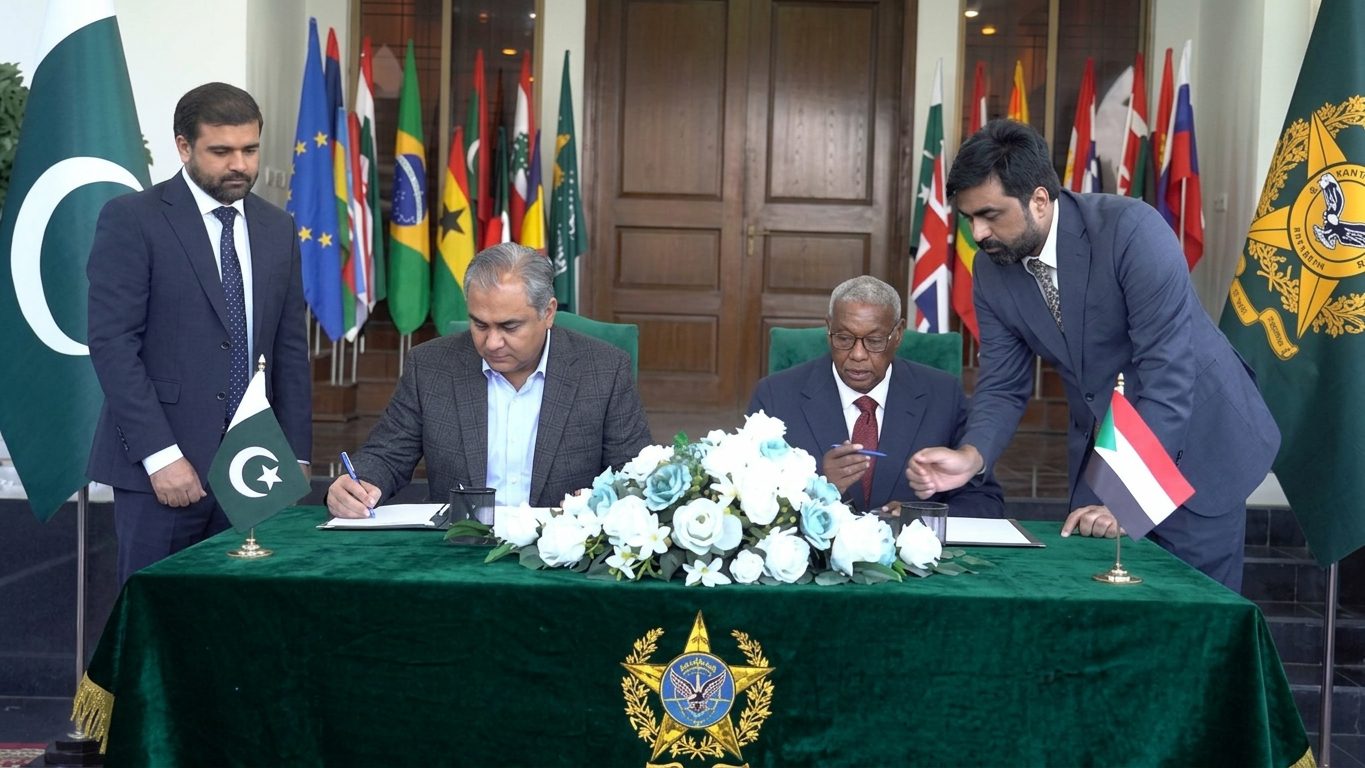
ISLAMABAD (Web Desk) – Pakistan and Sudan have signed an agreement allowing holders of diplomatic and official passports to travel between the two countries without obtaining visas, in a move aimed at strengthening bilateral relations and facilitating government-level engagement.
The agreement was signed in Islamabad by Pakistan’s Interior Minister Mohsin Naqvi and his Sudanese counterpart, Lieutenant General Babiker Samra Mustafa Ali.
Naqvi described the arrangement as an important milestone in relations between the two countries, saying it would make official visits, high-level engagements and exchanges of delegations easier.
He said the visa exemption would also create opportunities for closer institutional contacts and cooperation across different sectors.
The Sudanese minister welcomed the agreement, describing it as a significant step towards strengthening friendly relations and institutional ties. Both sides reaffirmed their commitment to expanding cooperation and maintaining closer contact.
The arrangement applies to diplomatic and official passport holders and does not establish visa-free travel for all citizens of either country.
Broader security cooperation
During their meeting, the two ministers also discussed ways to strengthen collaboration in security, internal affairs, police training, institutional development, cybercrime and matters relating to Pakistan’s National Database and Registration Authority (NADRA).
Both sides agreed to work towards a formal agreement on cooperation against cybercrime, which they intend to sign in the near future.
The proposed arrangement is expected to provide a framework for closer coordination as governments face increasingly complex digital threats, including online fraud, cyberattacks and criminal activity conducted across national borders.
Naqvi said Pakistan was ready to share its experience and expertise with Sudan, particularly in areas related to law enforcement and cybercrime prevention.
He also offered professional training opportunities for Sudanese police officers, saying Pakistani institutions could assist in strengthening the capabilities of their Sudanese counterparts.
The offer reflects an effort to develop practical links between the two countries’ security institutions rather than limiting cooperation to diplomatic exchanges.
Visa difficulties and healthcare support
The discussions also addressed difficulties faced by Sudanese women married to Pakistani nationals and living in Pakistan.
Naqvi directed relevant authorities to take immediate steps to resolve their visa-related problems, according to details of the meeting.
The issue highlighted the practical challenges that can arise for families when immigration procedures become complicated, particularly for foreign spouses residing in Pakistan.
The Pakistani minister also assured his counterpart that Sudanese citizens travelling to Pakistan for medical treatment would be facilitated in accessing healthcare services.
Pakistan has offered to support Sudanese patients seeking treatment in the country, although no specific arrangements or medical facilities were identified in the announcement.
The Sudanese minister welcomed Pakistan’s offers of assistance and expressed interest in benefiting from its experience in areas including cybercrime prevention and institutional development.
He described Pakistan as a brotherly country and said Sudan wanted to strengthen cooperation across a range of sectors. He also thanked the Pakistani government for its support.
Focus on closer bilateral ties
The latest agreement adds to efforts by Islamabad and Khartoum to broaden their relationship through official contacts, institutional cooperation and technical exchanges.
The visa exemption is expected to simplify travel for government representatives and facilitate more frequent meetings between officials. The proposed cybercrime agreement and police training offer could provide further opportunities for cooperation once detailed arrangements are finalised.
However, the two governments have yet to announce a timetable for signing the cybercrime agreement or provide details about the training programmes.
The meeting nevertheless demonstrated a shared interest in strengthening ties beyond traditional diplomatic engagement, with both countries identifying security, technology and institutional development as areas for closer collaboration.