


By M Qadeer
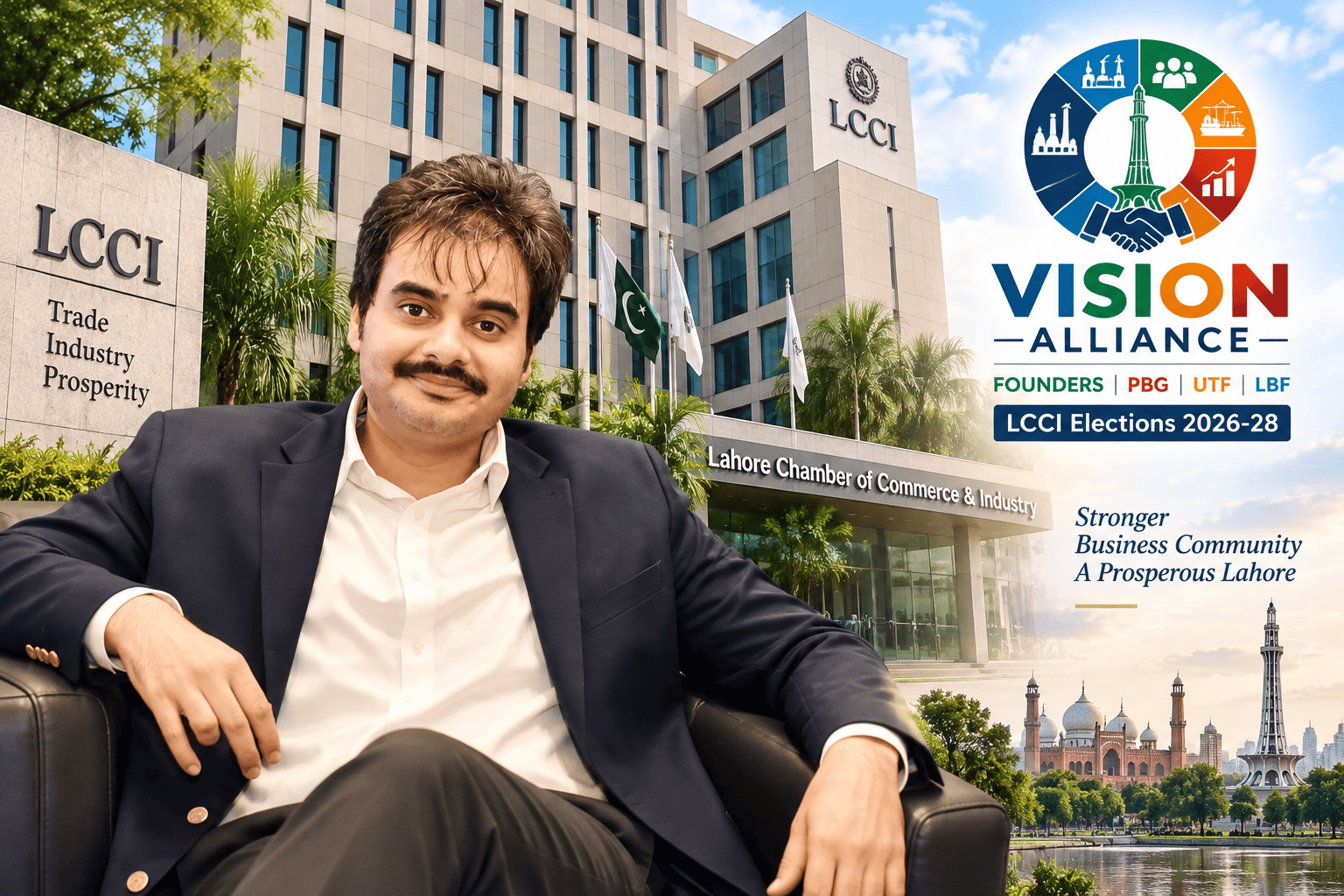
LAHORE: Chairman of the Pioneer Businessmen Group (PBG), Ali Hussam Asghar, has called for greater institutional support for small and medium enterprises (SMEs), saying that the future of Lahore’s economy is closely linked with the growth of smaller businesses and the ability of the business community to operate with dignity, confidence and predictability.
In a statement ahead of the Lahore Chamber of Commerce and Industry (LCCI) elections, Asghar said the chamber should give greater attention to the practical problems faced by traders, manufacturers, SMEs and entrepreneurs and should work as an effective bridge between the business community and government institutions.
PBG is part of the Vision Alliance for the LCCI 2026-28 elections, alongside the Founders Group, Lahore Businessmen Front and the Nasir Hameed Khan Group. The alliance has said its objective is to represent the common interests of Lahore’s business community and strengthen the chamber’s role in raising business concerns before government institutions.
SMEs are the backbone of economic activity
Asghar said SMEs should be treated as an important component of Lahore’s economic strategy because thousands of businesses depend on relatively small-scale commercial and industrial activity.
“Small and medium enterprises are not a secondary part of the economy. They are at the heart of commercial activity and provide livelihoods to a large number of families,” he said.
He said SMEs often face challenges that can be different from those confronting large industrial groups. Access to finance, taxation, regulatory procedures, energy costs, documentation requirements, market access and government facilitation can have a direct impact on their ability to survive and expand.
According to Asghar, a business-friendly policy framework should therefore recognise the different needs of businesses of different sizes.
“An established industrial group may have the resources to employ specialists to deal with complicated procedures, but a small businessman may have to deal with these matters himself. The chamber must understand this difference,” he said.
‘Businessmen deserve dignity and respect’
The PBG chairman said that dignity and respect for businessmen should remain central to the functioning of institutions dealing with the private sector.
“Businessmen are contributing to the economy through investment, employment, production, trade and taxes. Their legitimate concerns deserve to be heard with respect,” he said.
He said the business community should be able to approach government departments and regulatory institutions without unnecessary hurdles.
The objective, he added, should not be confrontation between the public and private sectors but constructive engagement based on facts, consultation and practical solutions.
“A businessman should feel that institutions are there to facilitate legitimate economic activity. Respect for the business community does not mean that businesses should be above the law. It means that laws and regulations should be implemented fairly, transparently and professionally,” Asghar said.
LCCI should strengthen its role as a bridge
Asghar said the LCCI has an important institutional role because it can bring the concerns of businesses directly to policymakers.
He said the chamber should maintain regular engagement with federal and provincial departments and should follow up on issues raised by members.
“The chamber should not only identify problems. It should also prepare proposals, present them before the relevant authorities and follow their implementation,” he said.
He stressed that businessmen needed to know whether their complaints and proposals were actually being pursued.
“Representation should not end with a meeting or a press statement. There must be follow-up,” he added.
The LCCI Election Commission has finalised arrangements for the 2026 elections and said the process would be conducted transparently, peacefully and according to the applicable law.
Predictability is essential for investment
Asghar said investors and entrepreneurs require predictability before making long-term business decisions.
He said businesses calculate taxation, energy, financing, labour, logistics and regulatory costs before expanding operations or making new investments.
“If the business environment is unpredictable, a businessman naturally becomes cautious about expansion. We need policies that allow entrepreneurs to plan for the next five, 10 or 15 years,” he said.
He called for greater consultation with the private sector before major policies affecting businesses are introduced.
“Consultation should take place before problems emerge, not only after the business community starts protesting,” he said.
Easier access to finance for SMEs
The PBG chairman said access to affordable and timely financing remained important for SMEs.
He said many small businesses had viable ideas and markets but lacked the financial resources necessary to expand.
“An entrepreneur may have a good product, customers and the ability to create employment, but without working capital or access to finance, growth becomes difficult,” he said.
He suggested that the chamber should strengthen its interaction with financial institutions and explore mechanisms through which legitimate SMEs could obtain better information about available financing facilities.
He also called for greater financial literacy among small entrepreneurs so they could understand banking procedures, documentation requirements and financing options.
Energy costs affect competitiveness
Asghar said energy costs were another major concern for industrial and commercial enterprises.
He said industries needed reliable energy supplies at competitive costs to remain viable and expand production.
“When production costs rise sharply, the impact is not limited to one factory. It affects prices, competitiveness, investment and employment,” he said.
He called for sustained dialogue between the business community and policymakers on energy-related issues.
Rather than treating energy only as an individual industry’s problem, he said it should be considered part of a broader industrial competitiveness strategy.
Tax system should be predictable
The PBG chairman said the business community recognised the importance of taxation but wanted a system that was predictable, transparent and easier to comply with.
“Businesses understand that the state needs revenue. At the same time, the taxation system should encourage documentation and expansion rather than create unnecessary uncertainty,” he said.
He said the chamber should continue providing policymakers with feedback about the practical consequences of tax measures.
According to Asghar, businesses should be given an opportunity to explain how proposed regulations affect different sectors before policies are finalised.
Focus on exports and market expansion
Asghar said Lahore’s businesses had considerable potential to expand into international markets.
He said LCCI could support exporters through market intelligence, international business contacts, trade delegations and interaction with foreign chambers and commercial missions.
The LCCI president has also recently emphasised stronger links between Pakistan’s business community and diplomatic missions to promote trade, investment and business-to-business connections.
Asghar said export promotion required more than trade delegations.
“We need competitive products, reliable production, efficient logistics, predictable policies and access to information about international markets,” he said.
He added that SMEs should also be encouraged to become part of export supply chains.
Young entrepreneurs need opportunities
The PBG chairman said young entrepreneurs should receive greater opportunities to participate in the formal business ecosystem.
He said young people increasingly wanted to establish businesses in technology, services, manufacturing, e-commerce and other emerging sectors.
“LCCI should create more opportunities for young entrepreneurs to interact with experienced businessmen, financial institutions and international companies,” he said.
He suggested that mentorship, networking, training and market-access programmes could help young entrepreneurs turn ideas into sustainable businesses.
Business representation should be inclusive
Asghar said representation within a chamber should reflect the diversity of the business community.
He said Lahore has large industrial groups, SMEs, manufacturers, traders, exporters, retailers, wholesalers, service providers and emerging technology businesses.
“Every category has its own concerns. A chamber becomes stronger when all of these voices are heard,” he said.
He said the purpose of business groups and alliances should ultimately be to provide effective representation rather than create divisions within the business community.
‘The chamber belongs to its members’
Asghar said LCCI should remain accessible to its entire membership.
“The chamber belongs to its members. Its strength comes from the confidence of the business community,” he said.
He called for greater interaction between elected representatives and ordinary chamber members.
According to him, members should be able to communicate their concerns and receive updates about issues being pursued on their behalf.
“Accessibility is extremely important. A businessman should feel that he can approach the chamber and that his concern will be heard,” he said.
Need for constructive public-private partnership
Asghar also stressed the importance of public-private partnership in economic policymaking.
He said government institutions possessed regulatory authority while the private sector had direct experience of markets, production and investment.
“Good policy requires both perspectives. Policymakers need to understand what is happening on the ground, while businesses need to understand the government’s economic objectives,” he said.
He said LCCI could play a constructive role by bringing the two sides together.
The chamber’s recent discussions with government officials have also focused on business conditions and the importance of involving stakeholders in policymaking.
PBG’s role in Vision Alliance
Asghar said PBG’s participation in the Vision Alliance reflected its emphasis on broader cooperation among business groups.
PBG, the Founders Group, LBF and the Nasir Hameed Khan Group announced their joint participation in the LCCI elections, saying their stated objective was to protect common business interests and make the chamber’s role more effective.
He said cooperation among different business groups could provide a broader platform for discussing the concerns of traders and industrialists.
“The business community has many different voices, but there are also many common interests. We should focus on those common interests,” he said.
‘Economic growth must begin with business confidence’
Asghar said economic growth could not be sustained without confidence among entrepreneurs and investors.
He said businesses needed to believe that their investments would be supported by a stable and predictable environment.
“If businessmen are confident, they invest. When they invest, factories expand, shops grow, services increase and employment opportunities are created,” he said.
He added that improving the business environment should therefore be considered part of the broader economic development agenda.
Message to the business community
The PBG chairman said the LCCI election should be viewed as an opportunity for members to discuss the future direction of their chamber.
He said businessmen should focus on policies, institutional performance and the practical needs of their businesses.
“Our business community is mature and understands its responsibilities. It knows that strong institutions are important for economic development,” he said.
He reiterated that his emphasis would remain on SMEs, business facilitation, dignity of businessmen, investment, exports and stronger engagement between the private sector and government.
“Lahore’s business community needs an LCCI that listens, engages and follows through. Our focus should be on creating an environment where businessmen can work with confidence and dignity and where SMEs can grow into larger enterprises,” Asghar said.


