


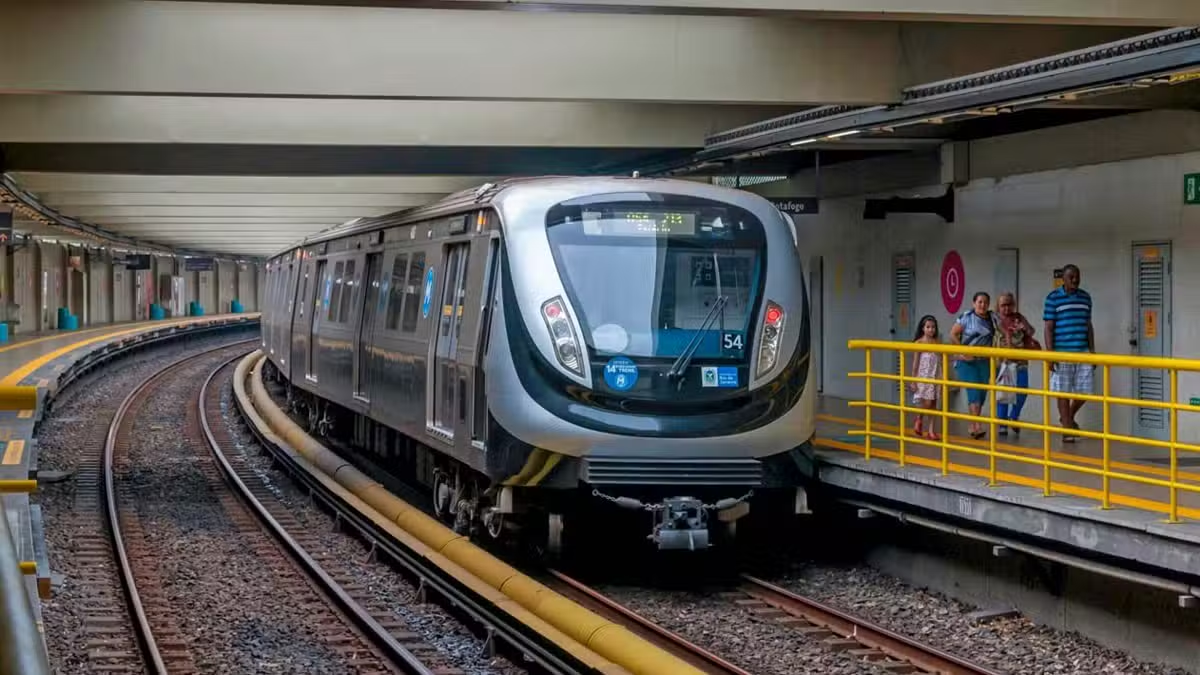
KARACHI (Web Desk) – The Pakistan Academy of Engineering (PAE) has proposed the development of Karachi’s first underground railway network, describing it as a long-term solution to the city’s increasing traffic congestion and growing public transport needs. The proposal was presented during the academy’s 40th Symposium on urban mobility, where local and international experts discussed modern transit systems for megacities.
The symposium, titled “Importance of Underground Mobility in a Megacity,” brought together transport planners, engineers, and infrastructure specialists from Pakistan, the United States, and China. Participants examined the performance of underground railway systems operating in major cities, including Singapore, New York, Washington DC, Delhi, Friedberg, and Dhaka, to identify solutions that could be adapted for Karachi.
Following the discussions, the experts unanimously recommended constructing two underground railway corridors to improve mobility across the city. The first proposed route would run from Numaish Chowrangi to Merewether Tower, connecting central Karachi with one of its busiest commercial districts. The second corridor would extend from FTC on Shahrah-e-Faisal to I.I. Chundrigar Road and Tower, linking major business centres and employment hubs.
According to the Pakistan Academy of Engineering, the proposed underground railway is intended to complement Karachi’s existing Bus Rapid Transit (BRT) network rather than replace it. The integrated transport system would allow commuters to move more efficiently between different parts of the city while reducing dependence on private vehicles.
PAE President Prof. Dr. Brig. (retd.) Nasim Akhtar Khan said Karachi’s rapidly expanding population requires long-term infrastructure planning instead of temporary traffic management measures. He noted that an underground railway could provide a sustainable, high-capacity transport system capable of meeting the city’s future mobility demands.
Experts at the symposium highlighted several potential benefits of the project. They said an underground railway would help ease traffic congestion on major roads, shorten travel times, improve connectivity between residential and commercial areas, and provide a more reliable public transport option for millions of residents. The system could also contribute to lower vehicle emissions and improved air quality by encouraging greater use of mass transit.
Karachi, Pakistan’s largest city and economic hub, continues to experience rising traffic volumes as its population grows. Existing road infrastructure faces increasing pressure from private vehicles, commercial transport, and daily commuters, making the expansion of mass transit services an important priority for urban planners.
The proposed underground railway would represent one of the largest public transport infrastructure projects in Karachi’s history if approved. However, the academy has not announced estimated construction costs, funding arrangements, or a proposed implementation timeline. Government approval, feasibility studies, and detailed engineering assessments would be required before the project could move into the planning and construction phases.
While the proposal remains at a conceptual stage, transport experts believe underground rail transit could play a key role in improving Karachi’s long-term transportation network. By integrating with existing BRT services and future urban transport projects, the system could help create a more efficient, sustainable, and accessible public transport network for one of South Asia’s largest metropolitan cities.


