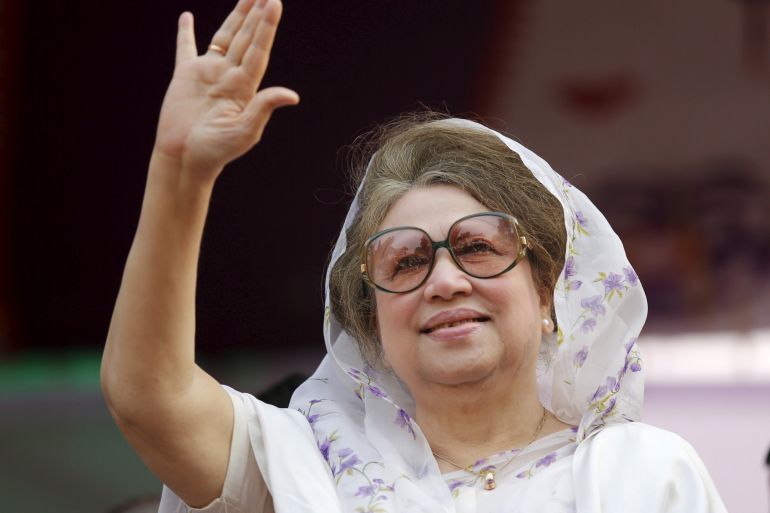



DHAKA (Web Desk) – Khaleda Zia, Bangladesh’s first female prime minister and one of the most influential political figures in the country’s modern history, passed away on December 30, 2025, at the age of 80 after a prolonged illness, according to media reports citing family sources and BNP officials.
Read also: Lieutenan Genral Waqer-Uz-Zaman appointed new Army Chief of Bangladesh
Khaleda, who led the Bangladesh Nationalist Party (BNP) for more than four decades, had been battling multiple health complications, including advanced liver and cardiac disease. In her final months, she remained largely homebound and under continuous medical supervision. Her spokesman said she spent her last days surrounded by close family members, including her son Tarique Rahman, who is now the acting chairman of the BNP.
Born on August 15, 1945, Khaleda Zia entered national politics unexpectedly following the 1981 assassination of her husband, then–President Ziaur Rahman, founder of the BNP. Widowed and largely reserved from political life until then, she rose to political prominence swiftly, taking over leadership of the BNP and later becoming the country’s first woman to hold the office of prime minister.
Khaleda first served as prime minister from 1991 to 1996, ushering Bangladesh into its first democratic government after years of military rule. She returned to power in 2001, leading a coalition government until 2006. Her years in office saw major political and economic shifts, as well as periods of intense street agitation, political polarization, and bouts of instability.
Her lifelong political rivalry with Sheikh Hasina, current prime minister and leader of the Awami League, defined political discourse in Bangladesh for decades. The two leaders were often referred to by analysts as the “battling Begums,” symbolizing the deeply divided nature of Bangladeshi politics.
After leaving office, Khaleda Zia faced a series of corruption cases. She was imprisoned in 2018 on graft charges that her party strongly claimed were politically motivated. Due to deteriorating health, she was later granted conditional freedom and shifted to home care.
Khaleda leaves behind a legacy of both transformative leadership and contested political memory. Supporters hail her as a pioneer of women’s leadership in a Muslim-majority nation and a defender of multiparty democracy, while critics point to periods of political violence, allegations of corruption, and accusations of authoritarian tendencies under her governments.
Funeral arrangements are expected to be announced by her family and the BNP. Leaders across the region are anticipated to issue condolences, marking the end of an era in South Asian politics.