


By Our Correspondent
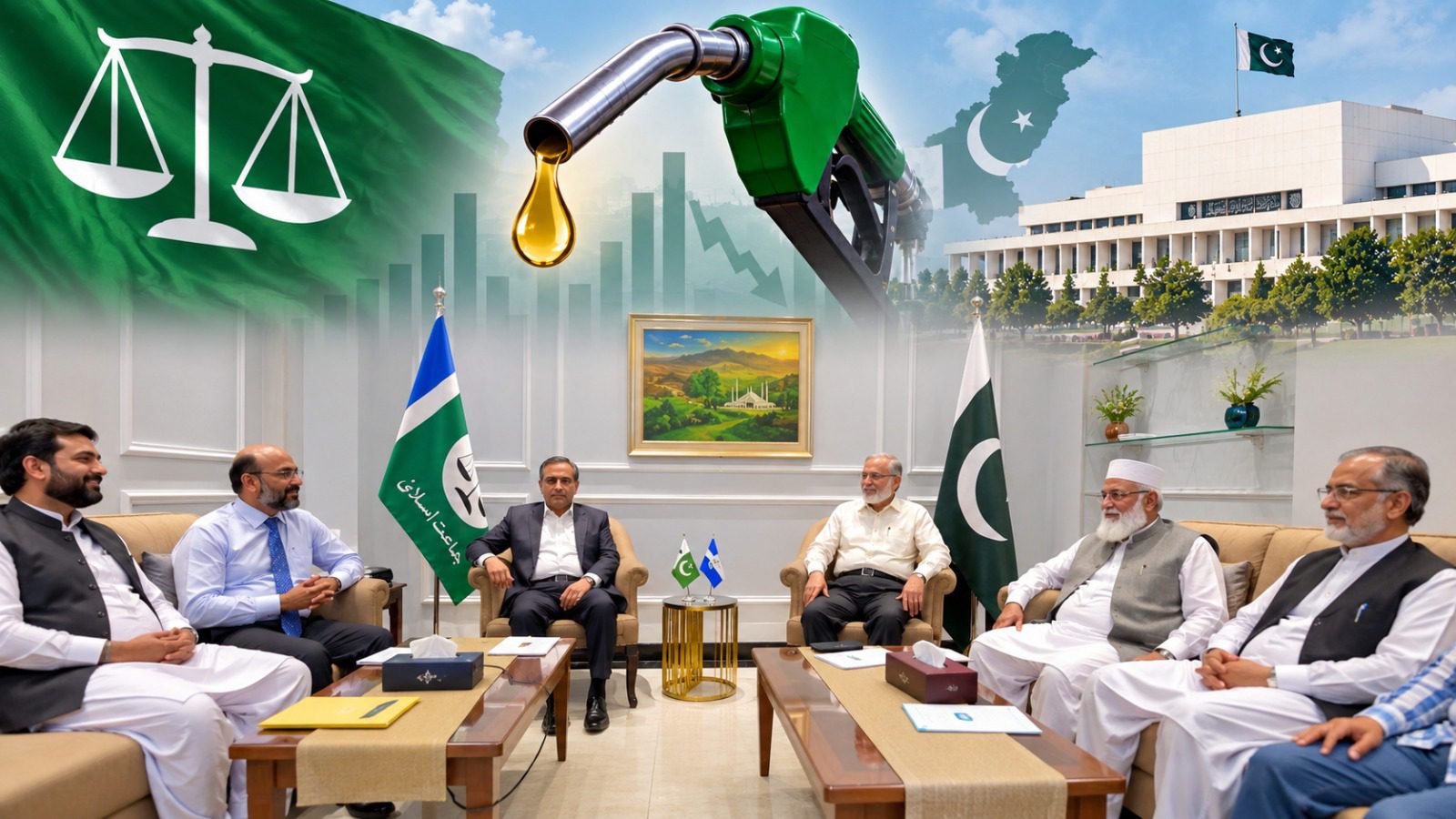
ISLAMABAD: The federal government and Jamaat-e-Islami (JI) on Monday formally opened negotiations over the petroleum levy, bringing the two sides to the table as the opposition party continues to demand relief for consumers facing high fuel costs.
The negotiations mark an important development in the ongoing dispute over the petroleum levy, which has become the central focus of Jamaat-e-Islami’s recent protest campaign.
A JI delegation led by Deputy Emir Liaqat Baloch is participating in the negotiations with the government team.
The Jamaat-e-Islami delegation also includes Syed Firasat Shah, Nasrullah Randhawa, Inayatullah Khan, Ziauddin Ansari Advocate, Naveed Ali Baig and Shahid Naeem.
The government’s negotiating team is being led by Federal Minister for Planning Ahsan Iqbal, while Rana Sanaullah Khan and Ali Pervaiz Malik are also participating in the talks.
Petroleum levy at centre of negotiations
The petroleum levy is expected to dominate the discussions, with Jamaat-e-Islami preparing to present proposals aimed at either abolishing the levy or substantially reducing its impact on consumers.
JI representatives will formally explain their position to the government and propose measures that could provide relief to the public from the financial burden associated with fuel taxation.
The party has made the petroleum levy one of the key issues in its campaign against rising living costs, arguing that taxes and levies imposed on petroleum products ultimately affect almost every section of society.
Changes in petrol and diesel prices have a wider economic impact because fuel costs influence transportation, agriculture, industry and the movement of goods across the country.
JI seeks relief for consumers
Jamaat-e-Islami is expected to press the government to explore alternatives that could allow it to reduce or eliminate the petroleum levy without transferring additional costs to ordinary consumers.
The party has maintained that the burden of raising government revenue should not disproportionately fall on people already struggling with high household expenses.
The negotiations follow sustained political pressure from JI over the petroleum levy and inflation.
The party has been holding protests and sit-ins at different locations as part of its campaign for relief, while its leadership has repeatedly indicated that the issue should ultimately be resolved through meaningful negotiations with the government.
The opening of formal talks therefore represents a potentially significant stage in the campaign.
Government faces revenue challenge
For the government, however, any decision concerning the petroleum levy would have financial implications because the levy represents an important source of federal revenue.
This creates a difficult balancing act for policymakers: providing relief to consumers while also meeting the government’s fiscal and revenue requirements.
The talks are consequently expected to focus not only on JI’s demand for relief but also on whether alternative measures can be identified to compensate for any reduction in petroleum levy collections.
Neither side had announced an agreement at the start of the negotiations.
Fuel prices remain sensitive issue
The negotiations are taking place at a time when petroleum prices remain a politically and economically sensitive issue in Pakistan.
Higher petrol prices directly affect motorists and commuters, while increases in diesel prices can have broader consequences because diesel is extensively used in commercial transport, agriculture and the movement of essential commodities.
As transport and production costs rise, businesses can pass some of those expenses on to consumers, adding pressure to household budgets.
This wider impact has made fuel taxation a major component of Jamaat-e-Islami’s campaign for economic relief.
Talks could determine future of protests
The outcome of the government-JI negotiations could also influence the future direction of the party’s protest movement.
If the two sides reach an understanding on reducing the petroleum levy or providing alternative relief, it could pave the way for de-escalation of the dispute.
However, failure to make progress could lead Jamaat-e-Islami to maintain pressure on the government over the issue.
JI has already sought to make the petroleum levy a national public-interest issue rather than limiting its campaign to fuel prices alone, linking it with inflation and the broader cost-of-living pressures faced by households.
The presence of senior political figures on both sides indicates that the government and Jamaat-e-Islami are treating the negotiations seriously.
Focus now on possible breakthrough
Attention will now turn to the proposals presented by Liaqat Baloch’s delegation and the response from the government team headed by Ahsan Iqbal.
A key question will be whether the government is prepared to consider a reduction in the levy and, if so, how any resulting revenue shortfall would be addressed.
For Jamaat-e-Islami, the negotiations provide an opportunity to translate its protest campaign into concrete relief measures.
For the government, the talks offer a chance to address the political pressure surrounding fuel prices while explaining the fiscal constraints behind petroleum taxation.
With the petroleum levy directly connected to fuel prices and indirectly affecting transportation and other economic activity, any decision emerging from the negotiations could have implications beyond the immediate political dispute.
The talks are therefore likely to remain closely watched as both sides attempt to find common ground between public relief and the government’s revenue needs.


