


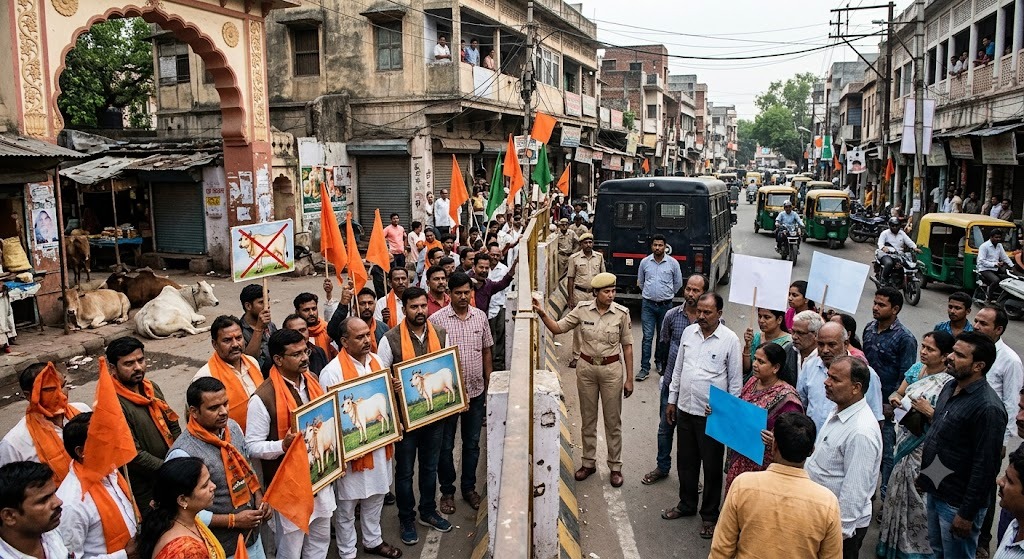
NEW DELHI (Agencies) — A renewed national debate has emerged in India over cow slaughter regulations, with conflicting state-level policies, economic considerations, and rising political rhetoric contributing to a sensitive and often polarized public discourse.
The issue has gained attention following allegations from critics who claim that enforcement of cow protection laws is being selectively applied in some regions, leading to concerns about discrimination against minority communities, particularly Muslims involved in livestock trade and meat processing industries.
Political leaders have repeatedly emphasized the importance of maintaining law and order in connection with cow protection laws. In past remarks frequently cited in public discourse, Prime Minister Narendra Modi has stressed that no individual or group should take the law into their own hands, particularly in relation to vigilante actions linked to cattle protection. These statements are often referenced in debates surrounding enforcement and mob-related incidents.
At the same time, India’s cattle and meat industry presents a complex economic picture. The country is widely recognized as one of the major exporters of buffalo meat globally, contributing significantly to agricultural exports and rural employment. However, cow slaughter remains banned or heavily restricted in several states due to religious, cultural, and legislative protections.
This has created a patchwork of regulations across the country. Some Indian states enforce strict bans on cow slaughter, while others allow regulated cattle trade and processing under specific conditions. The differences in state policies have led to inconsistencies in enforcement, particularly in interstate cattle movement, where legal interpretations often vary.
Law enforcement agencies in several northern and central Indian states have increased monitoring of cattle transport in recent years, citing concerns over illegal smuggling and violations of state laws. These operations have sometimes led to arrests and confrontations, which critics argue risk escalating tensions in already sensitive communal environments.
Supporters of strict cow protection laws argue that these measures are necessary to preserve cultural and religious values and to prevent illegal slaughter practices. They maintain that enforcement is aimed at upholding state legislation rather than targeting any specific community.
However, civil rights groups and opposition voices continue to raise concerns about the social impact of these laws, particularly on small traders, farmers, and workers dependent on the livestock economy. They argue that inconsistent enforcement and occasional vigilante activity have created fear and uncertainty in some communities.
The ongoing debate reflects deeper divisions in Indian society over religion, law enforcement, economic policy, and minority rights. Cow-related legislation has increasingly become a politically sensitive issue that extends beyond agriculture into national identity and governance.
The policy divergence between states affects trade flows, rural livelihoods, and interstate commerce in livestock. It also influences political narratives, especially during elections or periods of heightened communal sensitivity.
Analysts expect continued legal scrutiny and political debate over cow protection laws, with possible judicial interventions aimed at clarifying enforcement standards and reducing inconsistencies across states.
In the wider South Asian context, developments in India are often discussed in Pakistan’s media as part of regional political discourse. However, Pakistan’s livestock industry operates under different legal and cultural frameworks, with beef and cattle trade regulated primarily on economic and food security grounds rather than religious prohibition laws.