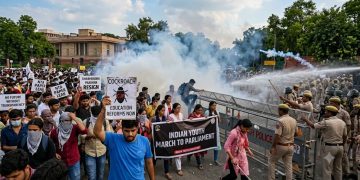



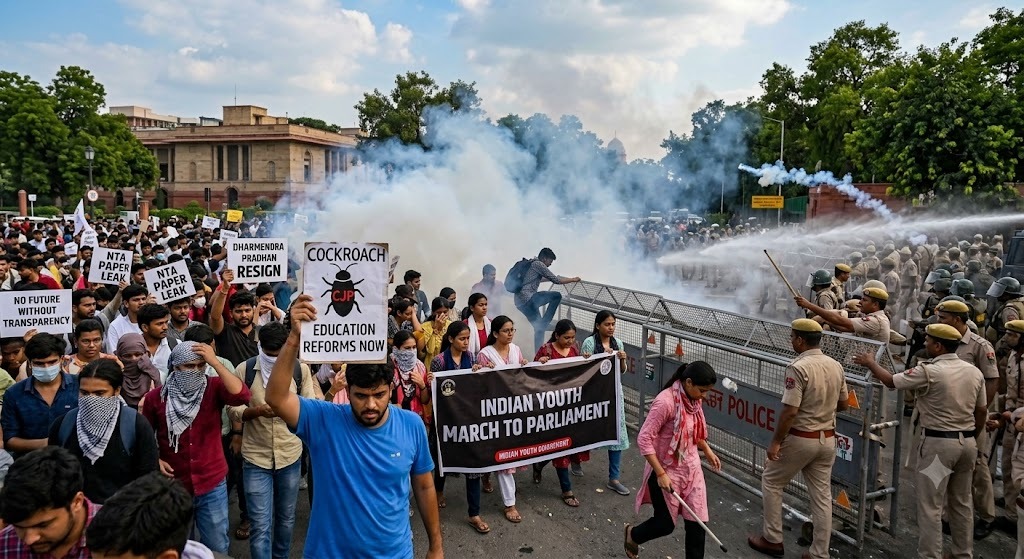
NEW DELHI (Web Desk) — Police in India’s capital used tear gas and batons on Monday to disperse demonstrators attempting to march toward Parliament, as supporters of a youth-led protest movement called for education reforms and the resignation of Education Minister Dharmendra Pradhan.
Thousands of people gathered at Jantar Mantar, New Delhi’s designated protest site, before groups of demonstrators attempted to move toward Parliament despite authorities denying permission for the march. Police had tightened security around the parliamentary complex as the monsoon session of Parliament began.
According to Delhi Police, restrictions were imposed to maintain public order and protect the high-security zone surrounding Parliament. Officers intervened after protesters attempted to cross security barricades, leading to clashes in which tear gas and batons were used to disperse sections of the crowd.
Protest organisers criticised the police response, describing the demonstration as peaceful and accusing authorities of using excessive force. Many participants continued marching in smaller groups after the initial confrontation.
The protest movement, known as the Cockroach Janta Party (CJP), emerged earlier this year after a remark made during a court hearing was adopted by young activists as a symbol of protest. The campaign has since grown rapidly on social media and evolved into a wider movement focused on education policy and government accountability.
The demonstrations have been fuelled by public concern over repeated allegations of question paper leaks in competitive examinations for medical colleges and government jobs. Protesters are demanding reforms to the examination system, greater transparency and the resignation of the education minister.
The movement has also drawn attention following the hospitalisation of activist Sonam Wangchuk, who has been on a prolonged hunger strike. Wangchuk has called for action on education-related concerns and greater engagement between the government and protest leaders.
In a possible sign of dialogue, representatives of the movement met Health Minister J.P. Nadda on Monday. Protest leaders said they presented their demands during the meeting, including calls for reforms in the examination system and changes in the education ministry.
The demonstrations have attracted support from students, professionals and civil society groups across several Indian cities. Opposition parties and rights advocates have also expressed concern over the handling of the protests, while the government has maintained that security measures are necessary to preserve public order.
The protests represent one of the most significant public demonstrations faced by Prime Minister Narendra Modi’s government in recent months, with the debate now extending beyond education to broader issues of accountability and public engagement.
Authorities continue to monitor the situation in New Delhi as Parliament remains in session and further demonstrations are expected in the coming days.


