


WASHINGTON/TEHRAN: The United States and Iran exchanged another round of military strikes on Friday, as the conflict widened across the Gulf region and raised fresh concerns about energy security, commercial shipping and regional stability.
The latest military exchanges came as the United States carried out overnight strikes in southern Iran, while Iranian forces reported retaliatory attacks against targets in several Gulf countries and elsewhere in the region, according to US Central Command (CENTCOM), Iranian state media and the BBC.
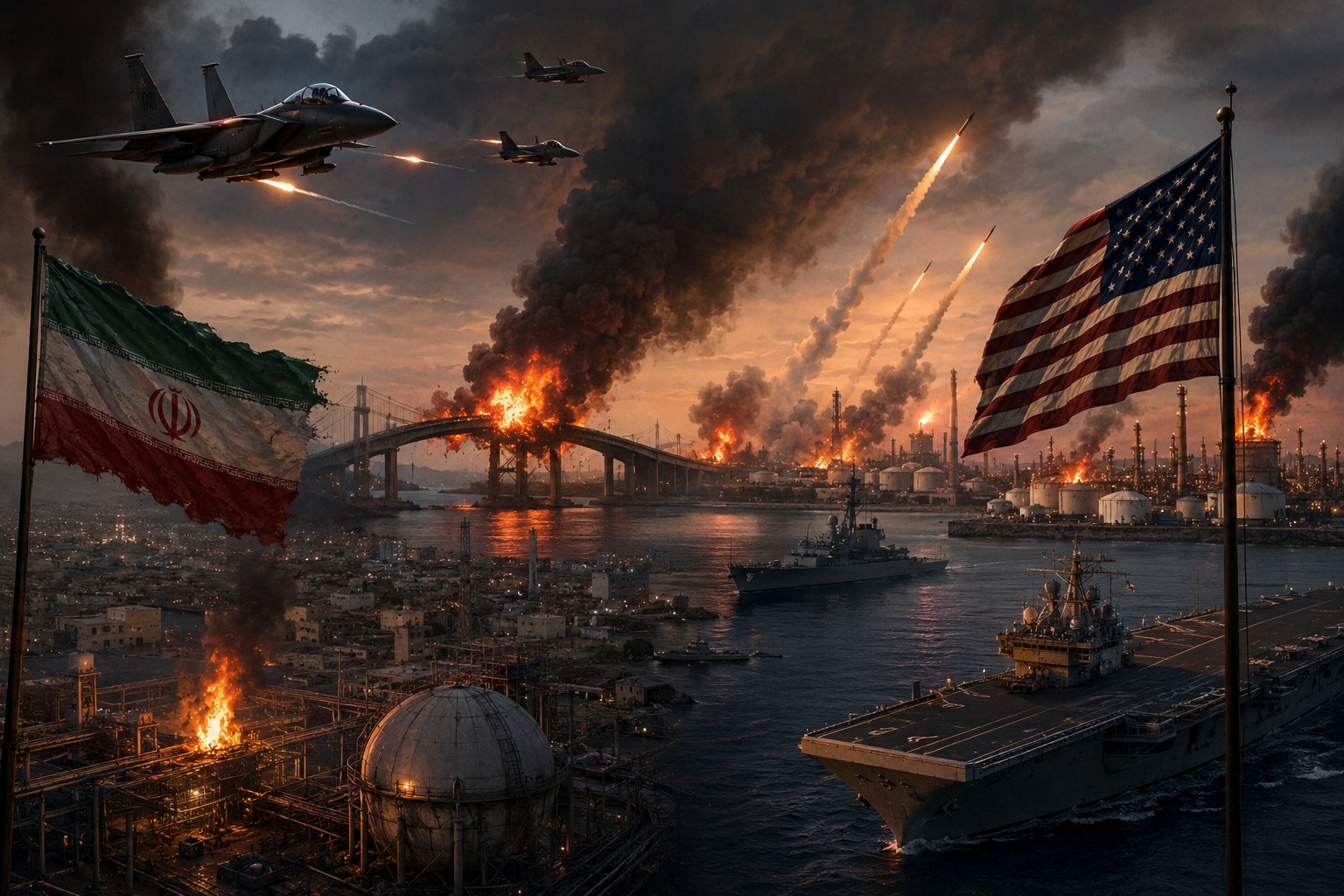
According to CENTCOM, American forces struck multiple military targets in southern Iran as part of operations aimed at reducing Tehran’s military capabilities. The command said the attacks focused on coastal surveillance systems, air defence positions, military logistics facilities and maritime assets linked to Iranian operations near the Strait of Hormuz.
Iranian state media and provincial authorities, however, said the strikes also damaged civilian infrastructure, including bridges, transport facilities and energy-related installations in Hormozgan province. Local officials said power infrastructure was affected in some areas, leading to electricity disruptions following the overnight attacks.
BBC Verify confirmed visible damage to at least one bridge west of Bandar Abbas using geolocated video and satellite imagery. However, the full extent of the reported damage to civilian and energy infrastructure has not been independently verified.
The latest escalation follows days of heightened military activity centred on the Strait of Hormuz, one of the world’s most strategically important maritime routes through which about 20% of global oil consumption passes, according to the International Energy Agency (IEA) and the US Energy Information Administration (EIA).
Iran’s Islamic Revolutionary Guard Corps (IRGC) said it responded by launching strikes against what it described as US military-related targets in Oman, Kuwait and Bahrain. The IRGC also claimed it struck a US military facility near al-Tanf in southern Syria. The United States has not confirmed the claim.
Authorities in Kuwait said projectiles struck facilities linked to electricity generation and water desalination, causing damage, a fire and temporary disruption to several power generation units. Officials did not immediately attribute responsibility, according to statements carried by the Kuwait News Agency (KUNA).
Jordan’s armed forces said they intercepted three missiles entering the country’s airspace, adding that no casualties or property damage were reported.
In Iraq’s Kurdistan region, local authorities said overnight attacks killed eight people in Sulaymaniyah, while additional drones were intercepted over Erbil without causing casualties. Kurdish officials blamed Iran for the attacks, according to Rudaw and Agence France-Presse (AFP). Iran had not commented on those allegations at the time of reporting.
The continued military exchanges have further disrupted activity around the Strait of Hormuz, increasing uncertainty for global energy markets.
IEA Executive Director Fatih Birol warned that prolonged instability in the Gulf could affect international energy supplies if shipping disruptions continue. Energy analysts say any extended interruption to traffic through the Strait of Hormuz could influence crude oil prices because the waterway is the primary export route for crude oil and liquefied natural gas from Gulf producers.
The United States has also expanded maritime operations in the Gulf of Oman. According to CENTCOM, US naval forces boarded a vessel and redirected several commercial ships as part of measures related to restrictions on Iranian maritime activity.
Diplomatic efforts have continued despite the fighting.
The foreign ministers of China and Pakistan called on both Washington and Tehran to halt military operations and resume negotiations, stressing that dialogue remains essential to reducing regional tensions, according to official statements from both governments.
Meanwhile, uncertainty remains over reports concerning an American citizen allegedly released from detention in Iran. US President Donald Trump welcomed what he described as the release of a US national, while Iran’s judiciary denied that any prisoner exchange or release had taken place.
International observers continue to monitor the humanitarian impact of the conflict and its implications for regional security and global trade. The UN High Commissioner for Human Rights has previously reiterated that international humanitarian law prohibits deliberate attacks on civilians and civilian infrastructure.
With neither Washington nor Tehran signalling an immediate halt to military operations, analysts say the risk of further escalation remains high. Markets are closely watching developments around the Strait of Hormuz, where any prolonged disruption could have consequences for global energy supplies, shipping routes and international trade.


