




By Maheen Sultan
ISLAMABAD — National budgets are often presented as precise blueprints for the fiscal year, yet the real-time demands of managing multi-trillion rupee liabilities can rapidly disrupt official projections.
Newly analyzed government accounting documents offer a rare glimpse behind the curtain of state finance, revealing how the twin pressures of short-term borrowing and shifting market interest rates forced actual spending to outpace initial targets by over Rs2.08 trillion across two critical debt management categories.
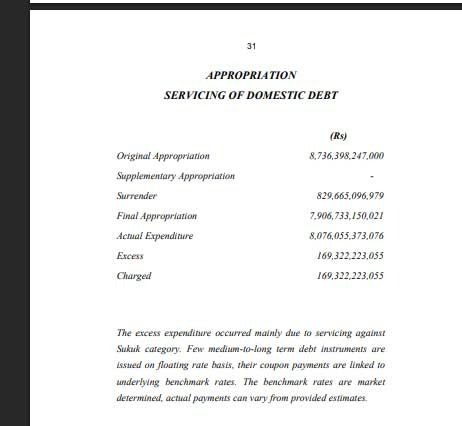
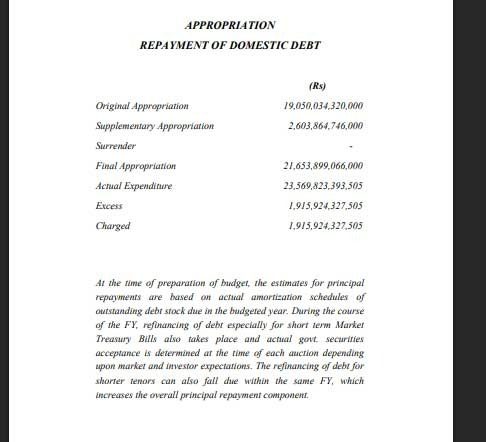
The first financial ledger, repaymnet-of-deomestic-debts, highlights the massive scale of the principal amounts the state must settle with internal lenders. Initially, the government earmarked an original allocation of Rs19.05 trillion to pay back its domestic debt. As fiscal pressures mounted mid-year, authorities approved a substantial supplementary budget of Rs2.60 trillion to bridge emerging funding gaps. This adjusted the total planned repayment target to Rs21.65 trillion.
However, by the close of the financial period, final records revealed that actual expenditures had ballooned to Rs23.57 trillion. Despite the multi-trillion rupee mid-year safety net, the state experienced a significant budget overrun, spending an excess of Rs1.92 trillion above its final authorized limits.
According to the official text in repaymnet-of-deomestic-debts, this multi-trillion rupee gap is rooted in the government’s heavy reliance on short-term market instruments, specifically Market Treasury Bills. While long-term debt follows predictable, structured payment timelines, immediate cash flow crunches force the state to issue short-term bills that mature in just a few months. Because these temporary liabilities frequently fall due within the exact same fiscal year they are issued, they create a rapid borrowing and repayment cycle. This turnover dramatically inflates the principal repayment column, pushing the final bill past planned baselines.
The fiscal pressure compounds further when looking at the second ledger, Servicing-of-Domestiic-debts, which tracks the interest—or “servicing” fees—required to maintain these massive domestic debts.
Initially, the state set aside an original appropriation of Rs 8.74 trillion just to cover internal interest payments. Mid-way through the year, anticipating lower costs, authorities officially reduced or “surrendered” Rs 829.67 billion from the budget, lowering the final interest target to Rs 7.91 trillion.
This reduction proved premature. Shifting real-world market dynamics pushed the actual expenditure back up to Rs 8.08 trillion, resulting in an unbudgeted excess interest cost of Rs 169.32 billion.
The document explains that this secondary deficit occurred primarily due to interest payments linked to Islamic bonds, known as Sukuk. A significant portion of these medium-to-long-term debt instruments are issued on a “floating rate” basis, meaning their payout amounts are directly tied to changing market benchmark rates rather than fixed fees. When market-determined benchmark rates fluctuated higher during the year, the state’s interest obligations jumped accordingly, erasing the mid-year budget cuts.
For the public, these technical ledger entries carry significant real-world consequences. When a government must unexpectedly divert over Rs 2.08 trillion in combined excess spending to cover principal rollovers and rising interest rates, it significantly constrains the wider national balance sheet. Every unbudgeted rupee swallowed by short-term market volatility is a resource that cannot be funneled into vital public infrastructure, healthcare, or economic development, underscoring how deeply short-term borrowing choices impact the broader national economy.


