



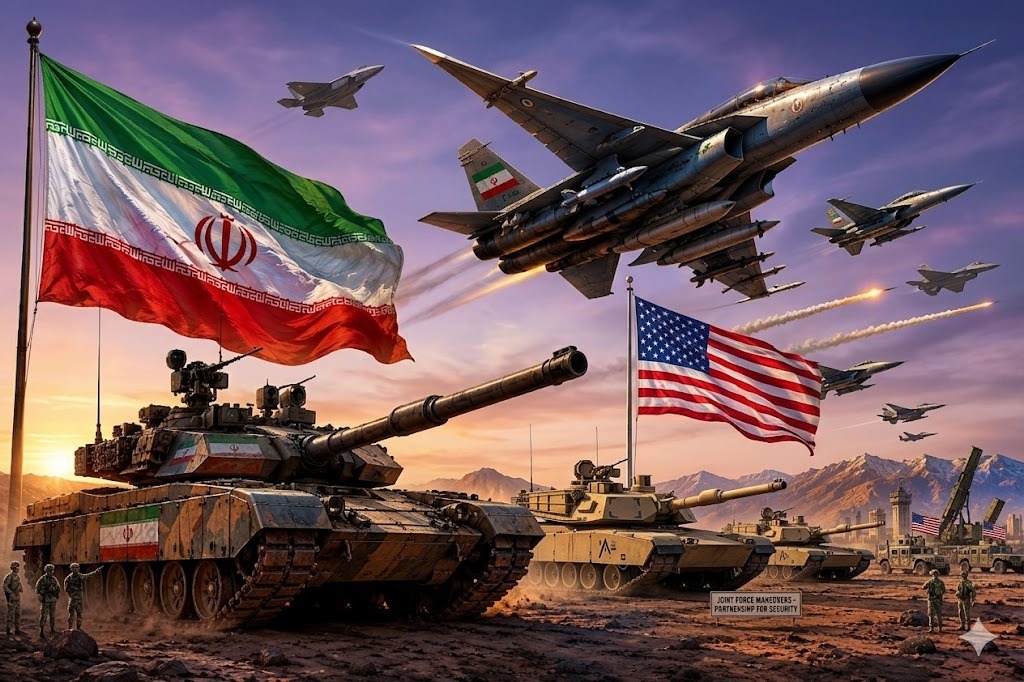
WASHINGTON / TEHRAN (Agencies) – Hostilities between Iran and the United States intensified for a second consecutive day on Thursday, with both sides exchanging missile and airstrikes across multiple locations in the Middle East, including Kuwait and Bahrain, further deepening fears of a wider regional conflict.
According to international reports, Iran launched retaliatory attacks following renewed U.S. air and cruise missile strikes on Iranian territory. The escalation came after U.S. President Donald Trump warned that Tehran would “pay the price” for stalled diplomatic negotiations.
The U.S. military reportedly carried out a second round of airstrikes overnight, targeting Iranian military surveillance, communication systems, and air defence installations. The strikes were conducted by the U.S. Air Force, Navy, and Marine Corps, though officials did not disclose the extent of the damage.
Iran responded with missile strikes aimed at several regional locations, including Bahrain, Kuwait, and Jordan. Bahrain, which hosts the U.S. Navy’s 5th Fleet headquarters, activated emergency alerts and air defence systems amid incoming missile threats. Kuwait also closed its airspace temporarily and diverted flights as its air defence systems engaged incoming projectiles.
Explosions were reported in multiple Iranian cities, including Tehran, Bandar Abbas, and other southern regions near the strategically important Strait of Hormuz, a key global oil transit route.
The Iranian Foreign Ministry stated that recent U.S. strikes had “effectively rendered the ceasefire meaningless,” although it stopped short of officially withdrawing from any truce arrangement.
The crisis has also impacted international shipping and regional security. U.S. Central Command accused a Palau-flagged tanker of violating a blockade on Iran, stating that strikes were carried out on its engine room to disable the vessel. Three Indian seafarers were killed in the incident, according to Indian officials.
Kuwait confirmed heightened security measures, with its military intercepting incoming missiles and temporarily suspending air traffic operations. Bahrain also activated missile sirens as a precautionary response.
Pakistan expressed deep concern over the rapidly escalating tensions, urging both the United States and Iran to exercise restraint and return to dialogue. The Foreign Office reiterated Islamabad’s support for peaceful resolution and diplomatic engagement to prevent further escalation in the region.
The ongoing exchange marks one of the most serious flare-ups between the two countries in recent years, raising fears of broader instability across the Gulf, particularly around critical maritime and energy corridors.


