


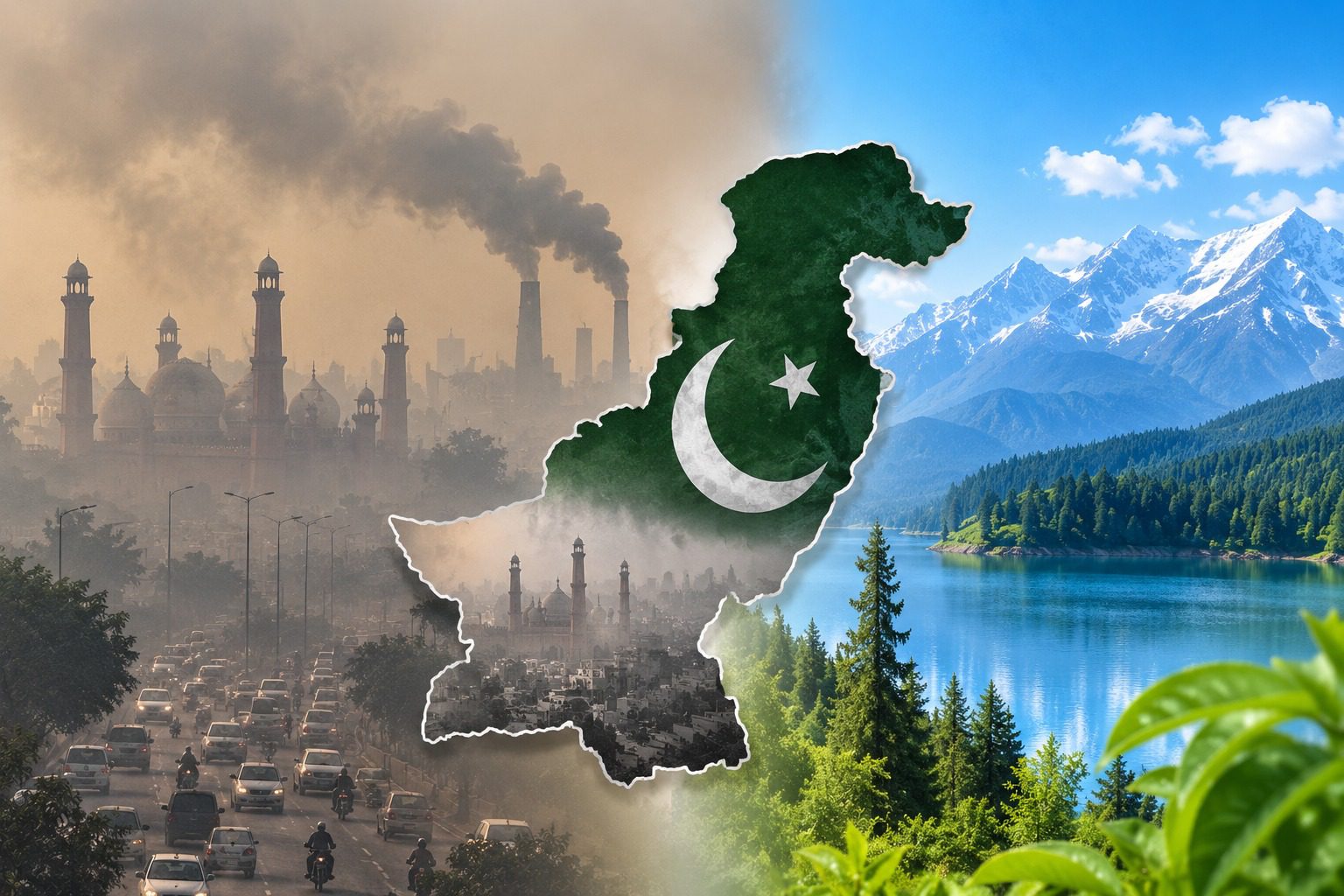
ISLAMABAD (Web Desk) -Pakistan remained at the top of the global air pollution ranking in 2025 even as its average concentration of harmful fine particles declined compared with the previous year, according to IQAir’s latest World Air Quality Report.
The report put Pakistan’s annual average PM2.5 concentration at 67.3 micrograms per cubic metre, compared with 73.7 µg/m³ in 2024. Despite the year-on-year improvement, the 2025 level was still more than 13 times the World Health Organization’s recommended annual guideline of 5 µg/m³.
PM2.5 consists of extremely small airborne particles measuring no more than 2.5 micrometres in diameter. Their small size allows them to penetrate deep into the lungs and, in some cases, enter the bloodstream. The WHO links exposure to particulate air pollution with increased risks of cardiovascular and respiratory diseases, stroke and lung cancer.
South Asia faces severe pollution burden
Pakistan was followed closely by Bangladesh, which recorded an annual PM2.5 concentration of 66.1 µg/m³.
Tajikistan ranked third at 57.3 µg/m³, followed by Chad at 53.6 and the Democratic Republic of the Congo at 50.2 µg/m³. India, another South Asian country frequently affected by severe smog, ranked sixth.
The figures underline the scale of the air pollution challenge across South Asia, where densely populated urban areas can face emissions from transport, industry, construction, power generation and seasonal agricultural burning, alongside weather conditions that can trap pollutants close to the ground.
Lahore among cities facing severe pollution
Pakistan’s pollution problem was particularly visible in its major cities.
IQAir data showed that Lahore recorded an annual average PM2.5 concentration of 88.9 µg/m³ in 2025. While this represented an improvement from 102.1 µg/m³ in 2024, the concentration remained far above the WHO guideline.
Punjab, particularly Lahore and surrounding districts, regularly experiences periods of severe smog during the colder months when weather conditions can prevent pollutants from dispersing.
The 2025 report also highlighted the concentration of heavily polluted cities in Asia. The world’s 25 most polluted cities covered by the ranking were located in India, Pakistan and China.
Clean air remains rare globally
At the opposite end of the ranking, only 13 countries and territories recorded annual PM2.5 concentrations that complied with the WHO guideline in 2025.
They included Australia, Iceland, Estonia, Panama, Grenada and Andorra, along with Bermuda, Barbados, French Polynesia, Puerto Rico, the US Virgin Islands, New Caledonia and Réunion.
The broader global picture was also concerning. IQAir analysed air-quality information covering 143 countries, regions and territories, with about 91pc exceeding the WHO annual PM2.5 guideline.
Only around 14pc of cities included in the assessment met the recommended standard.
There were, however, signs of improvement in several parts of the world. IQAir reported that annual average PM2.5 concentrations declined in 75 countries during 2025, while 54 experienced increases.
For Pakistan, the reduction from 73.7 µg/m³ in 2024 to 67.3 µg/m³ in 2025 indicates an improvement in the annual average, but the country’s continued position at the top of the ranking shows that its air pollution challenge remains substantial.


